
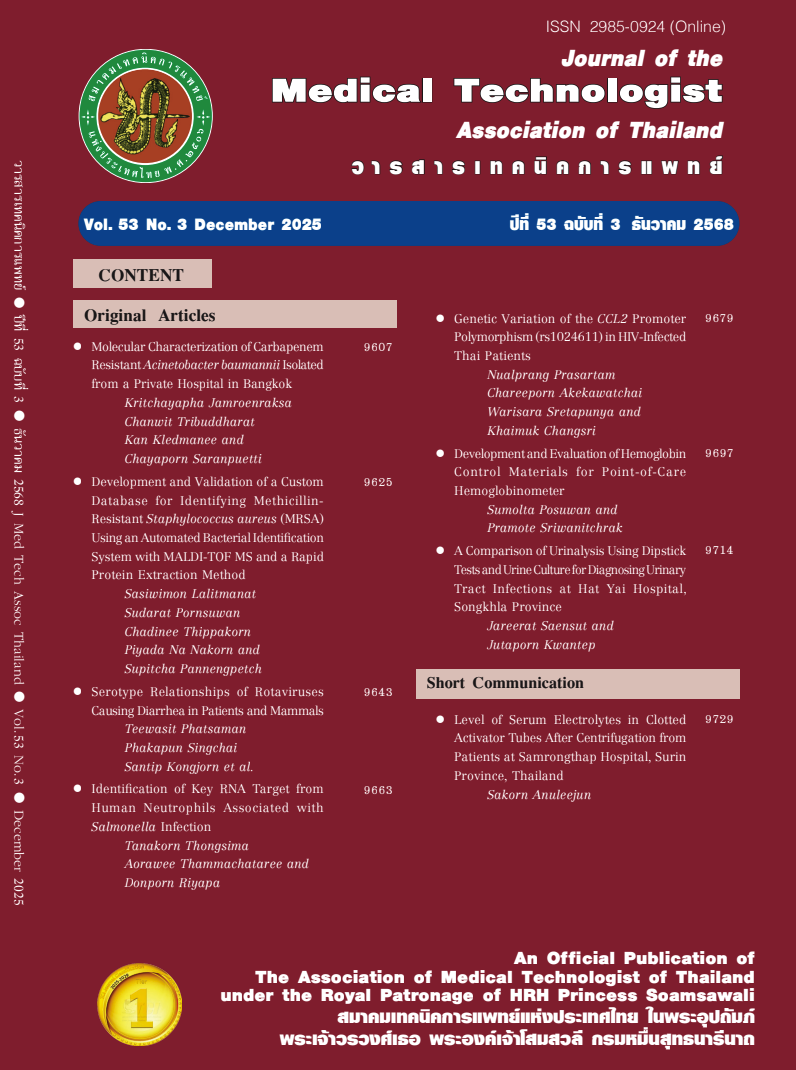
Serotype Relationships of Rotaviruses Causing Diarrhea in Patients and Mammals
Keywords:
Rotaviruses, Diarrhea, Mammals, Zoonosis, SerotypeAbstract
Group A rotavirus (RVA) is the major pathogen causing acute gastroenteritis, and new strain of RVA could be generated by reassortment between rotavirus genes among RVA strains. Vaccination could not be effective to prevent the disease if mutant RVA carries mutational point(s) at binding site(s) of vaccine. The aim of this study was to determine the serotype relationships of RVA from patients and mammals by nucleotide sequences analysis using Sanger sequencing. A total of 350 stool samples were collected from Nakhon Pathom, Ratchaburi, and Udon Thani, during September 2022 and May 2023. We found that 83 samples showed positive results by reverse transcription PCR and 56 samples (67.47 %, from 83 detectable samples) could be classified as the VP7 (G-serotype) and VP4 (P-serotype) of RVA. Results of phylogenetic analysis showed that G3 was major VP7 (41.07 %), followed by G9 (33.93%). The major VP4 was P[8] (51.79%), followed by P[13] (33.93%). The predominant RVA was G3P[8], followed by G8P[8]. Interestingly, we found that the VP7 gene of G9 were closely related to porcine-like human RVA. The VP7 gene of G5 and G1 human RVA were also closely related to those of porcine RVA. The VP7 gene of G6 genotype from cattle was closely related to porcine and/or porcine-like human RVA. Analysis of neutralization epitopes using amino acid sequences revealed that the G10P[11] strain in cattle and the G5P[8] strain in patients carried the amino acid change at 33 and 10 positions, respectively. The polar amino acid changes were 19 and 6 positions, respectively, in comparison to vaccine strains. These RVA isolates might be generated by reassortment between human and animal RVAs. These variations in antigenic sites might lead to escape from the RVA neutralizing-antibody in rotavirus vaccines. Therefore, continuous monitoring of RVA serotypes and RVA reassortment is necessary to provide relevant data for assessing the impact on the protectiveness of currently available vaccines.References
Jelle M, Max C, Erica H, et al. Full genome-based classification of rotaviruses reveals a common origin between human Wa-Like and porcine rotavirus strains and human DS-1-like and bovine rotavirus strains. J Virol 2008; 82: 3204–3219.
Martella V, Banyai K, Matthijnssens J, Buonavoglia C, Ciarlet M. Zoonotic aspects of rotaviruses. Vet Microbiol 2010; 140: 246–255.
Ghosh S, Alam MM, Ahmed MU, Talukdar RI, Paul SK, Kobayashi N. Complete genome constellation of a caprine group A rotavirus strain reveals common evolution with ruminant and human rotavirus strains. J Gen Virol 2010; 91: 2367–73.
Maes P, Matthijnssens J, Rahman M, Ranst MV. RotaC: A web-based tool for the complete genome classification of group A rotaviruses. BMC Microbiol 2009; 9: 238.
Viralzone.expasy.org [homepage on the Internet]. Rotavirus [cited 2025 Jan 6]. Available from: https://viralzone.expasy.org/107?outline=all_by_species
Dennehy PH. Rotavirus Vaccines: an Overview. Clin Microbiol Rev 2008; 21(1): 198–208.
KU LEUVEN [homepage on the Internet]. Newly assigned genotypes: List of accepted genotypes. Rotavirus Classification Working Group [cited 2025 Jan 6]. Available from: https://rega.kuleuven.be/cev/viralmetagenomics/virus-classification/rcwg
Asma S, Bostan N, Khan J, Aziz A. Effect of rotavirus genetic diversity on vaccine impact. Wiley 2021; 32(1): e2259.
Mukherjee A, Ghosh S, Bagchi P, et al. Full genomic analyses of human rotavirus G4P[4], G4P[6], G9P[19] and G10P[6] strains from North-eastern India- evidence for interspecies transmission and complex reassortment events. Clin Microbiol Infect 2011; 17: 1343–1346.
Ghosh S, Shintani T, Kobayashi N. Evidence for the porcine origin of equine rotavirus strain H-1. Vet Microbiol 2012; 158: 410–414.
Wang YH, Pang B, Zhou X, et al. Complex evolutionary patterns of two rare human G3P[9] rotavirus strains possessing a feline/canine-like H6 genotype on an AU-1-like genotype constellation. Infect Genet Evol 2013; 16: 103–112.
Tacharoenmuang R, Komoto S, Guntapong R, et al. Whole genomic analysis of an unusual human G6P[14] rotavirus strain isolated from a child with diarrhea in Thailand: evidence for bovine-to-human interspecies transmission and reassortment events. PLoS One 2015; 10(9): e0139381.
Komoto S, Tacharoenmuang R, Guntapong R, et al. Identification and characterization of a human G9P[23] rotavirus strain from a child with diarrhoea in Thailand: evidence for porcine to human interspecies transmission. J Gen Virol 2017; 98: 532–538.
Tacharoenmuang R, Komoto S, Guntapong R, et al. Characterization of a G10P[14] rotavirus strain from a diarrheic child in Thailand: Evidence for bovine-to-human zoonotic transmission. Infect Genet Evol 2018; 63: 43–57.
Cunliffe NA, Nakagomi O. A critical time for rotavirus vaccines: a review. Expert Rev Vaccines 2005; 4(4): 521–32.
Aleksandra P, Vladimir V, Gordana K, et al. Detection and molecular characterization of rotavirus
infections in children and adults with gastroenteritis from Vojvodina, Serbia. microorganisms 2022; 10:
Taniguchi K, Wakasugi F, Pongsuwanna Y, et al. Identification of human and bovine rotavirus serotypes
by polymerase chain reaction. Epidemiol Infect 1992; 109(2): 303–312.
Wu H, Taniguchi K, Wakasugi F, et al. Survey on the distribution of the gene 4 alleles of human rotaviruses by polymerase chain reaction. Epidemiol Infect 1994; 112(3): 615–622.
Esona MD, Armah GE, Geyer A, Steele AD. detection of an unusual human rotavirus strain with G5P[8]
specificity in a Cameroonian child with diarrhea. J Clin Microbiol 2004; 42(1): 441–444.
Chutoam P, Intamaso U. Estimates the evolution of G8P[8] rotaviruses in Thailand during 2012 – 2014.
Trends in Sciences 2022; 19(18): 5812.
Intamaso U1, Poomipak W, Chutoam P, et al. Genotype distribution and phylogenetic analysis of
rotaviruses in Thailand and emergence of uncommon genotypes Arch Clin Microbiol 2017; 8: 60.
Matsuno S, Hasegawa A, Mukoyama A, et al. A candidate for a new serotype of human rotavirus. J Virol 1985; 54(2): 623–624.
Theamboonlers A, Bhattarakosol P, Chongsrisawat V, et al. Molecular characterization of group A human rotaviruses in Bangkok and Buriram, Thailand during 2004–2006 reveals the predominance of G1P[8], G9P[8] and a rare G3P[19] strain. Virus Genes 2008; 36: 289–298.
Santosham M, Nelson EA, Bresee JS. Implementing rotavirus vaccination in Asia. Vaccine 2007; 25: 7711–7716.
Downloads
Published
How to Cite
Issue
Section
License
Copyright (c) 2025 Journal of the Medical Technologist Association of Thailand

This work is licensed under a Creative Commons Attribution-NonCommercial-NoDerivatives 4.0 International License.


