
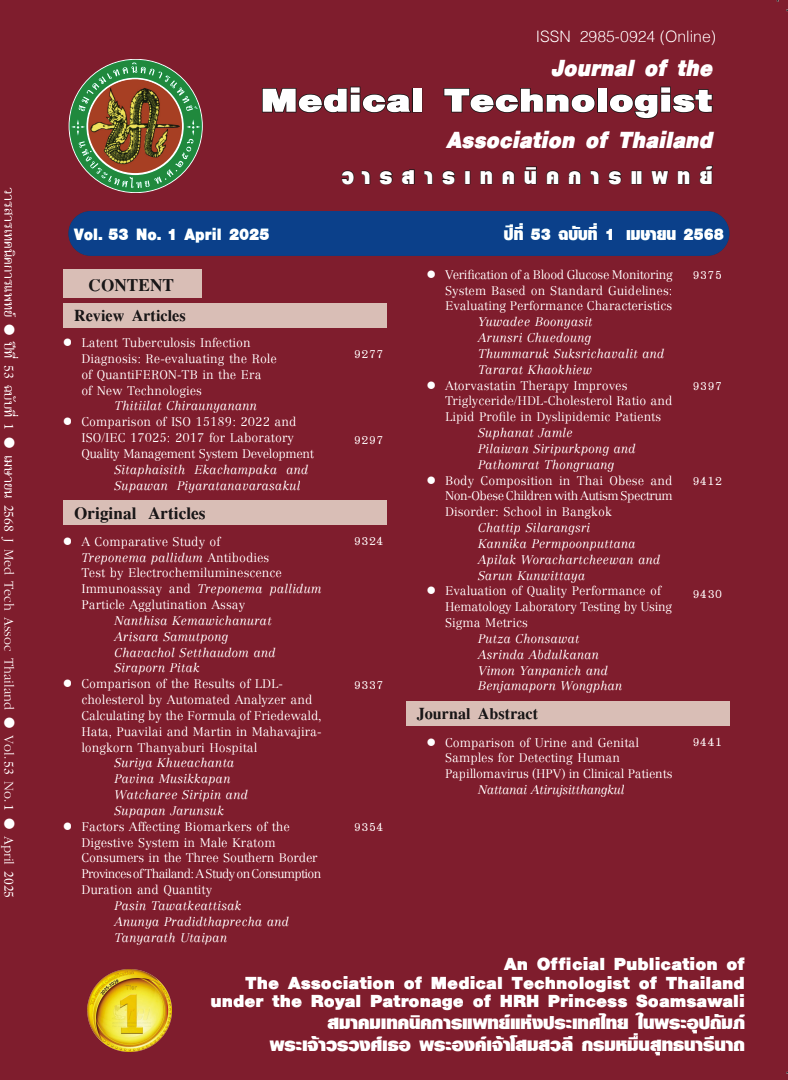
Body Composition in Thai Obese and Non-Obese Children with Autism Spectrum Disorder: School in Bangkok
Keywords:
Children with autism, Obesity, Body compositionAbstract
Obesity is a condition characterized by the excessive accumulation of fat beyond what the body needs or can metabolize, leading to increased risks of chronic non-communicable diseases (NCDs) such as diabetes, hypertension, heart disease, and cancer. The incidence of obesity is on the rise, particularly among individuals diagnosed with autism. At present, the assessment of overweight and obesity is based on the weight-for-height criteria for Thai children aged 6–19 years, categorized by gender. However, this assessment does not indicate body composition levels, such as body fat mass (BFM), percentage of body fat (PBF), skeletal muscle mass (SMM), fat-free mass (FFM), and visceral fat area. Therefore, this research aimed to study body composition in children with autism. The research selected a purposive sample and Phibun Prachasan School that accepts special children to study together with normal children. The study found that out of 41 children with autism (aged 7–17 years), 29 were obese and 12 were normal. The body composition values, such as BFM, PBF, and visceral fat area, showed significant differences (p < 0.05) between the obese and non-obese groups. The findings of this research are crucial for developing new approaches to obesity monitoring among children with autism in Thailand. The knowledge of research is beneficial to autistic children, teachers, parents, doctors, nurses, medical technologists, and experts in developing health promotion programs for autistic children in the future. This research is relevant with Sustainable Development Goal (SDG) strategy 3 (Good Health and Well-being) and strategy 5 (Gender Equality).
References
Piché ME, Tchernof A, Després JP. Obesity phenotypes, diabetes, and cardiovascular diseases. Circ Res 2020; 126: 1477-500.
Department of Health, Ministry of Public Health, Thailand. Annual report 2021. Bangkok: Department of Health; 2021. (in Thai)
Yamborisut U, Mo-Suwan L. Prevalence of childhood and adolescent obesity in Thailand: a review. J Med Assoc Thai 2014; 97: 44-51.
Phulkerd S, Nakraksa P, Mo-Suwan L, Lawrence M. Progress towards achieving the recommendations of the Commission on Ending Childhood Obesity: a comprehensive review and analysis of current policies, actions and implementation gaps in Thailand. Nutrients 2021; 13: 1913-27.
Pi-Sunyer X. The medical risks of obesity. Postgrad Med 2009; 121: 21-33.
Chu DT, Minh Nguyet NT, Dinh TC, et al. An update on physical health and economic consequences of overweight and obesity. Diabetes Metab Syndr 2018; 12: 1095-1100.
Cherif L, Boudabous J, Khemekhem K, et al. Feeding problems in children with autism spectrum disorders. J Fam Med 2018; 1: 30-9.
Obrusnikova I, Cavalier AR. Perceived barriers and facilitators of participation in after-school physical activity by children with autism spectrum disorders. J Dev Phys Disabil 2011; 23: 195-211.
Scahill L, Jeon S, Boorin SJ, et al. Weight gain and metabolic consequences of risperidone in young children with autism spectrum disorder. J Am Acad Child Adolesc Psychiatry 2016; 55: 415-23.
Chen AY, Kim SE, Houtrow AJ, et al. Prevalence of obesity among children with chronic conditions. Obesity (Silver Spring) 2010; 18: 210-3.
Curtin C, Bandini LG, Perrin EC, et al. Prevalence of overweight in children and adolescents with attention deficit hyperactivity disorder and autism spectrum disorders: a chart review. BMC Pediatr 2005; 5: 41-8.
Healy S, Aigner CJ, Haegele JA. Prevalence of overweight and obesity among US youth with autism spectrum disorder. Autism 2019; 23: 1046-50.
Supekar K, Iyer T, Menon V. The influence of sex and age on prevalence rates of comorbid conditions in autism. Autism Res 2017; 10: 778-89.
Brondino N, Fusar-Poli L, Miceli E, et al. Prevalence of medical comorbidities in adults with autism spectrum disorder. J Gen Intern Med 2019; 34: 1992-4.
Holmes CJ, Racette SB. The utility of body composition assessment in nutrition and clinical practice: an overview of current methodology. Nutrients 2021; 13: 2477-93.
Andreoli A, Garaci F, Cafarelli FP, et al. Body composition in clinical practice. Eur J Radiol 2016; 85: 1461-8.
American Psychiatric Association. Diagnostic and statistical manual of mental disorders. 4th ed. text revision. Washington, DC: American Psychiatric Association; 2000.
American Psychiatric Association. Diagnostic and statistical manual of mental disorders (DSM-5). 5th ed. Washington DC: American Psychiatric Press; 2013.
Hill AP, Zuckerman KE, Fombonne E. Obesity and autism. Pediatrics 2015; 136: 1051-61.
Healy S, Aigner CJ, Haegele JA. Prevalence of overweight and obesity among US youth with autism spectrum disorder. Autism 2019; 23: 1046-50.
Sammels O, Karjalainen L, Dahlgren J, et al. Autism spectrum disorder and obesity in children: a systematic review and meta-analysis. Obes Facts 2022; 15: 305-20.
Dhaliwal KK, Orsso CE, Richard C, et al. Risk factors for unhealthy weight gain and obesity among children with autism spectrum disorder. Int J Mol Sci 2019; 20: 3256-85.
Zeidan J, Fombonne E, Scorah J, et al. Global prevalence of autism: a systematic review update. Autism Res 2022; 15: 778-90.
Rouphael M, Sacre Y, Bitar T, et al. Body composition and anthropometric measurements in children and adolescents with autism spectrum disorder: a case-control study in Lebanon. Nutrients 2024; 16: 832-47.
Vegar R, Turid LH, Arnulf L, et al. Cohort Profile Update: The Young-HUNT Study, Norway. Int J Epidemiol 2004. [cited 2023 Oct 10]; 53(1). Available from: https://doi.org/10.1093/ije/dyae013
Shahane V, Kilyk A, Srinivasan SM. Effects of physical activity and exercise-based interventions in young adults with autism spectrum disorder: a systematic review. Autism 2024; 28: 276-300.
Robidoux H, Ellington E, Lauerer J. Screen time: the impact of digital technology on children and strategies in care. J Psychosoc Nurs Ment Health Serv 2023.
Downloads
Published
How to Cite
Issue
Section
License
Copyright (c) 2025 Journal of the Medical Technologist Association of Thailand

This work is licensed under a Creative Commons Attribution-NonCommercial-NoDerivatives 4.0 International License.


