
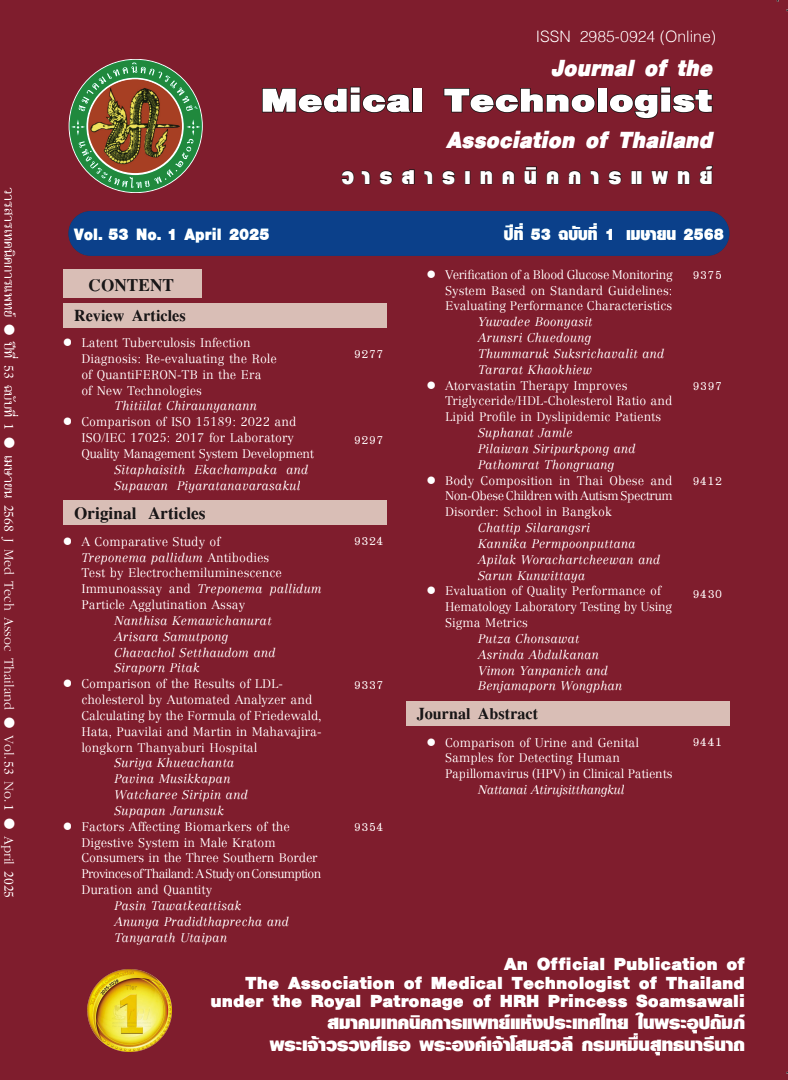
Verification of a Blood Glucose Monitoring System Based on Standard Guidelines: Evaluating Performance Characteristics
Keywords:
Blood glucose monitoring system, Within-laboratory precision, Allowable deviation from linearity, Packed cell volume, System accuracyAbstract
The Health Impact Blood Glucose Monitoring System Model No. BG-709 and Health Impact Blood Glucose Test Strip were verified for assessing the performance characteristics, including precision, linearity, interferences, and system accuracy, in accordance with the Clinical and Laboratory Standards Institute documents, i.e. EP15-A3, EP06-Ed2, and POCT12-A3, and ISO 15197:2013 guidelines. The measurement precision was assessed by calculating the standard deviation (SD) and coefficient of variation (%CV) for each glucose concentration interval. The repeatability and within-laboratory precision were acceptable across the target blood glucose ranges (< 100 mg/dL and ≥ 100 mg/dL) for all devices and strip lots with the SDs between 0.95–1.29 and 1.69–2.18, respectively, and with the CVs in the range of 0.60–1.63% and 1.29–2.68%, respectively. Moreover, the results of meter-to-meter comparison showed no significant differences between the groups (p-value = 0.160, 0.486 and 0.941). To determine the linearity verification, the allowable deviation from linearity (ADL) criterion was set to be 5%. Indeed, the results demonstrated that the proposed system met this criterion. Regression analysis was also performed to calculate the correlation coefficient (r), which was found to be within the range of 0.9984–0.9998. The acceptable recoveries ranged from 96.67% to 108.33%, with linearity observed in the range of 30 to 550 mg/dL. Additionally, the interferences, i.e. galactose (15 mg/dL), maltose (1,250 mg/dL), icodextrin (1,094.4 mg/dL), triglyceride (1,850 mg/dL), and packed cell volume (0–70%), did not interfere with the measurement results. In summary, the system accuracy of Health Impact Blood Glucose Monitoring System met the acceptance criteria of CLSI POCT12-A3 and ISO 15197:2013 requirements for evaluating blood glucose level.
References
World Health Organization. World health statistics 2023: monitoring health for the SDGs, sustainable development goals. Geneva: World Health Organization; 2023.
Aekplakorn W, Puckcharern H, Satheannoppakao W. Thai National Health Examination Survey, 6th Edition, 2019–2020. 1st ed. Bangkok: Aksorn Graphic and Design Publishing House; 2021. (in Thai)
Teebuphachatsakul W, Chancunapas P, Duangsawang W. Standards for the validation methods of portable blood glucose meters for subdistrict health promoting hospitals (SHPH) and urban community health centers (UCHC). 1st ed. Bangkok: Beyond Publishing Co., Ltd.; 2022. (in Thai)
International Organization for Standardization. ISO 15189:2022 Medical laboratories—requirements for quality and competence. 4th ed. Geneva: International Organization for Standardization; 2022.
Clinical and Laboratory Standards Institute. User verification of precision and estimation of bias; approved guideline—third edition. CLSI document EP15-A3. Wayne, PA: Clinical and Laboratory Standards Institute; 2014.
Clinical and Laboratory Standards Institute. Evaluation of linearity of quantitative measurement procedures. 2nd ed. CLSI guideline EP06. Clinical and Laboratory Standards Institute; 2020.
International Organization for Standardization. ISO 15197:2013 In vitro diagnostic test systems—requirements for blood-glucose monitoring systems for self-testing in managing diabetes mellitus. 2nd ed. Geneva: International Organization for Standardization; 2013.
Clinical and Laboratory Standards Institute. Point-of-care blood glucose testing in acute and chronic care facilities; approved guidelines—third edition. CLSI document POCT12-A3. Wayne, PA: Clinical and Laboratory Standards Institute; 2013.
Clinical and Laboratory Standards Institute. Measurement procedure comparison and bias estimation using patient samples. 3rd ed. CLSI guideline EP09c. Wayne, PA: Clinical and Laboratory Standards Institute; 2018.
Clinical and Laboratory Standards Institute. User verification of linearity workbook. CLSI workbook EP06-Ed2-WB. Clinical and Laboratory Standards Institute; 2022.
Swartz ME, Krull IS. Handbook of analytical validation. Boca Raton: CRC Press; 2012.
AOAC.org. Appendix F guidelines for standard method performance requirements. AOAC Official Methods of Analysis [serial on the internet]. 2016 [cited 2024 Oct 11]; 1–18. Available from: https://www.aoac.org/wp-content/uploads/2019/08/app_f.pdf
Resources.psmile.org [homepage on the internet]. The Plone® Open Source CMS/WCM; c2000–24 [cited 2024 Mar 8]. Available from: https://resources.psmile.org/resources/equipment/smile-validation-guidelines/chemistry/Equ3.5-A-03%20Precision%20Requirements-Chemistry.doc/view
Datainnovations.com [homepage on the internet]. Data Innovations LLC.; c2024 [cited 2024 Mar 8]. Available from: https://www.datainnovations.com/allowable-total-error-table
Killeen AA, Long T, Souers R, Styer P, Ventura CB, Klee GG. Verifying performance characteristics of quantitative analytical systems: calibration verification, linearity, and analytical measurement range. Arch Pathol Lab Med 2014; 138:1173–81.
Yoo EH, Lee SY. Glucose biosensors: an overview of use in clinical practice. Sensors 2010; 10:4558–76.
Floré KM, Delanghe JR. Analytical interferences in point-of-care testing glucometers by icodextrin and its metabolites: an overview. Perit Dial Int 2009; 29:377–83.
Frias JP, Lim CG, Ellison JM, Montandon CM. Review of adverse events associated with false glucose readings measured by GDH-PQQ-based glucose test strips in the presence of interfering sugars. Diabetes Care 2010; 33:728–9.
Cho YI, Mooney MP, Cho DJ. Hemorheological disorders in diabetes mellitus. J Diabetes Sci Technol 2008; 2:1130–8.
Çapoğlu I, Ünüvar N, Bektaş Y, Yilmaz Ö, Kaya MD. The effects of high haematocrit levels on glucose metabolism disorders. J Int Med Res 2002; 30:433–7.
Sun J, Han K, Xu M, et al. Blood viscosity in subjects with type 2 diabetes mellitus: roles of hyperglycemia and elevated plasma fibrinogen. Front Physiol 2022; 13:1–11.
Pfützner A, Schipper C, Ramljak S, et al. Determination of hematocrit interference in blood samples derived from patients with different blood glucose concentrations. J Diabetes Sci Technol 2013; 7:170–8.
Demircik F, Kirsch V, Ramljak S, Vogg M, Pfützner AH, Pfützner A. Laboratory evaluation of linearity, repeatability, and hematocrit interference with an internet-enabled blood glucose meter. J Diabetes Sci Technol 2019; 13:514–21.
Jopling J, Henry E, Wiedmeier SE, Christensen RD. Reference ranges for hematocrit and blood hemoglobin concentration during the neonatal period: data from a multihospital health care system. Pediatrics 2009; 123:e333–7.
Olansky L, Kennedy L. Finger-stick glucose monitoring: issues of accuracy and specificity. Diabetes Care 2010; 33:948–9.
Promdee L, Mingchai J, Tinkachat S, et al. Interfering substance in point-of-care testing glucometer. Songkla Med J 2012; 29:289–97. (in Thai)
Wittayapornpong K, Treebuphachatsakul W. In vitro study of low concentrations of D-mannose interferences on blood glucose testing by glucose meters. Buddhachinaraj Med J 2016; 33:272–81. (in Thai)
Downloads
Published
How to Cite
Issue
Section
License
Copyright (c) 2025 Journal of the Medical Technologist Association of Thailand

This work is licensed under a Creative Commons Attribution-NonCommercial-NoDerivatives 4.0 International License.


