
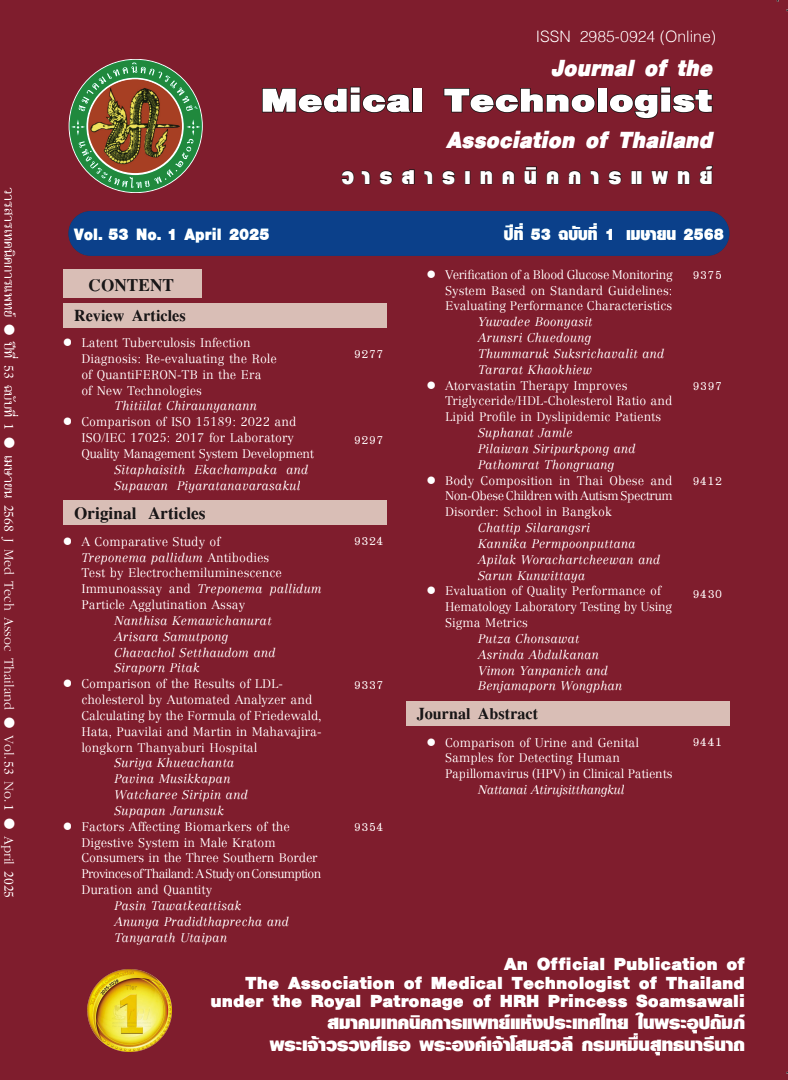
Latent Tuberculosis Infection Diagnosis: Re-evaluating the Role of QuantiFERON-TB in the Era of New Technologies
Keywords:
QuantiFERON-TB, Latent tuberculosis infection, Interferon-gamma, Mycobacterium tuberculosisAbstract
Tuberculosis (TB) caused by Mycobacterium tuberculosis (Mtb) remains a global health challenge, with high prevalence in Southeast Asia, Africa and the Western Pacific. Identification of latent tuberculosis infection (LTBI) individually is essential for preventing disease progression, especially in high-risk groups, for instance, HIV-positive individuals. QuantiFERON-TB (QFT) has effectively emerged as blood test for LTBI diagnosis, offering significant advantages over the traditional tuberculin skin test (TST). This review highlights the strengths of QFT for TB diagnosis. The article explored recent advancements in the field and discussed the promising future of QFT. Comprehensive review, focusing on the benefits and challenges associated with QFT was thoroughly conducted. The review investigated the potential of novel antigens, biomarker integration and wider application in resource-limited settings and high-risk populations. Comparatively, QFT served as a valuable tool for TB control and elimination. Future research and development should involve discovering new antigens and biomarkers, integrating QFT with other diagnostic tools and adopting its use in resource-constrained settings and high-risk groups. QFT has revolutionized LTBI diagnosis. Recognizing its advancements can further enhance QFT role in TB management, ultimately infection control and elimination efforts.
References
Afriyie-Mensah JS, Aryee R, Zigah F, Amaning-Kwarteng E, Seraphin MN. The burden of bacteriologically negative TB diagnosis: a four-year review of tuberculosis cases at a tertiary facility. Tuberc Res Treat. 2023;6648137.
Kardan-Yamchi J, Kazemian H, Battaglia S, Abtahi H, Rahimi Foroushani A, Hamzelou G, et al. Whole genome sequencing results associated with minimum inhibitory concentrations of 14 anti-tuberculosis drugs among rifampicin-resistant isolates of Mycobacterium tuberculosis from Iran. J Clin Med. 2020;9:465.
Chaw L, Chien LC, Wong J, Takahashi K, Koh D, Lin RT. Global trends and gaps in research related to latent tuberculosis infection. BMC Public Health. 2020;20:352.
Wong YJ, Ng KY, Lee SWH. How can we improve latent tuberculosis infection management using behaviour change wheel: a systematic review. J Public Health (Oxf). 2023;45:e447–e466.
O’Connell J, de Barra E, McConkey S. Systematic review of latent tuberculosis infection research to inform programmatic management in Ireland. Ir J Med Sci. 2022;191:1485–1504.
Amer H. Quantiferon in the diagnosis of tuberculosis. Int J Clin Case Rep Rev. 2023;14:1–6.
Oh CE, Ortiz-Brizuela E, Bastos ML, Menzies D. Comparing the diagnostic performance of QuantiFERON-TB Gold Plus to other tests of latent tuberculosis infection: a systematic review and meta-analysis. Clin Infect Dis. 2021;73:e1116–e1125.
Zhang L, Yang Z, Wu F, Ge Q, Zhang Y, Li D, et al. Multiple cytokine analysis based on QuantiFERON-TB gold plus in different tuberculosis infection status: an exploratory study. BMC Infect Dis. 2024;24:28.
Zhang Y, Zhou G, Shi W, Hu M, Kong D, et al. Comparing the diagnostic performance of QuantiFERON-TB Gold Plus with QFT-GIT, T-SPOT.TB and TST: a systematic review and meta-analysis. BMC Infect Dis. 2023;23:40.
Zulu M, Monde N, Nkhoma P, Malama S, Munyeme M. Nontuberculous mycobacteria in humans, animals, and water in Zambia: a systematic review. Front Trop Dis. 2021;2.
Bae W, Park KU, Song EY, Kim SJ, Lee YJ, Park JS, et al. Comparison of the sensitivity of QuantiFERON-TB Gold In-Tube and T-SPOT.TB according to patient age. PLoS One. 2016;11:e0156917.
Eisenhut M, Fidler K. Performance of tuberculin skin test measured against interferon gamma release assay as reference standard in children. Tuberc Res Treat. 2014;413459.
Qumseya BJ, Ananthakrishnan AN, Skaros S, Bonner M, Issa M, Zadvornova Y, et al. QuantiFERON-TB gold testing for tuberculosis screening in an inflammatory bowel disease cohort in the United States. Inflamm Bowel Dis. 2011;17:77–83.
Clifford V, Tebruegge M, Curtis N. Limitations of current tuberculosis screening tests in immunosuppressed patients. BMJ. 2015;350:h2226.
Hewitt RJ, Francis M, Singanayagam A, Kon OM. Screening tests for tuberculosis before starting biological therapy. BMJ. 2015;350:h1060.
Matucci A, Maggi E, Vultaggio A. Cellular and humoral immune responses during tuberculosis infection: useful knowledge in the era of biological agents. J Rheumatol. 2014;91:17–23.
de Martino M, Lodi L, Galli L, Chiappini E. Immune response to Mycobacterium tuberculosis: a narrative review. Front Pediatr. 2019;7:350.
Sun YF, Pi J, Xu JF. Emerging role of exosomes in tuberculosis: from immunity regulations to vaccine and immunotherapy. Front Immunol. 2021;12:628973.
Sun X, Li W, Zhao L, Fan K, Qin F, Shi L, et al. Current landscape of exosomes in tuberculosis development, diagnosis, and treatment applications. Front Immunol. 2024;15:1401867.
Gaudino SJ, Kumar P. Cross-talk between antigen presenting cells and T cells impacts intestinal homeostasis, bacterial infections, and tumorigenesis. Front Immunol. 2019;10:360.
Tvingsholm SA, Frej MS, Rafa VM, Hansen UK, Ormhøj M, Tyron A, et al. TCR-engaging scaffolds selectively expand antigen-specific T-cells with a favorable phenotype for adoptive cell therapy. J ImmunoTher Cancer. 2023;11:e006847.
Radwan J, Babik W, Kaufman J, Lenz TL, Winternitz J. Advances in the evolutionary understanding of MHC polymorphism. Trends Genet. 2020;36:298–311.
Matzaraki V, Kumar V, Wijmenga C, Zhernakova A. The MHC locus and genetic susceptibility to autoimmune and infectious diseases. Genome Biol. 2017;18:76.
Zhang Z, Lu M, Qin Y, Gao W, Tao L, Su W, et al. Neoantigen: a new breakthrough in tumor immunotherapy. Front Immunol. 2021;12:672356.
Gupta RG, Li F, Roszik J, Lizée G. Exploiting tumor neoantigens to target cancer evolution: current challenges and promising therapeutic approaches. Cancer Discov. 2021;11:1024–1039.
Peng M, Mo Y, Wang Y, Wu P, Zhang Y, Xiong F, et al. Neoantigen vaccine: an emerging tumor immunotherapy. Mol Cancer. 2019;18:128.
Foreman TW, Nelson CE, Sallin MA, Kauffman KD, Sakai S, Otaizo-Carrasquero F, et al. CD30 co-stimulation drives differentiation of protective T cells during Mycobacterium tuberculosis infection. J Exp Med. 2023;220:e20222090.
Imanishi T, Saito T. T cell co-stimulation and functional modulation by innate signals. Trends Immunol. 2020;41:200–212.
Honikel MM, Olejniczak SH. Co-stimulatory receptor signaling in CAR-T cells. Biomolecules. 2022;12:1303.
Harrison AJ, Du X, von Scheidt B, Kershaw MH, Slaney CY. Enhancing co-stimulation of CAR T cells to improve treatment outcomes in solid cancers. Immunotherapy Adv. 2021;1:1–9.
Liu X, Li H, Li S, Yuan J, Pang Y. Maintenance and recall of memory T cell populations against tuberculosis: implications for vaccine design. Front Immunol. 2023;14:1100741.
Carpenter SM, Nunes-Alves C, Booty MG, Way SS, Behar SM. A higher activation threshold of memory CD8+ T cells has a fitness cost that is modified by TCR affinity during tuberculosis. PLoS Pathog. 2016;12:e1005380.
Hojyo S, Tumes D, Murata A, Tokoyoda K. Multiple developmental pathways lead to the generation of CD4 T-cell memory. Int Immunol. 2020;32:589–595.
Kumar R, Singh P, Kolloli A, Shi L, Bushkin Y, Tyagi S, et al. Immunometabolism of Phagocytes During Mycobacterium tuberculosis infection. Front Mol Biosci. 2019;6:105.
Mazzone R, Zwergel C, Artico M, Taurone S, Ralli M, Greco A, et al. The emerging role of epigenetics in human autoimmune disorders. Clin Epigenetics. 2019;11:34.
Colon-Echevarria CB, Lamboy-Caraballo R, Aquino-Acevedo AN, Armaiz-Pena GN. Neuroendocrine regulation of tumor-associated immune cells. Front Oncol. 2019;9:1077.
Parveen S, Murphy JR, Bishai WR. Targeting inhibitory cells such as Tregs and MDSCs in the tuberculous granuloma. In: Karakousis PC, Hafner R, Gennaro ML, editors. Advances in Host-Directed Therapies Against Tuberculosis. Cham: Springer International Publishing; 2021. p.169–203.
Woodworth JS, Christensen D, Cassidy JP, Agger EM, Mortensen R, Andersen P. Mucosal boosting of H56:CAF01 immunisation promotes lung-localised T cells and an accelerated pulmonary response to Mycobacterium tuberculosis infection without enhancing vaccine protection. Mucosal Immunol. 2019;12:816–826.
Li K, Yang C, Jiang Z, Liu S, Liu J, Fan C, et al. Quantitative investigation of factors relevant to the T cell spot test for tuberculosis infection in active tuberculosis. BMC Infect Dis. 2019;19:673.
Abubakar I, Stagg HR, Whitworth H, Lalvani A. How should I interpret an interferon gamma release assay result for tuberculosis infection? Thorax. 2013;68:298–301.
Brown J, Kumar K, Reading J, Harvey J, Murthy S, Capocci S, et al. Frequency and significance of indeterminate and borderline Quantiferon Gold TB IGRA results. Eur Respir J. 2017;50:1701267.
Saluzzo F, Mantegani P, Poletti de Chaurand V, Cirillo DM. QIAreach QuantiFERON-TB for the diagnosis of Mycobacterium tuberculosis infection. Eur Respir J. 2022;59:2102563.
Doosti-Irani A, Ayubi E, Mostafavi E. Tuberculin and QuantiFERON-TB-Gold tests for latent tuberculosis: a meta-analysis. Occup Med (Lond). 2016;66:437–445.
Chiappini E, Accetta G, Bonsignori F, Boddi V, Galli L, Biggeri A, et al. Interferon-gamma release assays for the diagnosis of Mycobacterium tuberculosis infection in children: a systematic review and meta-analysis. Int J Immunopathol Pharmacol. 2012;25:557–564.
Ma Y, Li R, Shen J, He L, Li Y, Zhang N, et al. Clinical effect of T-SPOT.TB test for the diagnosis of tuberculosis. BMC Infect Dis. 2019;19:993.
Lee E, Holzman RS. Evolution and current use of the tuberculin test. Clin Infect Dis. 2002;34:365–370.
Auguste P, Tsertsvadze A, Pink J, Court R, McCarthy N, Sutcliffe P, et al. Comparing interferon-gamma release assays with tuberculin skin test for identifying latent tuberculosis infection that progresses to active tuberculosis: systematic review and meta-analysis. BMC Infect Dis. 2017;17:200.
European Centre for Disease Prevention and Control. Handbook on tuberculosis laboratory diagnostic methods in the European Union – updated 2023. 2nd ed. Stockholm: ECDC; 2023.
Schumacher SG, Wells WA, Nicol MP, Steingart KR, Theron G, Dorman SE, et al. Guidance for studies evaluating the accuracy of sputum-based tests to diagnose tuberculosis. J Infect Dis. 2019;220:S99–S107.
Datta S, Alvarado K, Gilman RH, Valencia T, Aparicio C, Ramos ES, et al. Optimising fluorescein diacetate sputum smear microscopy for assessing patients with pulmonary tuberculosis. PLoS One. 2019;14:e0214131.
Dusthackeer A, Balasubramanian M, Shanmugam G, Priya S, Nirmal CR, Sam Ebenezer R, et al. Differential culturability of Mycobacterium tuberculosis in culture-negative sputum of patients with pulmonary tuberculosis and in a simulated model of dormancy. Front Microbiol. 2019;10:2381.
Dong B, He Z, Li Y, Xu X, Wang C, Zeng J. Improved conventional and new approaches in the diagnosis of tuberculosis. Front Microbiol. 2022;13:924410.
Zheng WQ, Hu ZD. Pleural fluid biochemical analysis: the past, present and future. Clin Chem Lab Med. 2023;61:921–934.
Downloads
Published
How to Cite
Issue
Section
License
Copyright (c) 2025 Journal of the Medical Technologist Association of Thailand

This work is licensed under a Creative Commons Attribution-NonCommercial-NoDerivatives 4.0 International License.


