
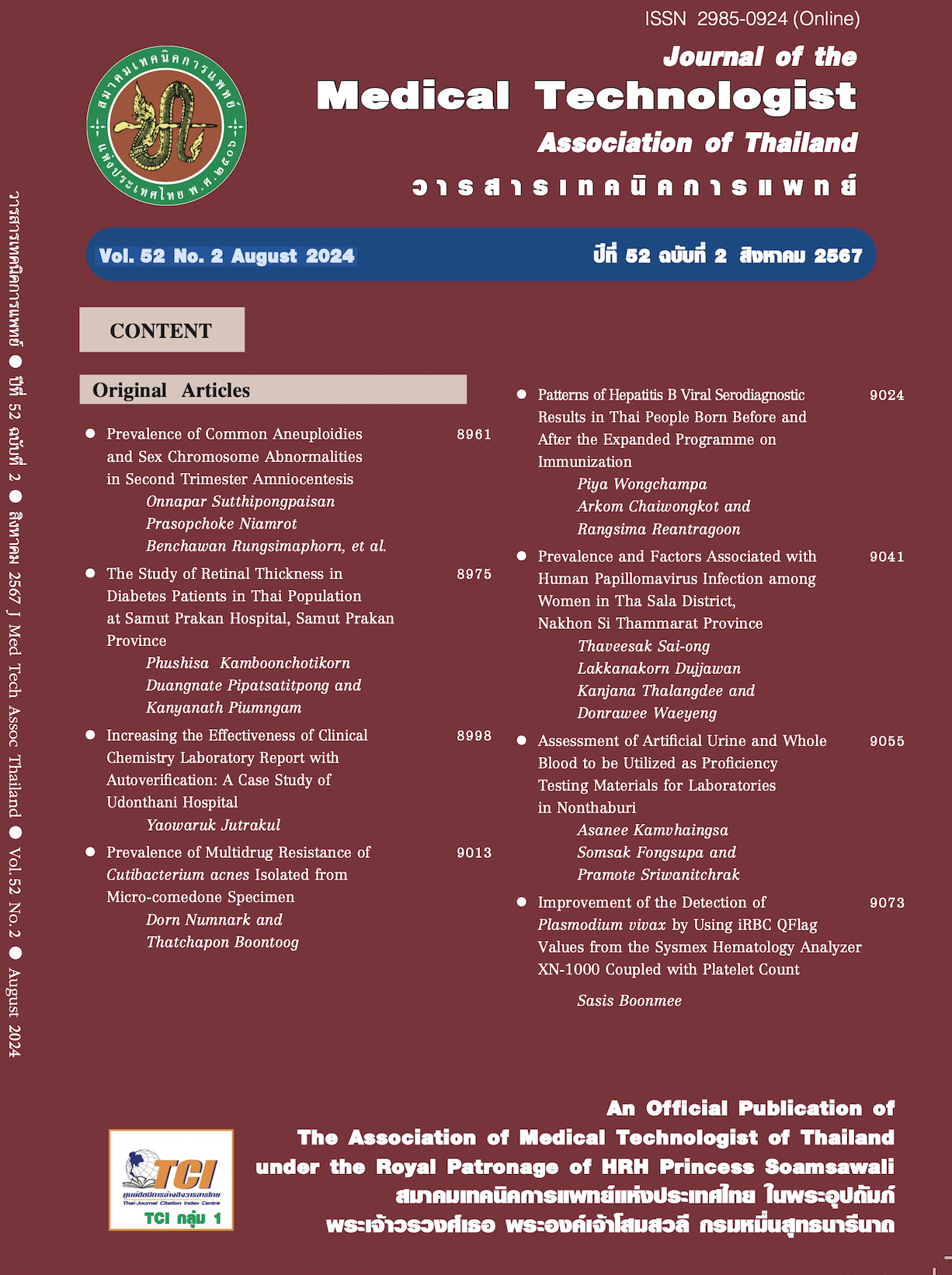
The Study of Retinal Thickness in Diabetes Patients in Thai Population at Samut Prakan Hospital, Samut Prakan Province
Keywords:
Retinal thickness, Diabetes, HbA1c, Optical coherence tomographyAbstract
The purpose of this research was to study the retinal thickness in good glycemic control (HbA1c < 7%, n = 122) and poor glycemic control (HbA1c ≥ 7%, n = 122) diabetic patients compared with healthy people in the Thai population (HbA1c < 5.7%, n = 122). The retinal thickness results were collected from the Ophthalmology Department Samut Prakan Hospital, Samut Prakan Province, from the retrospective medical records (from September 2018 - September 2020) with Thai ethnicity and without retinal disease, aged 41-80 years old, both males and females, 366 people. Retinal thickness analysis was performed using optical coherence tomography (OCT) in 9 parameters: Fovea, T Inner, S Inner, N Inner, Inf Inner, T Outer, S Outer, N Outer and Inf Outer. The results showed that the retinal thickness decreases with increasing age and there is a difference between males and females. In the healthy group and the group with good diabetes control, between the ages of 41-50 and 51-60 years, males have an average retinal thickness of 3.34% more than that in females. Normal males have an average retinal thickness of 274.66 ± 23.89 μm, females average 263 ± 21.59 μm. When compare the retinal thickness between the healthy group and the groups with good and poor glycemic control, in the age range from 41 to 80 years old, there was a statistically significant difference at the 0.05 level. It was found that the retinal thickness in 5 OCT parameters, Fovea, T Outer, S Outer, N Outer, and Inf Outer, tended to increase with HbA1c levels. When analyzing by age range, the difference was found to be insignificant in some age groups. For the Fovea parameter, in the age range of 61-70 years, it was found that the retinal thickness in diabetes groups had increased thickness compared to that in the healthy group. While the age range of 71-80 years found that the thickness decreased statistically significantly (p-value < 0.05). The results of this study can be used to develop a database in forensic science for assessing the retinal thickness and age range in Thai population, comparing between diabetic and healthy people.
References
Roberts DK, Lukic AS, Yang Y, Moroi SE, Wilensky JT, Wernick MN. Novel observations and potential applications using digital infrared iris imaging. Ophthalmic Surg Lasers Imaging 2009; 40: 207-16.
Benalcazar DP, Bastias D, Perez CA, Bowyer KW. A 3D iris scanner from multiple 2D visible light images. IEEE Access 2019; 7: 61461-72.
Hill RB. Retina identification. Biometrics: Personal identification in networked society. 1996: 123-41.
Davis NL, Wetli CV, Shakin JL. The retina in forensic medicine: Applications of ophthalmic endoscopy: The first 100 cases. Am J Forensic Med Pathol 2006; 27: 1-10.
Myers CE, Klein BE, Meuer SM, et al. Retinal thickness measured by spectral - domain optical coherence tomography in eyes without retinal abnormalities: the Beaver Dam Eye Study. Am J Ophthalmol 2015; 159: 445-56. e1.
Nieves-Moreno M, Martínez-de-la-Casa JM, Morales-Fernández L, Sánchez-Jean R, Sáenz-Francés F, García-Feijoó J. Impacts of age and sex on retinal layer thicknesses measured by spectral domain optical coherence tomography with Spectralis. PloS one 2018; 13: e0194169.
Song WK, Lee SC, Lee ES, Kim CY, Kim SS. Macular thickness variations with sex, age, and axial length in healthy subjects: a spectral domain - optical coherence tomography study. Investig Ophthalmol Vis Sci 2010; 5: 3913-8.
Guariguata L, Whiting DR, Hambleton I, Beagley J, Linnenkamp U, Shaw JE. Global estimates of diabetes prevalence for 2013 and projections for 2035. Diabetes Res Clin Pract 2014; 103: 137-49.
Kashani AH, Zimmer - Galler IE, Shah SM, et al. Retinal thickness analysis by race, gender, and age using Stratus OCT. Am J Ophthalmol 2010; 149: 496-502. e1.
Dumitrescu AG, Istrate SL, Iancu RC, Guta OM, Ciuluvica R, Voinea L. Retinal changes in diabetic patients without diabetic retinopathy. Rom J Ophthalmology 2017; 61: 249.
Jiang J, Liu Y, Chen Y, et al. Analysis of changes in retinal thickness in type 2 diabetes without diabetic retinopathy. J Diabetes Res 2018; 2018: 3082893.
Yamane T. Statistics: an introductory analysis by Taro Yamane. New York: Harper and Row; 1967.
Mintz HR, Waisbourd M, Kessner R, Stolovitch C, Dotan G, Neudorfer M. Macular thickness following strabismus surgery as determined by optical coherence tomography. J Pediatr Ophthalmol Strabismus 2016; 53: 11-5.
Sharma A, Agarwal P, Sathyan P, Saini V. Macular thickness variability in primary open angle glaucoma patients using Optical Coherence Tomography. J Curr Glaucoma Pract 2014; 8: 10.
Park HY, Kim IT, Park CK. Early diabetic changes in the nerve fibre layer at the macula detected by spectral domain optical coherence tomography. Br J Ophthalmol 2011; 95: 1223-8.
Pires I, Santos AR, Nunes S, Lobo C. Macular thickness measured by stratus optical coherence tomography in patients with diabetes type 2 and mild nonproliferative retinopathy without clinical evidence of macular edema. Ophthalmologica 2013; 229: 181-6.
Chanlalit W. Ocular complications from diabetes mellitus. J Med Health Sci 2016; 23: 36-45.
Downloads
Published
How to Cite
Issue
Section
License
Copyright (c) 2024 Journal of the Medical Technologist Association of Thailand

This work is licensed under a Creative Commons Attribution-NonCommercial-NoDerivatives 4.0 International License.


