
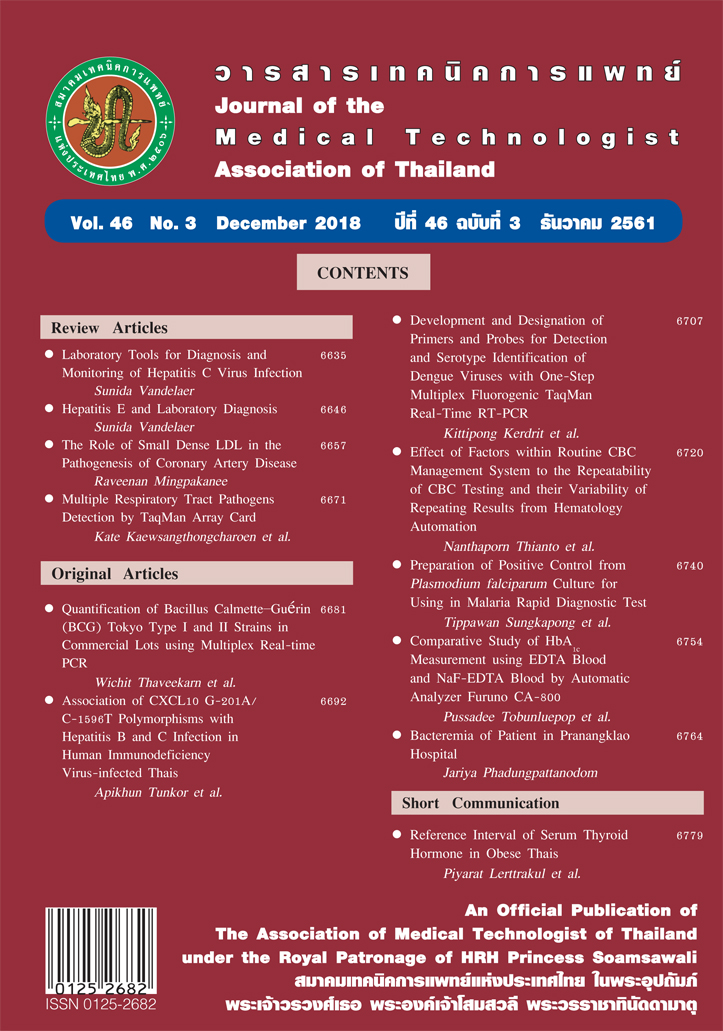
Hepatitis E and Laboratory Diagnosis
Keywords:
Hepatitis E virus, Laboratory diagnosisAbstract
Hepatitis E is an important global public health problem of enterically transmitted hepatitis. There are an estimated 20 million HEV infections worldwide, leading to an estimated3.3 million symptomatic cases of hepatitis E. Transmission of HEV occurs mainly by the fecal-oral route. There are four major genotypes of HEV. HEV genotypes 1 and 2 are mainly restricted to humans, whereas genotypes 3 and 4 are zoonotic transmission. The common laboratory testing for HEV infection includes IgM and IgG anti-HEV antibodies, as well as HEV RNA and HEV antigens detection. This article reviews the information on basic knowledge of HEV, epidemiology, transmissions, pathogenesis, treatment, preventions and the laboratory diagnosis of HEV infection.
Downloads
Published
2019-07-03
How to Cite
1.
วานเดอลาร์ ส. Hepatitis E and Laboratory Diagnosis. วารสารเทคนิคการแพทย์ [internet]. 2019 Jul. 3 [cited 2026 Oct. 24];46(3):6646-5. available from: https://he01.tci-thaijo.org/index.php/jmt-amtt/article/view/200986
Issue
Section
Review Article


