
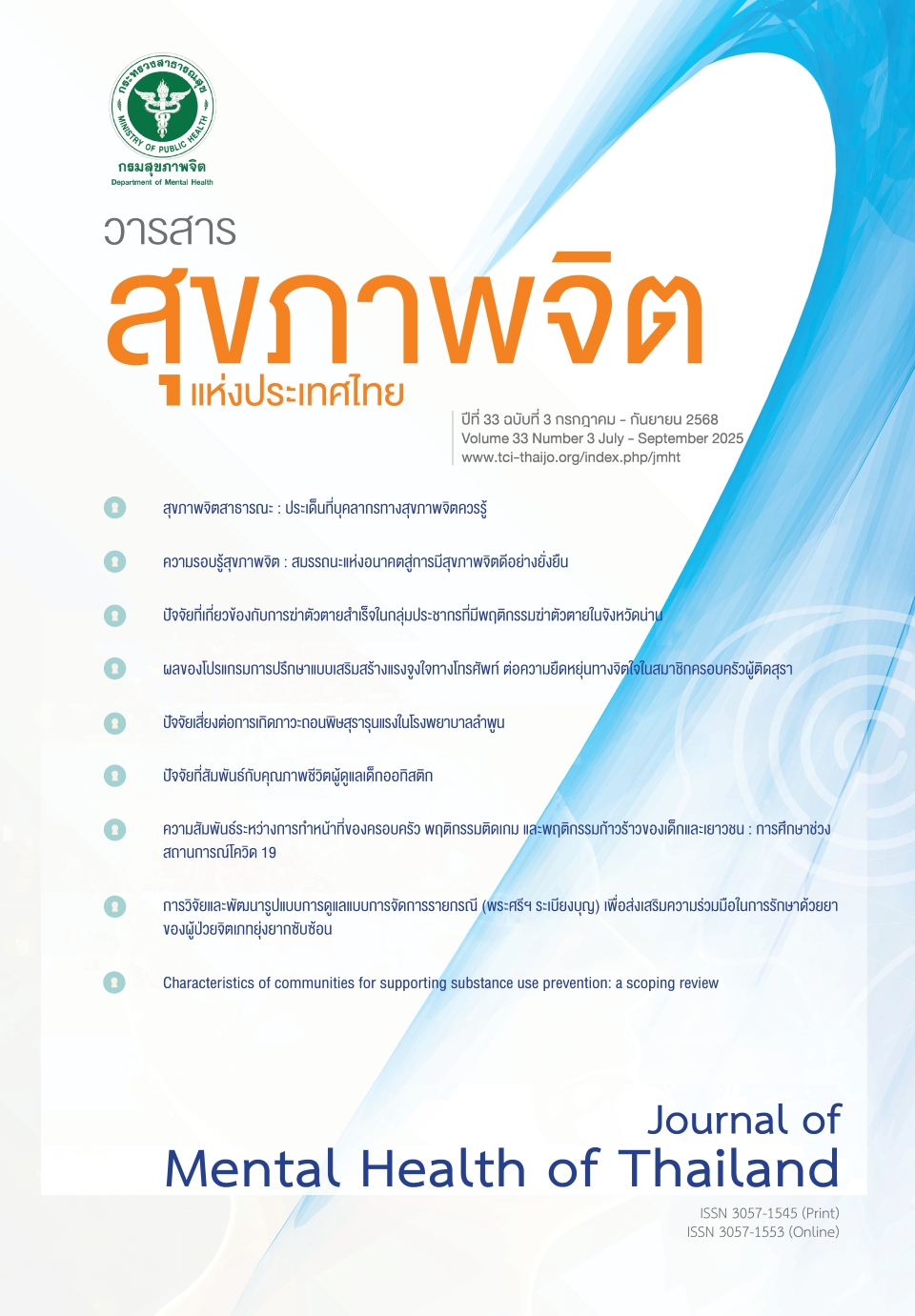
ปัจจัยเสี่ยงต่อการเกิดภาวะถอนพิษสุรารุนแรงในโรงพยาบาลลำพูน
DOI:
https://doi.org/10.64838/jmht.2025.276079คำสำคัญ:
ปัจจัยเสี่ยง, ภาวะถอนพิษสุรา, ภาวะถอนพิษสุรารุนแรงชนิดเพ้อสับสนบทคัดย่อ
วัตถุประสงค์: เพื่อระบุปัจจัยที่มีความสัมพันธ์กับการเกิดภาวะถอนพิษสุรารุนแรงในผู้ป่วยที่มีภาวะถอนพิษสุรา
วิธีการ: ศึกษาข้อมูลย้อนหลังจากเวชระเบียนของผู้มารับการรักษาแบบผู้ป่วยใน โรงพยาบาลลำพูน ตั้งแต่วันที่ 1 ตุลาคม พ.ศ. 2565 ถึง 30 กันยายน พ.ศ. 2566 และมีภาวะถอนพิษสุราตั้งแต่แรกรับ เก็บรวบรวมข้อมูลทั่วไป ประวัติการดื่มสุราและการบำบัดรักษา ผลตรวจทางห้องปฏิบัติการและสัญญาณชีพแรกรับ และคะแนน alcohol withdrawal scale (AWS) วิเคราะห์ข้อมูลด้วยสถิติเชิงพรรณนาและการถดถอยโลจิสติกพหุคูณ
ผล: กลุ่มตัวอย่าง 190 คน เป็นชายร้อยละ 87.4 อายุเฉลี่ย 48.9 ปี มีโรคประจำตัวร้อยละ 38.9 และดื่มสุราเป็นประจำร้อยละ 93.7 ปัจจัยที่เพิ่มโอกาสการเกิดภาวะถอนพิษสุรารุนแรง (AWS 10 คะแนนขึ้นไป) อย่างมีนัยสำคัญ เมื่อเทียบกับภาวะถอนพิษสุราแบบไม่รุนแรง ได้แก่ การดื่มสุราเป็นประจำ การสูบบุหรี่ ประวัติการเกิดภาวะถอนพิษสุรา ประวัติการบำบัดภาวะถอนพิษสุรา ประวัติความจำเสื่อมชั่วคราวจากสุรา ค่าตรวจทางห้องปฏิบัติการแรกรับ liver function test, blood sugar/DTX, creatinine, calcium, magnesium, และ potassium ผิดปกติ ความดันโลหิต systolic แรกรับสูงกว่า 110 มม.ปรอท และชีพจรแรกรับมากกว่า 100 ครั้ง/นาที
สรุป: ควรพัฒนาแนวทางเฝ้าระวังดูแลผู้ป่วยกลุ่มเสี่ยงต่อภาวะถอนพิษสุรารุนแรง ได้แก่ ผู้ดื่มสุราเป็นประจำ มีประวัติภาวะถอนพิษสุรา และมีผลตรวจทางห้องปฏิบัติการและสัญญาณชีพแรกรับผิดปกติ เพื่อป้องกันภาวะแทรกซ้อนที่เกี่ยวข้องและการเสียชีวิต
Downloads
เอกสารอ้างอิง
Peacock A, Leung J, Larney S, Colledge S, Hickman M, Rehm J, et al. Global statistics on alcohol, tobacco and illicit drug use: 2017 status report. Addiction. 2018;113(10):1905-26. DOI: https://doi.org/10.1111/add.14234
National Center for Drug Abuse Statistics. Alcohol abuse statistics [Internet]. South Carolina: National Center for Drug Abuse Statistics; 2023 [cited 2024 Mar 15]. Available from: https://drugabusestatistics.org/alcohol-abuse-statistics/.
Trevisan LA, Boutros N, Petrakis IL, Krystal JH. Complications of alcohol withdrawal: pathophysiological insights. Alcohol Health Res World. 1998;22(1):61-6.
Phatthakorn A, Thippayawong T, Renuwattananon A, Rattanasang P, Rakkanapichonchut W. Clinical practice guideline of alcohol withdrawal patient for multidisciplinary team [Internet]. Pathum Thani: Princess Mother National Institute on Drug Abuse Treatment, Department of Medical Services; 2015 [cited 2024 Mar 15]. Available from: http://www.pmnidat.go.th/thai/downloads/handbook/60/1-58.pdf (in Thai)
Goodson CM, Clark BJ, Douglas IS. Predictors of severe alcohol withdrawal syndrome: a systematic review and meta-analysis. Alcohol Clin Exp Res. 2014;38(10):2664-77. DOI: https://doi.org/10.1111/acer.12529
Wood E, Albarqouni L, Tkachuk S, Green CJ, Ahamad K, Nolan S, et al. Will this hospitalized patient develop severe alcohol withdrawal syndrome?: the rational clinical examination systematic review. JAMA. 2018;320(8):825-33. DOI: https://doi.org/10.1001/jama.2018.10574
Mayo-Smith MF. Pharmacological management of alcohol withdrawal: a meta-analysis and evidence-based practice guideline. JAMA. 1997;278(2):144-51. DOI: https://doi.org/10.1001/jama.1997.03550020076042
Fiellin DA, O’Connor PG, Holmboe ES, Horwitz RI. Risk for delirium tremens in patients with alcohol withdrawal syndrome. Subst Abus. 2002;23(2):83-94. DOI: https://doi.org/10.1080/08897070209511478
Lee JH, Jang MK, Lee JY, Kim SM, Kim KH, Park JY, et al. Clinical predictors for delirium tremens in alcohol dependence. J Gastroenterol Hepatol. 2005;20(12):1833-7. DOI: https://doi.org/10.1111/j.1440-1746.2005.03932.x
Wright T, Myrick H, Henderson S, Peters H, Malcolm R. Risk factors for delirium tremens: a retrospective chart review. Am J Addict. 2006;15(3):213-9. DOI: https://doi.org/10.1080/10550490600625798
Berggren U, Fahlke C, Berglund KJ, Blennow K, Zetterberg H, Balldin J. Thrombocytopenia in early alcohol withdrawal is associated with development of delirium tremens or seizures. Alcohol Alcohol. 2009;44(4):382-6. DOI: https://doi.org/10.1093/alcalc/agp012
Eyer F, Schuster T, Felgenhauer N, Pfab R, Strubel T, Saugel B, et al. Risk assessment of moderate to severe alcohol withdrawal—predictors for seizures and delirium tremens in the course of withdrawal. Alcohol Alcohol. 2011;46(4):427-33. DOI: https://doi.org/10.1093/alcalc/agr053
Kim DW, Kim HK, Bae EK, Park SH, Kim KK. Clinical predictors for delirium tremens in patients with alcohol withdrawal seizures. Am J Emerg Med. 2015;33(5):701-4. DOI: https://doi.org/10.1016/j.ajem.2015.02.030
Teetharatkul T, Vittayanont A. Delirium tremens in psychiatric ward at Songklanagarind hospital. Journal of Health Science and Medical Research. 2018;36(3):205-14. DOI: https://doi.org/10.31584/jhsmr.2018.36.3.17
Burapakajornpong N, Maneeton B, Srisurapanont M. Pattern and risk factors of alcohol withdrawal delirium. J Med Assoc Thai. 2011;94(8):991-7.
Lokapan B, Saengcharnchai P, Rattanasumawong W. Risk factors for delirium tremens in patients with alcohol withdrawal syndrome in psychiatric ward. Journal of the Psychiatric Association of Thailand. 2022;67(1):71-86. (in Thai)
Inchum W, Suwan P, Sirichantra N. The factors related to alcohol withdrawal in broken bone with hazardous use patients at Udon Thani hospital. Journal of Nursing and Health Care. 2021;39(1):78-87. (in Thai)
National Statistical Office. Population health behavior survey 2021. Bangkok: National Statistical Office; 2021 [cited 2024 Mar 15]. Available from: https://www.nso.go.th/nsoweb/nso/survey_detail/w6?set_lang=th (in Thai)
Psychiatric Department, Lamphun Hospital. Service profile. Lamphun: Lamphun Hospital; 2022. (in Thai)
Thorndike RL, editor. Educational Measurement. 2nd ed. Washington DC: American Council on Education; 1971.
Clapp P, Bhave SV, Hoffman PL. How adaptation of the brain to alcohol leads to dependence: a pharmacological perspective. Alcohol Res Health. 2008;31(4):310-39.
Nagy J. Alcohol related changes in regulation of NMDA receptor functions. Curr Neuropharmacol. 2008;6(1):39-54. DOI: https://doi.org/10.2174/157015908783769662
Ormseth CH, LaHue SC, Oldham MA, Josephson SA, Whitaker E, Douglas VC. Predisposing and precipitating factors associated with delirium. JAMA Netw Open. 2023;6(1):e2249950. DOI: https://doi.org/10.1001/jamanetworkopen.2022.49950
Magny E, Le Petitcorps H, Pociumban M, Bouksani-Kacher Z, Pautas É, Belmin J, et al. Predisposing and precipitating factors for delirium in community-dwelling older adults admitted to hospital with this condition: a prospective case series. PLoS One. 2018;13(2):e0193034. DOI: https://doi.org/10.1371/journal.pone.0193034
Nagari N, Babu MS. Assessment of risk factors and precipitating factors of delirium in patients admitted to intensive care unit of a tertiary care hospital. Br J Med Pract. 2019;12(2):a011.
Elisaf M, Merkouropoulos M, Tsianos EV, Siamopoulos KC. Pathogenetic mechanisms of hypomagnesemia in alcoholic patients. J Trace Elem Med Biol. 1995;9(4):210-4. DOI: https://doi.org/10.1016/S0946-672X(11)80026-X
ดาวน์โหลด
เผยแพร่แล้ว
รูปแบบการอ้างอิง
ฉบับ
ประเภทบทความ
สัญญาอนุญาต
ลิขสิทธิ์ (c) 2025 วารสารสุขภาพจิตแห่งประเทศไทย

อนุญาตภายใต้เงื่อนไข Creative Commons Attribution-NonCommercial-NoDerivatives 4.0 International License.
- ผู้อ่านสามารถนำข้อความ ข้อมูล จากวารสารไปใช้ไปใช้ประโยชน์ทางวิชาการได้ เช่น เพื่อการสอน เพื่อการอ้างอิง แต่การนำไปใช้เพื่อวัตถุประสงค์อื่น เช่น เพื่อการค้า จะต้องได้รับอนุญาตเป็นลายลักษณ์อักษรจากกรมสุขภาพจิตก่อน
- ความคิดเห็น ข้อมูล และบทสรุปต่าง ๆ ที่ลงตีพิมพ์ในวารสารสุขภาพจิตแห่งประเทศไทยเป็นของผู้เขียนบทความและมิได้แสดงว่ากองบรรณาธิการหรือกรมสุขภาพจิตเห็นพ้องด้วย