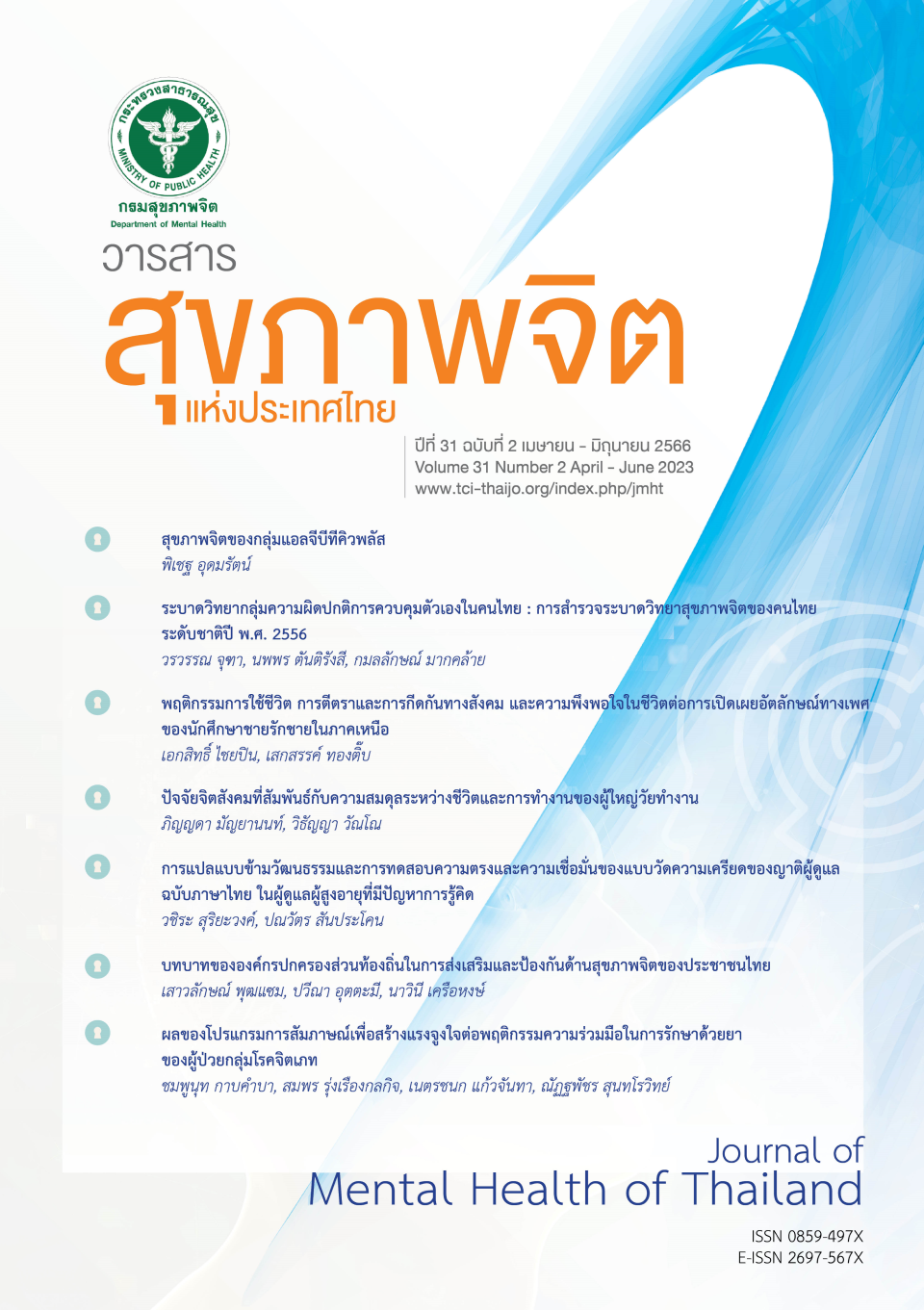
ผลของโปรแกรมการสัมภาษณ์เพื่อสร้างแรงจูงใจต่อพฤติกรรมความร่วมมือในการรักษาด้วยยาของผู้ป่วยกลุ่มโรคจิตเภท : การทบทวนวรรณกรรมอย่างเป็นระบบ
คำสำคัญ:
การสัมภาษณ์เพื่อสร้างแรงจูงใจ, ความร่วมมือในการรักษาด้วยยา, กลุ่มโรคจิตเภทบทคัดย่อ
วัตถุประสงค์ : เพื่อทบทวนผลของโปรแกรมการสัมภาษณ์เพื่อสร้างแรงจูงใจ (motivational interviewing: MI) ที่ไม่บูรณาการกับการบำบัดด้านจิตสังคมอื่น ต่อพฤติกรรมความร่วมมือในการรักษาด้วยยาของผู้ป่วยกลุ่มโรคจิตเภท
วิธีการ : การทบทวนวรรณกรรมอย่างเป็นระบบ สืบค้นงานวิจัยตามแนวปฏิบัติของ Joanna Briggs Institute ใช้ศัพท์บังคับและคำสำคัญตามกรอบ PICO ผ่านฐานข้อมูลอิเล็กทรอนิกส์ PubMed, CINAHL, Cochrane Library, ProQuest, Google Scholar และ ThaiJO ร่วมกับการสืบค้นด้วยมือ คัดเลือกและประเมินคุณภาพงานวิจัยโดยผู้วิจัย 2 คนที่เป็นอิสระต่อกัน ด้วยเครื่องมือ Cochrane risk of bias tool for randomized trials (RoB 2.0) รายงานระดับคุณภาพเป็น 3 ระดับ ได้แก่ ความเสี่ยงต่อการมีอคติระดับต่ำ ไม่ชัดเจน และสูง สกัดข้อมูลโดยผู้วิจัย 2 คนอย่างเป็นอิสระต่อกัน สังเคราะห์ข้อมูลด้วยการวิเคราะห์เชิงพรรณนา
ผล : จากงานวิจัยที่สืบค้นได้ทั้งหมด 1,047 เรื่อง มีงานวิจัยที่ผ่านเกณฑ์การคัดเข้า 6 เรื่อง ตีพิมพ์ระหว่างปี พ.ศ. 2556 - 2566 เป็นการทดลองแบบสุ่มและมีกลุ่มควบคุม 2 เรื่องและการวิจัยกึ่งทดลอง 4 เรื่อง พบว่า งานวิจัย 5 เรื่องที่มีอคติระดับสูงหรือไม่ชัดเจนรายงานว่ากลุ่มทดลองที่ได้รับโปรแกรม MI มีคะแนนพฤติกรรมความร่วมมือในการรักษาด้วยยาสูงกว่ากลุ่มควบคุมที่ได้รับการดูแลตามปกติอย่างมีนัยสำคัญทางสถิติในระยะหลังทดลองทันที ขณะที่งานวิจัย 1 เรื่องที่มีอคติในระดับต่ำไม่พบความแตกต่างของค่าคะแนนพฤติกรรมความร่วมมือในการรักษาด้วยยาระหว่างกลุ่มทดลองและกลุ่มควบคุม
สรุป : โปรแกรม MI ช่วยเพิ่มพฤติกรรมความร่วมมือในการรักษาด้วยยาของผู้ป่วยกลุ่มโรคจิตเภทในระยะสั้น อย่างไรก็ตาม อคติและความแตกต่างของระเบียบวิธีวิจัยของงานวิจัยทำให้การนำผลการศึกษาไปใช้มีข้อจำกัดและไม่สามารถสรุปผลด้วยการวิเคราะห์อภิมานได้
Downloads
เอกสารอ้างอิง
World Health Organization. Fact sheet: schizophrenia [Internet]. Geneva: World Health Organization; 2022 [cited 2023 Feb 13]. Available from: https://www.who.int/news-room/fact-sheets/detail/schizophrenia
Jaeschke K, Hanna F, Ali S, Chowdhary N, Dua T, Charlson F. Global estimates of service coverage for severe mental disorders: findings from the WHO Mental Health Atlas 2017. Glob Ment Health (Camb). 2021;8:e27. doi:10.1017/gmh.2021.19.
Ceraso A, Lin JJ, Schneider-Thoma J, Siafis S, Tardy M, Komossa K, et al. Maintenance treatment with antipsychotic drugs for schizophrenia. Cochrane Database Syst Rev. 2020;8(8):CD008016. doi:10.1002/14651858.CD008016.pub3.
World Health Organization. The world health report 2001: mental disorders affect one in four people [Internet]. Geneva: World Health Organization; 2023 [cited 2023 Feb 13]. Available from: https://www.who.int/news/item/28-09-2001-the-world-health-report-2001-mental-disorders-affect-one-in-four-people
Semahegn A, Torpey K, Manu A, Assefa N, Tesfaye G, Ankomah A. Psychotropic medication non-adherence and its associated factors among patients with major psychiatric disorders: a systematic review and meta-analysis. Syst Rev. 2020;9(1):17. doi:10.1186/s13643-020-1274-3.
Vega D, Acosta FJ, Saavedra P. Nonadherence after hospital discharge in patients with schizophrenia or schizoaffective disorder: A six-month naturalistic follow-up study. Compr Psychiatry. 2021;108(152240). doi:10.1016/j.comppsych.2021.152240.
Sendt KV, Tracy DK, Bhattacharyya S. A systematic review of factors influencing adherence to antipsychotic medication in schizophrenia-spectrum disorders. Psychiatry Res. 2015;225(1-2):14-30. doi:10.1016/j.psychres.2014.11.002.
Tham XC, Xie H, Chng CM, Seah XY, Lopez V, Klainin-Yobas P. Factors affecting medication adherence among adults with schizophrenia: a literature review. Arch Psychiatr Nurs. 2016;30(6):797-809. doi:10.1016/j.apnu.2016.07.007.
Yaegashi H, Kirino S, Remington G, Misawa F, Takeuchi H. Adherence to oral antipsychotics measured by electronic adherence monitoring in schizophrenia: a systematic review and meta-analysis. CNS Drugs. 2020;34(6):579-98. doi:10.1007/s40263-020-00713-9.
Chien WT, Mui J, Gray R, Cheung E. Adherence therapy versus routine psychiatric care for people with schizophrenia spectrum disorders: a randomised controlled trial. BMC Psychiatry. 2016;16(42):1-14. doi:10.1186/s12888-016-0744-6.
Xiao J, Mi W, Li L, Shi Y, Zhang H. High relapse rate and poor medication adherence in the Chinese population with schizophrenia: results from an observational survey in the People's Republic of China. Neuropsychiatr Dis Treat. 2015;11:1161-7. doi:10.2147/NDT.S72367.
กรมสุขภาพจิต. คู่มือระบบการดูแลผู้ป่วยจิตเวชที่มีความเสี่ยงสูงต่อการก่อความรุนแรงสำหรับสถาบัน/โรงพยาบาล สังกัดกรมสุขภาพจิต [The manual of serious mental illness with high risk to violence care system for institutes or hospitals covered by department of mental health]. กรุงเทพฯ: พรอสเพอรัสพลัส; 2563.
Kızılırmak Tatu M, Demir S. Effect of Group Psychoeducation on Treatment Adherence, Quality of Life and Well-Being of Patients Diagnosed with Schizophrenia. Issues Ment Health Nurs. 2021;42(3):256-66. doi:10.1080/01612840.2020.1793244.
Burns AM, Erickson DH, Brenner CA. Cognitive-behavioral therapy for medication-resistant psychosis: a meta-analytic review. Psychiatr Serv. 2014;65(7):874-80. doi:10.1176/appi.ps.201300213.
Shimada T, Ohori M, Inagaki Y, Shimooka Y, Sugimura N, Ishihara I, et al. A multicenter, randomized controlled trial of individualized occupational therapy for patients with schizophrenia in Japan. PLoS One. 2018;13(4):e0193869. doi:10.1371/journal.pone.0193869.
Miller WR, Rose GS. Toward a theory of motivational interviewing. Am Psychol. 2009;64(6):527-37. doi:10.1037/a0016830.
Miller WR, Rose GS. Motivational interviewing: Helping people change. New York: The Guilford Press; 2012.
Papus M, Dima AL, Viprey M, Schott AM, Schneider MP, Novais T. Motivational interviewing to support medication adherence in adults with chronic conditions: Systematic review of randomized controlled trials. Patient Educ Couns. 2022;105(11):3186-203. doi:10.1016/j.pec.2022.06.013.
Teeter BS, Kavookjian J. Telephone-based motivational interviewing for medication adherence: a systematic review. Transl Behav Med. 2014;4(4):372-81. doi:10.1007/s13142-014-0270-3.
Barnes RD, Ivezaj V. A systematic review of motivational interviewing for weight loss among adults in primary care. Obes Rev. 2015;16(4):304-18. doi:10.1111/obr.12264.
Lindson-Hawley N, Thompson TP, Begh R. Motivational interviewing for smoking cessation. Cochrane Database Syst Rev. 20152;(3):CD006936. doi:10.1002/14651858.CD006936.pub3.
Loots E, Goossens E, Vanwesemael T, Morrens M, Van Rompaey B, Dilles T. interventions to improve medication adherence in patients with schizophrenia or bipolar disorders: a systematic review and meta-analysis. Int J Environ Res Public Health. 2021;18(19):10213. doi:10.3390/ijerph181910213.
Zomahoun HTV, Guénette L, Grégoire JP, Lauzier S, Lawani AM, Ferdynus C, et al. Effectiveness of motivational interviewing interventions on medication adherence in adults with chronic diseases: a systematic review and meta-analysis. Int J Epidemiol. 2017;46(2):589-602. doi:10.1093/ije/dyw273.
Ertem MY, Duman ZÇ. The effect of motivational interviews on treatment adherence and insight levels of patients with schizophrenia: A randomized controlled study. Perspect Psychiatr Care. 2019;55(1):75-86. doi:10.1111/ppc.12301.
Barkhof E, Meijer CJ, de Sonneville LM, Linszen DH, de Haan L. The effect of motivational interviewing on medication adherence and hospitalization rates in nonadherent patients with multi-episode schizophrenia. Schizophr Bull. 2013;39(6):1242-51. doi:10.1093/schbul/sbt138.
Kender R. Computer-based brief motivational intervention for medication adherence in schizophrenia [dissertation]. Michigan: Wayne State University; 2010.
Martino S, Carroll KM, Nich C, Rounsaville BJ. A randomized controlled pilot study of motivational interviewing for patients with psychotic and drug use disorders. Addiction. 2006;101(10):1479-92. doi:10.1111/j.1360-0443.2006.01554.x.
Wing TH, Thomas KS. The effects of a compliance therapy programmer on Chinese male patients with schizophrenia. Asian journal of nursing studies. 2005;8(2);47-61.
Ozcan NK, Boyacıoğlu NE, Enginkaya S, Dinç H, Bilgin H. Reproductive health in women with serious mental illnesses. J Clin Nurs. 2014;23(9-10):1283-91. doi:10.1111/jocn.12332.
Anderson KH, Ford S, Robson D, Cassis J, Rodrigues C, Gray R. An exploratory, randomized controlled trial of adherence therapy for people with schizophrenia. Int J Ment Health Nurs. 2010;19(5):340-9. doi:10.1111/j.1447-0349.2010.00681.x.
Chien WT, Mui JH, Cheung EF, Gray R. Effects of motivational interviewing-based adherence therapy for schizophrenia spectrum disorders: a randomized controlled trial. Trials. 2015;16(270):1-14. doi:10.1186/s13063-015-0785-z.
Tufanaru C, Munn Z, Aromataris E, Campbell J, Hopp L. Chapter 3: Systematic reviews of effectiveness. In: Aromataris E, Munn Z, editors. JBI Manual for Evidence Synthesis. South Australia: JBI; 2020. doi:10.46658/JBIMES-20-04.
Page MJ, McKenzie JE, Bossuyt PM, Boutron I, Hoffmann TC, Mulrow CD, et al. The PRISMA 2020 statement: an updated guideline for reporting systematic reviews. BMJ. 2021;372:n71. doi:10.1136/bmj.n71.
Higgins JP, Altman DG, Gøtzsche PC, Jüni P, Moher D, Oxman AD, et al. The Cochrane Collaboration's tool for assessing risk of bias in randomised trials. BMJ. 2011;343:d5928. doi:10.1136/bmj.d5928.
Minozzi S, Cinquini M, Gianola S, Gonzalez-Lorenzo M, Banzi R. The revised Cochrane risk of bias tool for randomized trials (RoB 2) showed low interrater reliability and challenges in its application. J Clin Epidemiol. 2020;126:37-44. doi:10.1016/j.jclinepi.2020.06.015.
สุรศักดิ์ เสาแก้ว. การอ่านและการแปลผลงานวิจัยการวิเคราะห์อภิมาน [Understanding and interpretation of meta-analysis study]. เชียงรายเวชสาร. 2559;8(1):1-17.
จุฬาลักษณ์ ธรรมปัต, พิชามญชุ์ อินทะพุฒ, ชนัดดา แนบเกสร. ผลของโปรแกรมการสัมภาษณ์เพื่อเสริมสร้างแรงจูงใจต่อพฤติกรรมความร่วมมือในการใช้ยาของผู้ป่วยจิตเภทในโรงพยาบาล โรงพยาบาลพระศรีมหาโพธิ์ จังหวัดอุบลราชธานี [The effect of motivational interviewing program on medication compliance behaviors of persons with schizophrenia in hospital, Prasrimahabhodi psychiatric hospital, Ubon Ratchathani]. วารสารวิทยาศาสตร์สุขภาพแห่งประเทศไทย. 2566;5(1):33-45.
ชวนนท์ จันทร์สุข, นฤมล จันทร์สุข, อัฌชา หร่ายลอย. ผลของการให้คำปรึกษาเพื่อเสริมสร้างแรงจูงใจแบบสั้นต่อพฤติกรรมการใช้ยาตามเกณฑ์การรักษาของผู้ป่วยจิตเภท [The effects of brief intervention on medication adherence behaviors of schizophrenic patients]. วารสารพยาบาลทหารบก. 2562;20(2):170-7.
นุจรินทร์ บัวละคร, รังสิมันต์ สุนทรไชยา, สารรัตน์ วุฒิอาภา. ผลของโปรแกรมการบำบัดเพื่อเสริมสร้างแรงจูงใจโดยครอบครัวมีส่วนร่วมต่อความร่วมมือในการรักษาด้วยยาของผู้ป่วยในโรคร่วมจิตเภทและสุรา [The effects of a motivation enhancement therapy program with family involvement on the medication adherence of inpatients with Co-Occurring schizophrenia and alcohol use disorder]. วารสารพยาบาลทหารบก. 2561;9(พิเศษ):423-32.
รัชนี อุทัยพันธ์, เพ็ญนภา แดงด้อมยุทธ์. ผลของการสัมภาษณ์เพื่อสร้างแรงจูงใจแบบกลุ่มต่อความร่วมมือในการรักษาด้วยยาของผู้ป่วยจิตเภทในชุมชน [The effect of group motivational interviewing on medication compliance of schizophrenic patients in community]. วารสารการพยาบาลจิตเสชและสุขภาพจิต. 2556;27(1):136-48.
Lundahl B, Moleni T, Burke BL, Butters R, Tollefson D, Butler C, et al. Motivational interviewing in medical care settings: a systematic review and meta-analysis of randomized controlled trials. Patient Educ Couns. 2013;93(2):157-68. doi:10.1016/j.pec.2013.07.012.
Palacio A, Garay D, Langer B, Taylor J, Wood BA, Tamariz L. Motivational interviewing improves medication adherence: a systematic review and meta-analysis. J Gen Intern Med. 2016;31(8):929-40. doi:10.1007/s11606-016-3685-3.
Frey AJ, Lee J, Small JW, Sibley M, Owens JS, Skidmore B, et al. Mechanisms of Motivational Interviewing: a Conceptual Framework to Guide Practice and Research. Prev Sci. 2021;22(6):689-700. doi:10.1007/s11121-020-01139-x.
Lehmann A, Aslani P, Ahmed R, Celio J, Gauchet A, Bedouch P, et al. Assessing medication adherence: options to consider. Int J Clin Pharm. 2014;36(1):55-69. doi:10.1007/s11096-013-9865-x.
Palmer JA, Parker VA, Barre LR, Mor V, Volandes AE, Belanger E, et al. Understanding implementation fidelity in a pragmatic randomized clinical trial in the nursing home setting: a mixed-methods examination. Trials. 2019;20(656):1-10. doi:10.1186/s13063-019-3725-5.
ณัฐ นาเอก. แนวทางการประเมินงานวิจัยชนิดการทดลองแบบสุ่มที่มีการควบคุมด้วยเครื่องมือแคสพี [The guide to critically appraise a randomize controlled trail (RCT) using a CASP tool]. เชียงรายเวชสาร. 2563;12(2):131-55.
ดาวน์โหลด
ไฟล์ประกอบ
เผยแพร่แล้ว
รูปแบบการอ้างอิง
ฉบับ
ประเภทบทความ
สัญญาอนุญาต
ลิขสิทธิ์ (c) 2023 วารสารสุขภาพจิตแห่งประเทศไทย

อนุญาตภายใต้เงื่อนไข Creative Commons Attribution-NonCommercial-NoDerivatives 4.0 International License.
- ผู้อ่านสามารถนำข้อความ ข้อมูล จากวารสารไปใช้ไปใช้ประโยชน์ทางวิชาการได้ เช่น เพื่อการสอน เพื่อการอ้างอิง แต่การนำไปใช้เพื่อวัตถุประสงค์อื่น เช่น เพื่อการค้า จะต้องได้รับอนุญาตเป็นลายลักษณ์อักษรจากกรมสุขภาพจิตก่อน
- ความคิดเห็น ข้อมูล และบทสรุปต่าง ๆ ที่ลงตีพิมพ์ในวารสารสุขภาพจิตแห่งประเทศไทยเป็นของผู้เขียนบทความและมิได้แสดงว่ากองบรรณาธิการหรือกรมสุขภาพจิตเห็นพ้องด้วย