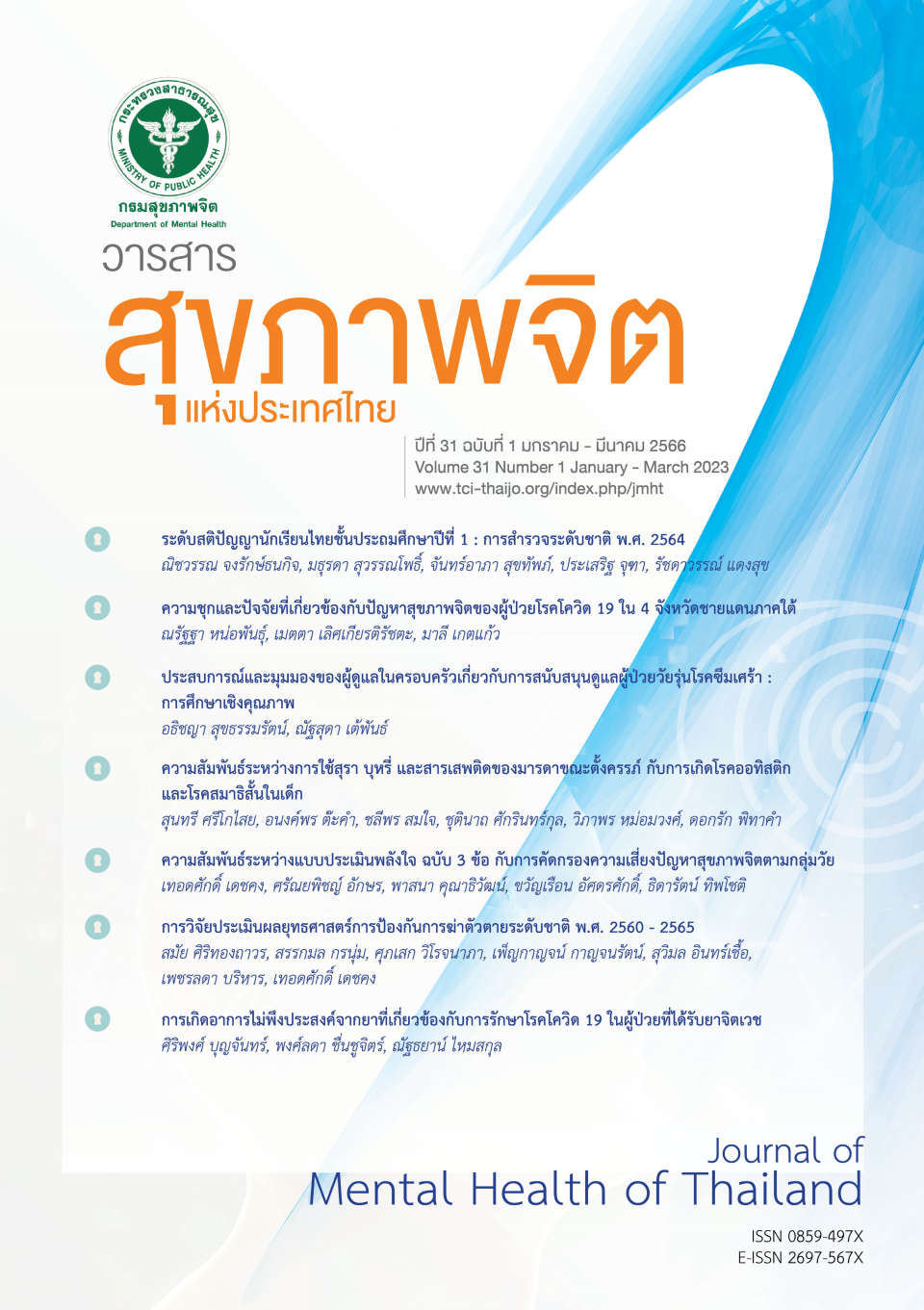
ประสบการณ์และมุมมองของผู้ดูแลในครอบครัวเกี่ยวกับการสนับสนุนดูแลผู้ป่วยวัยรุ่นโรคซึมเศร้า : การศึกษาเชิงคุณภาพ
คำสำคัญ:
วัยรุ่น, โรคซึมเศร้า, ผู้ดูแลในครอบครัว, การศึกษาเชิงคุณภาพบทคัดย่อ
วัตถุประสงค์ : เพื่อศึกษาประสบการณ์ทางจิตใจและมุมมองของผู้ดูแลในครอบครัวเกี่ยวกับการรับมือกับปัญหาและผลกระทบที่เกิดขึ้นระหว่างให้การสนับสนุนดูแลวัยรุ่นในครอบครัวที่เป็นโรคซึมเศร้า
วิธีการ : การศึกษาเชิงคุณภาพแนวปรากฏการณ์วิทยาเชิงตีความ ในกลุ่มตัวอย่างที่เป็นผู้ดูแลในครอบครัว 6 คน ซึ่งเคยมีประสบการณ์ในการดูแลหรือกำลังให้การดูแลวัยรุ่นอายุ 13 - 19 ปีที่ได้รับการวินิจฉัยโรคซึมเศร้า เก็บข้อมูลโดยการสัมภาษณ์เชิงลึกด้วยแนวคำถามกึ่งโครงสร้างเกี่ยวกับประสบการณ์และมุมมองของผู้ดูแลในครอบครัวในการสนับสนุนดูแลวัยรุ่นที่เป็นโรคซึมเศร้า ลักษณะแนวทางในการดูแลรับมือ มุมมอง ความคิด และอารมณ์ความรู้สึกที่เกิดขึ้นระหว่างให้การดูแล การปรับตัว และสิ่งที่ได้เรียนรู้จากประสบการณ์ของตนเอง
ผล : พบประเด็นสำคัญ 4 ประเด็น ได้แก่ 1) การมีทรัพยากรที่เพียงพอต่อการสนับสนุนดูแลวัยรุ่นที่เป็นโรคซึมเศร้า 2) การเปลี่ยนแปลงทางด้านอารมณ์ความรู้สึกที่เกิดขึ้นระหว่างให้การดูแล 3) แนวทางการปรับตัวในบทบาทของผู้ดูแล และ 4) การตกผลึกทางความคิดจากประสบการณ์ในการดูแล
สรุป : ผลการศึกษาเป็นประโยชน์ต่อผู้ที่กำลังเผชิญกับอุปสรรคปัญหาในการดูแลวัยรุ่นที่เป็นโรคซึมเศร้าและผู้ที่เกี่ยวข้องกับการให้บริการด้านสุขภาพจิต เพื่อให้เกิดความเข้าใจเกี่ยวกับการดูแลวัยรุ่นที่เป็นโรคซึมเศร้า ตลอดจนเป็นแนวทางในการพัฒนาตนเองและให้ความช่วยเหลือแก่สมาชิกในครอบครัวที่มีปัญหาทางจิตใจ
Downloads
เอกสารอ้างอิง
World Health Organization. Depression [Internet]. Geneva: World Health Organization; 2020 [cited 2022 Nov 6]. Available from: https://www.who.int/health-topics/depression#tab=tab_1
กรมสุขภาพจิต กระทรวงสาธารณสุข. รายงานการเข้าถึงบริการของผู้ป่วยโรคซึมเศร้า เดือนกันยายน 2565 [Report on service access for patients with depression, September 2022] [อินเทอร์เน็ต]. นนทบุรี: กรม; 2565 [สืบค้นเมื่อวันที่ 6 พ.ย. 2565]. จาก: https://thaidepression.com/www/report/main_report/pdf/ahb-09-22-mix_HDC.pdf
ศุภรัตน์ เอกอัศวิน, จอมสุรางค์ โพธิสัตย์, รสสุคนธ์ ชมชื่น. ความชุกของโรคจิตเวชในนักเรียนไทยอายุ 13-17 ปี [The prevalence of psychiatric disorders in Thai students aged 13-17 year]. วารสารสุขภาพจิตแห่งประเทศไทย. 2559;24(3):141-53.
วิมลวรรณ ปัญญาว่อง, รัตนศักดิ์ สันติธาดากุล, โชษิตา ภาวสุทธิไพศิฐ. ความชุกของภาวะซึมเศร้าและความเสี่ยงฆ่าตัวตายในวัยรุ่นไทย: การสำรวจโรงเรียนใน 13 เขตสุขภาพ [Prevalence of depression and suicidal risks in Thai adolescents: a survey in schools from 13 Public Health Region]. วารสารสุขภาพจิตแห่งประเทศไทย 2563;28(2):136-49.
วัยรุ่นรับบริการสุขภาพจิตไม่มีผู้ปกครองเพิ่ม 1.5 เท่า ย้ำสิทธิทำได้. [อินเทอร์เน็ต]. [กรุงเทพฯ]: กรุงเทพธุรกิจ; 2565 [สืบค้นเมื่อวันที่ 22 ก.พ. 2566]. จาก: www.bangkokbiznews.com/social/1008029
อธิบ ตันอารีย์, นิศากร แก้วพิลา, เบ็ญจา นิ่มนวล, เศรษฐพงศ์ บุญหมั่น, ลวิญญ์วิชญพงศ์ ภูมิจีน, ณัฏฐพัชร สุนทโรวิทย์. การรับบริการสุขภาพจิตและสาเหตุที่ไม่เข้ารับบริการสุขภาพจิตของผู้ป่วยจิตเวชไทย [Mental health service utilization and reason for not receiving services among individuals with mental disorders]. วารสารสุขภาพจิตแห่งประเทศไทย. 2560;25(3):176-86.
ปิติมา คูริโมโตะ. ความบกพร่องของทักษะทางสังคมและปัจจัยที่เกี่ยวข้องของผู้ป่วยโรคซึมเศร้าที่มารับการตรวจรักษาที่แผนกผู้ป่วยนอกจิตเวชศาสตร์ โรงพยาบาลจุฬาลงกรณ์ [Social skills deficits and the associated factors of patients with depressive disorders in outpatient psychiatric department, King Chulalongkorn Memorial hospital] [วิทยานิพนธ์ปริญญามหาบัณฑิต]. [กรุงเทพฯ]: จุฬาลงกรณ์มหาวิทยาลัย; 2562.
Puig-Antich J, Kaufman J, Ryan ND, Williamson DE, Dahl RE, Lukens E, et al. The psychosocial functioning and family environment of depressed adolescents. J Am Acad Child Adolesc Psychiatry. 1993;32(2):244-53.
กระทรวงสาธารณสุข กลุ่มอนามัยเด็กวัยเรียนวัยรุ่น สำนักส่งเสริมสุขภาพ. การสำรวจภาวะสุขภาพนักเรียนในประเทศไทย พ.ศ. 2564 [Thailand Global School-based Student Health Survey, 2021: GSHS] [อินเทอร์เน็ต]. นนทบุรี: กรมอนามัย; 2565 [สืบค้นเมื่อวันที่ 22 ก.พ. 2566]. จาก: https://kb.hsri.or.th/dspace/handle/11228/5784?locale-attribute=th
Nasser EH, Overholser JC. Recovery from major depression: the role of support from family, friends, and spiritual beliefs. Acta Psychiatr Scand. 2005;111(2):125-32. doi:10.1111/j.1600-0447.2004.00423.x.
Newman BM, Newman PR, Griffen S, O'Connor K, Spas J. The relationship of social support to depressive symptoms during the transition to high school. Adolescence. 2007;42(167):441-59.
Stark KD, Banneyer KN, Wang LA, Arora P. Child and adolescent depression in the family. Couple Family Psychol: Research and Practice. 2012;1(3):161-84. doi:10.1037/a0029916.
Plunkett SW, Henry CS, Robinson LC, Behnke A, Falcon PC. Adolescent perceptions of parental behaviors, adolescent self-esteem, and adolescent depressed mood. J Child Fam Stud. 2007;16:760-72. doi:10.1007/s10826-006-9123-0.
Ahlström BH, Skärsäter I, Danielson E. Living with major depression: experiences from families' perspectives. Scand J Caring Sci. 2009;23(2):309-16. doi:10.1111/j.1471-6712.2008.00624.x.
อาชวศรี คำหอม. การรับรู้ตราบาปของผู้ดูแล ทักษะชีวิต และการรับรู้ตราบาปของผู้ที่เป็นโรคจิตเภท [Perceived stigma of caregivers, life skills and perceived stigma of persons with schizophrenia] [วิทยานิพนธ์ปริญญามหาบัณฑิต]. เชียงใหม่: มหาวิทยาลัยเชียงใหม่; 2552.
Yamashita N, Kuzuoka H, Hirata K, Kudo T. Understanding the conflicting demands of family caregivers caring for depressed family members. In: Proceedings of the SIGCHI Conference on Human Factors in Computing Systems; 2013 Apr 27-May 2; Paris, France. New York: Association for Computing Machinery; 2013. p. 2637-46.
สุประวีณ์ ทองชิต, อุมาพร ตรังคสมบัติ. ความเครียดและความรู้สึกเป็นภาระการดูแลของผู้ปกครอง ที่พาเด็กมารับการรักษาที่หน่วยจิตเวชเด็ก โรงพยาบาลจุฬาลงกรณ์ [Stress and burdens in parents of children who came to child psychiatric clinic of King Chulalongkorn Memorial hospital]. จุฬาลงกรณ์เวชสาร. 2556;57(6):737-50.
Smith JA. Evaluating the contribution of interpretative phenomenological analysis. Health Psychol Rev. 2011;5(1):9-27. doi:10.1080/17437199.2010.510659.
American Psychiatric Association. Diagnostic and statistical manual of mental disorders. 5th ed. (DSM-5). Arlington: American Psychiatric Association; 2013. p. 123-88.
ชมพูนุท ศรีจันทร์นิล. การวิเคราะห์เชิงปรากฏการณ์วิทยาแบบตีความ: ระเบียบวิธีวิจัยเชิงคุณภาพสำหรับการวิจัยทางด้านจิตวิทยา [Interpretative phenomenological analysis: a qualitative methodology for psychological research]. วารสารศึกษาศาสตร์. 2560;28(3);1-13.
Chronister J, Chou CC, Kwan KL, Lawton M, Silver K. The meaning of social support for persons with serious mental illness. Rehabil Psychol. 2015;60(3):232-45. doi:10.1037/rep0000038.
Wilkinson PO, Harris C, Kelvin R, Dubicka B, Goodyer IM. Associations between adolescent depression and parental mental health, before and after treatment of adolescent depression. Eur Child Adolesc Psychiatry. 2013;22(1):3-11. doi:10.1007/s00787-012-0310-9.
Deb S, Chatterjee P, Walsh K. Anxiety among high school students in India: Comparisons across gender, school type, social strata and perceptions of quality time with parents. Australian Journal of Educational & Developmental Psychology. 2010;10:18-31.
Badri M, Khaili MA, Bahar MA, Yang G, Reynhout G, Rashdi AA. Social connection and self-perceived depression among adolescents: A path analytic model for Abu Dhabi. J Child Fam Stud. 2021;30:146-57. doi:10.1007/s10826-020-01891-2.
Desha LN, Nicholson JM, Ziviani JM. Adolescent depression and time spent with parents and siblings. Soc Indic Res. 2011;101:233-8. doi:10.1007/s11205-010-9658-8.
ชนกานต์ ชัชวาลา. วาทกรรมของโรคจิตเวชที่ปรากฏในวรรณกรรมร่วมสมัยของไทย: การศึกษาผลงานของ ปิยะพร ศักดิ์เกษม [Discourse on psychiatric disorders in modern Thai literature: a study of Piyaporn Saksasem’s novels]. วารสารศิลปศาสตร์ มหาวิทยาลัยสงขลานครินทร์. 2561;10(1):204-28.
Yap MB, Allen NB, Sheeber L. Using an emotion regulation framework to understand the role of temperament and family processes in risk for adolescent depressive disorders. Clin Child Fam Psychol Rev. 2007;10(2):180-96. doi:10.1007/s10567-006-0014-0.
ดาวน์โหลด
เผยแพร่แล้ว
รูปแบบการอ้างอิง
ฉบับ
ประเภทบทความ
สัญญาอนุญาต
ลิขสิทธิ์ (c) 2023 วารสารสุขภาพจิตแห่งประเทศไทย

อนุญาตภายใต้เงื่อนไข Creative Commons Attribution-NonCommercial-NoDerivatives 4.0 International License.
- ผู้อ่านสามารถนำข้อความ ข้อมูล จากวารสารไปใช้ไปใช้ประโยชน์ทางวิชาการได้ เช่น เพื่อการสอน เพื่อการอ้างอิง แต่การนำไปใช้เพื่อวัตถุประสงค์อื่น เช่น เพื่อการค้า จะต้องได้รับอนุญาตเป็นลายลักษณ์อักษรจากกรมสุขภาพจิตก่อน
- ความคิดเห็น ข้อมูล และบทสรุปต่าง ๆ ที่ลงตีพิมพ์ในวารสารสุขภาพจิตแห่งประเทศไทยเป็นของผู้เขียนบทความและมิได้แสดงว่ากองบรรณาธิการหรือกรมสุขภาพจิตเห็นพ้องด้วย