
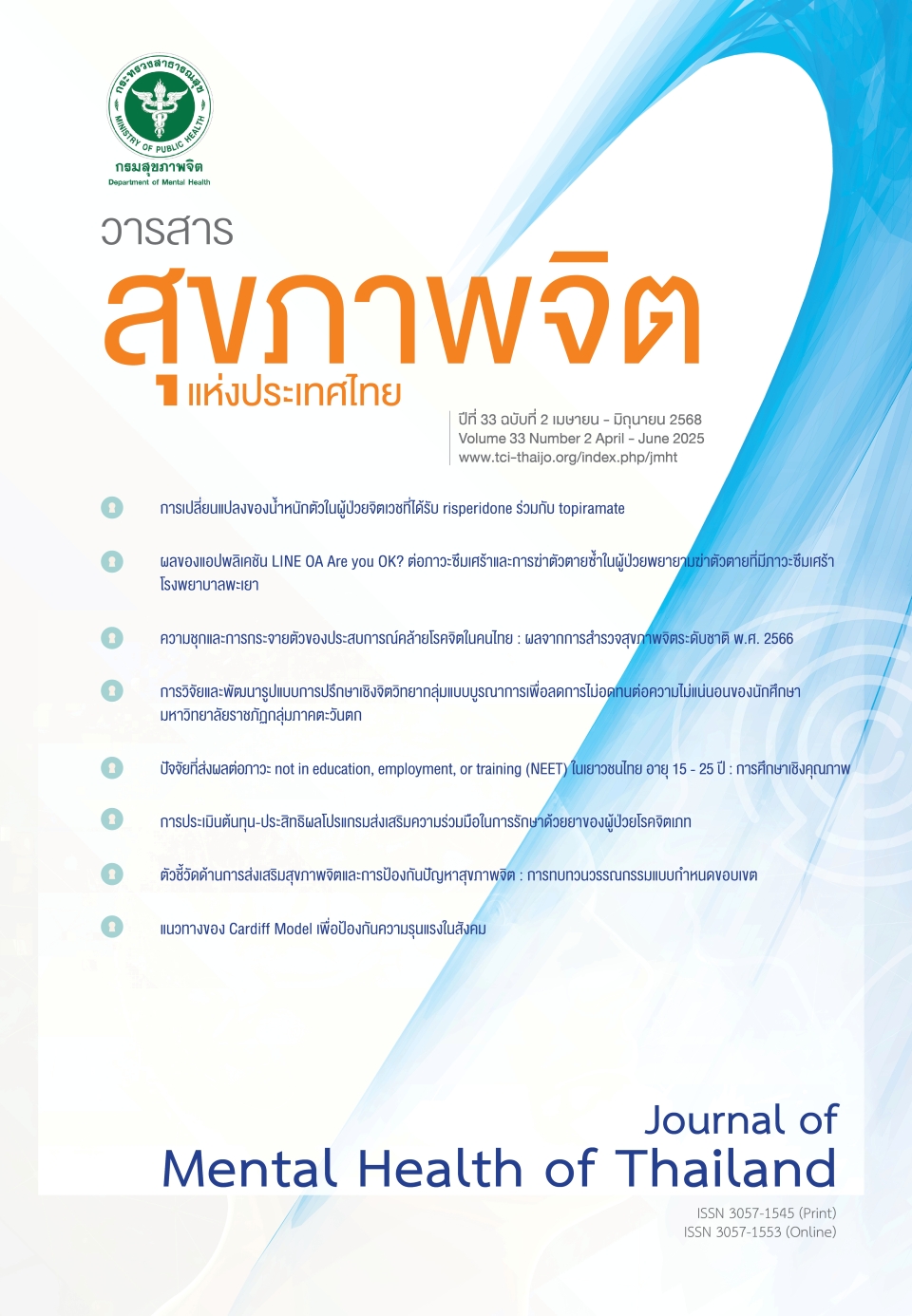
A qualitative study on the factors contributing to not in education, employment, or training (NEET) among Thai youths aged 15 - 25 years
DOI:
https://doi.org/10.64838/jmht.2025.274278Keywords:
NEET, parenting, risk factors, youthAbstract
Objective: To examine the phenomenon of being not in education, employment, or training (NEET) and its contributing factors among Thai youths.
Methods: This qualitative study was conducted with confirmed NEET youths aged 15 - 25 years and their parents from across Thailand. Data were collected from July to November 2023 through semi-structured interviews. The data were analyzed using content analysis, and ensured for reliability through triangulation.
Results: Twelve informants participated in the in-depth interviews, including nine NEET youths and three parents. Key contributing factors to NEET status included a mismatch between the youth’s qualifications and experiences and labor market demands, parental provision of psychological and financial supports during the NEET period, unclear communication of parental expectations regarding employment, and a lack of motivation or clear life goals among the youths.
Conclusion: NEET status among Thai youth is influenced by a combination of the individual, familial, and external factors. Interventions should incorporate educational programs that support self-discovery, along with psychological counseling and guidance services focusing on career planning and effective family communication.
Downloads
References
Bhulaor R, Saengprajakkul S, Thongwan P. Report of knowledge building and promotion of youth who are not in employment, education or training (NEETs), and youth who are disengaged in human capital accumulation activities for fostering youth potential to enter into the labor market. Bangkok: Thai Health Promotion Foundation; 2020.
Ralston K, Everington D, Feng Z, Dibben C. Economic Inactivity, not in employment, education or training (NEET) and scarring: the importance of neet as a marker of long-term disadvantage. Work Employ Soc. 2021;36(1):59-79. DOI: https://doi.org/10.1177/0950017020973882
Bania EV, Eckhoff C, Kvernmo S. Not engaged in education, employment or training (NEET) in an arctic sociocultural context: the NAAHS cohort study. BMJ Open. 2019;9(3):e023705. DOI: https://doi.org/10.1136/bmjopen-2018-023705
International Labour Organization. Young people not in employment, education or training [internet]. Geneva: International Labour Organization; 2019 [cited 2024 Aug 12]. Available from: https://sustainabledevelopment.un.org/content/documents/26634NEET_Sida_brief.pdf
Tanton C, McDonagh L, Cabecinha M, Clifton S, Geary R, Rait G, et al. How does the sexual, physical and mental health of young adults not in education, employment or training (NEET) compare to workers and students? BMC Public Health. 2021;21(1):412. DOI: https://doi.org/10.1186/s12889-021-10229-6
Organisation for Economic Co-operation and Development. Adolescent education and pre-employment interventions in Australia: keeping young people in education, employment and training. Paris: Organisation for Economic Co-operation and Development; 2023.
Manhica H, Lundin A, Danielsson AK. Not in education, employment, or training (NEET) and risk of alcohol use disorder: a nationwide register-linkage study with 485 839 Swedish youths. BMJ Open. 2019;9(10):e032888. DOI: https://doi.org/10.1136/bmjopen-2019-032888
Rodwell L, Romaniuk H, Nilsen W, Carlin JB, Lee KJ, Patton GC. Adolescent mental health and behavioural predictors of being NEET: a prospective study of young adults not in employment, education, or training. Psychol Med. 2018;48(5):861-71. DOI: https://doi.org/10.1017/S0033291717002434
Plenty S, Magnusson C, Låftman SB. Internalising and externalising problems during adolescence and the subsequent likelihood of being Not in Employment, Education or Training (NEET) among males and females: The mediating role of school performance. SSM Popul Health. 2021;15:100873. DOI: https://doi.org/10.1016/j.ssmph.2021.100873
Lindblad V, Ravn RL, Gaardsted PS, Hansen LEM, Lauritzen FF, Melgaard D. Beyond the mind: understanding the influence of mental health on youth NEET status in Europe—a systematic literature review. J Adolesc. 2024;96(7):1428-44. DOI: https://doi.org/10.1002/jad.12374
Intharawong S. Influence of perceived self-efficacy, job characteristics and quality of working life on job performance of staff in new university association [Thesis]. Pathum Thani: Rajamangala University of Technology Thanyaburi; 2017. (in Thai)
Bank of Thailand. Unemployed persons classified by reason for leaving employment [Internet]. Bangkok: Bank of Thailand; 2022 [cited 2024 Aug 12]. Available from: https://www.bot.or.th/th/research-and-publications/articles-and-publications/articles/regional-articles/reg-article-2022-05.html (in Thai)
Boonrod C, Pornnoppadol C, Atsariyasing W. Prevalence of not in education, employment, or training (NEET), associated factors, and the relationship with game addiction among youth aged 15 - 25 years in Thailand. Journal of the Psychiatric Association of Thailand. 2024;69(3):308-20. (in Thai) DOI: https://doi.org/10.1016/j.jaac.2024.08.141
Elo S, Kääriäinen M, Kanste O, Pölkki T, Utriainen K, Kyngäs H. Qualitative content analysis: a focus on trustworthiness. SAGE Open. 2014;4(1):1-10. DOI: https://doi.org/10.1177/2158244014522633
Lindblad V, Kragholm KH, Gaardsted PS, Hansen LEM, Lauritzen FF, Melgaard D. From illness to inactivity: exploring the influence of physical diseases on youth not in education, employment, or training status in Europe: a systematic literature review. J Adolesc. 2024;96(8):1695-712. DOI: https://doi.org/10.1002/jad.12386
Hemnarakorn P. The social factors affecting new graduates unemployment [Thesis]. Bangkok: Srinakharinwirot University; 2022. (in Thai)
Rahmani H, Groot W, Rahmani AM. Unravelling the NEET phenomenon: a systematic literature review and meta-analysis of risk factors for youth not in education, employment, or training. Int J Adolesc Youth. 2024;29(1):1-22. DOI: https://doi.org/10.1080/02673843.2024.2331576
Sakorn C. Factors affecting unemployment in Thailand [Thesis]. Chiang Mai: Maejo University; 2022. (in Thai)
Bank of Thailand. Unemployed persons classified by reason for leaving employment [Internet]. Bangkok: Bank of Thailand; 2019 [cited 2024 Aug 12]. Available from: https://app.bot.or.th/BTWS_STAT/statistics/BOTWEBSTAT.aspx?reportID=669&language=TH (in Thai)
Chaidetakkul T, Sethsombun P. The implications behind the low unemployment rate [Internet]. Bangkok: Bank of Thailand; 2019 [cited 2024 Aug 12]. Available from: https://www.bot.or.th/th/research-and-publications/articles-and-publications/articles/Article_06Feb2019.html (in Thai)
Baby Best Buy Editorial Team. The negative aspects of parenting like a friend [Internet]. Bangkok: Ace Con (Thailand) Co., Ltd.; 2020 Jul 20 [cited 2024 Aug 12]. Available from: https://www.babybbb.com/article_detail.php?nid=262 (in Thai)
Russell L. The realities of being young, unemployed and poor in post-industrial Britain. Power and Education. 2016;8(2):160-75. DOI: https://doi.org/10.1177/1757743816651896
Downloads
Published
How to Cite
Issue
Section
License
Copyright (c) 2025 Journal of Mental Health of Thailand

This work is licensed under a Creative Commons Attribution-NonCommercial-NoDerivatives 4.0 International License.
- Authorization to photocopy items for internal or personal use of specific clients, is granted. The consent does not extend to other kinds of copying, such as for general distribution, for advertising, or for resale.
- Unless otherwise states, the views and opinion expressed in Journal of Mental Health of Thailand are those of authors of the papers, and do not represent those of the editorial board or the Department of Mental Health.