
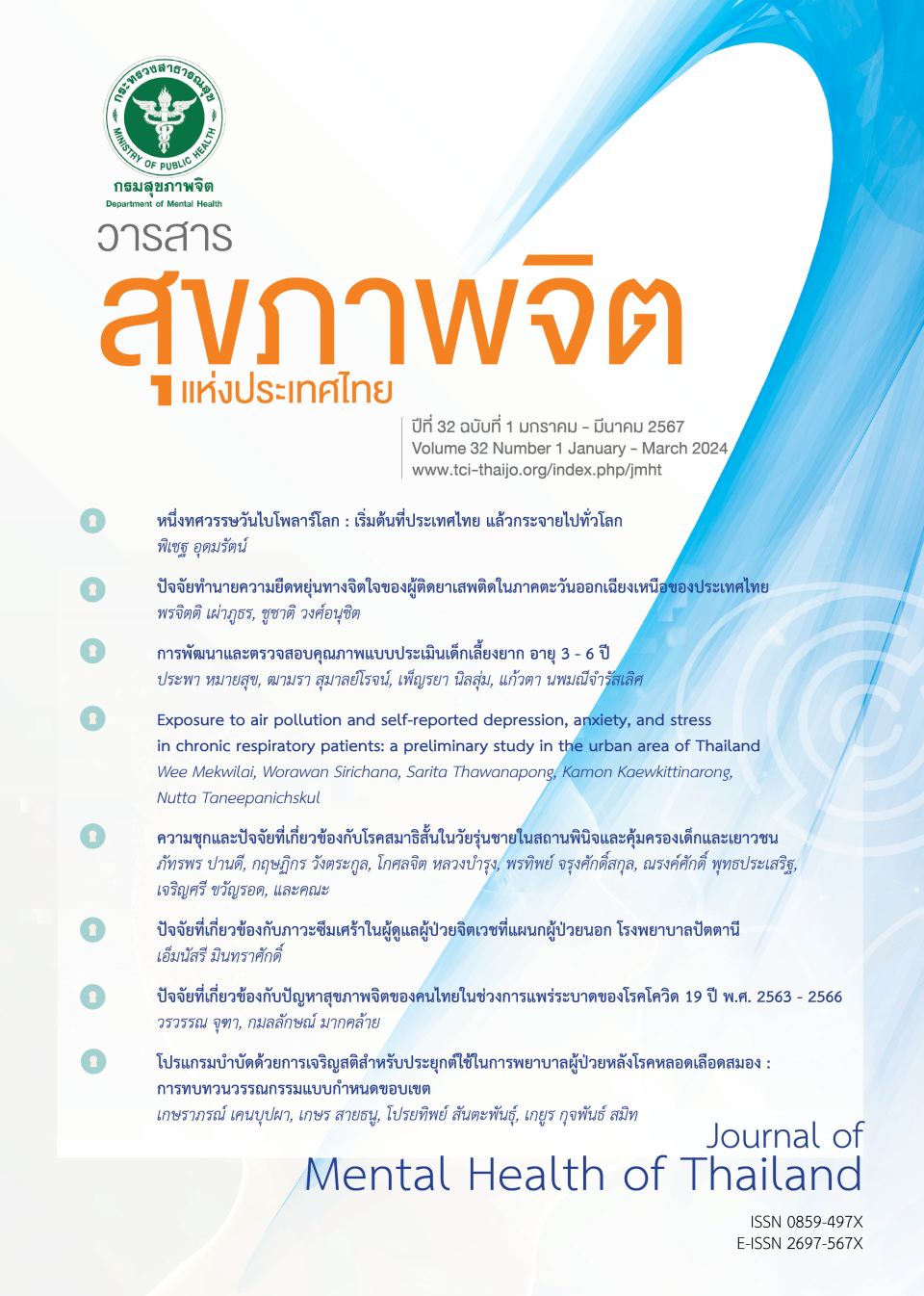
Development and psychometric properties of an assessment tool for children with challenging behaviors aged 3 - 6 years
Keywords:
inventory, psychometric properties, early childhood, difficult childAbstract
Objective: To develop and evaluate the psychometric properties of the assessment form for difficult children aged 3 - 6 years.
Methods: The assessment tool was developed based on functional emotional developmental and neurodevelopmental theories. The content validity was checked by finding the index of item-objective congruence (IOC) from five experts. The reliability was determined by the internal consistency using Cronbach’s alpha coefficient and corrected item-total correlation (CITC). The stability was assessed using the test-retest method. The construct validity was tested among the parents or primary caregivers of children aged 3 - 6 years using exploratory factor analysis (EFA).
Results: The draft version of an assessment consisted of 50 items, categorized into six aspects of child characteristics; the easy child, the sensitive child, the self-absorbed child, the defiant child, the inattentive child, and the active child. It had IOC between 0.6 - 1.00, the CITC between 0.28 - 0.81, and the test-retest correlation between 0.60 - 0.89 (p < .001). The EFA among 367 participants revealed that 33 items were retained, with the full scale and subscale Cronbach’s alpha coefficient of 0.83 and between 0.72 - 0.91, respectively.
Conclusion: The assessment form for difficult children is psychometrically sound, with favorable validity and high internal consistency.
Downloads
References
Teekavanich S, Chantaratin S, Sirisakpanit S, Tarugsa J. Prevalence and factors related to behavioral and emotional problems among preschool children in Bangkok, Thailand. J Med Assoc Thai. 2017;100(2):175-82.
Poulou MS. Emotional and behavioural difficulties in preschool. J Child Fam Stud. 2015;24(2):225-36. doi:10.1007/s10826-013-9828-9.
Greenspan SI. The challenging child: understanding, raising, and enjoying the five “difficult” types of children. Boston: Da Capo Press; 1995.
Thomas A, Chess S. Temperament and development. Brunner: American Psychological Association; 1977.
Tripathi S. The digital youth’s personality and conscience versul their vision adjustment. Journal of Early Childhood Education Management. 2019;1(1):90-100.
Thomasgard M. Working with challenging young children: relations between child temperament, response to novelty and sensory processing. Clin Pediatr (Phila). 2003;42(3):197-204. doi:10.1177/000992280304200302.
Saricelik S, Saban A. Classroom teachers’ perceptions of difficult children: a phenomenological study. Journal of Qualitative Research in Education. 2021;9(25):1-27. doi:10.14689/enad.25.1.
Li I, Shen PS, Wu ML, Wang W. The relationship between preschoolers’ sensory regulation and temperament: implications for parents and early childhood caregivers. Early Child Dev Care. 2022;192(1):1-11. doi:10.1080/03004430.2020.1853116.
Siriumpunkul P, Lerthattasilp T, Sungthong C, Keebang J. The development of the temperament promotion model among the difficultly children in early childhood. Bangkok: National Research Council of Thailand; 2018.
Deepaen S. The effects of a program for parents responding to children with difficult temperament on the temperament of preschool children [master’s thesis]. Pathum Thani: Thammasat University; 2018.
Siriumpunkul P, Keebang J. Temperament and related factors in early childhood. Journal of Mental Health of Thailand. 2021;29(1):80-92.
Comrey A., Lee H. A first course in factor analysis. New Jersey: Lawrence Erlbaum; 1992.
Greenspan SI, Wieder S. The interdisciplinary council on developmental and learning disorders diagnostic manual for infants and young children - an overview. J Can Acad Child Adolesc Psychiatry. 2008;17(2):76-89.
Gravetter, FJ, and Larry BW. Essentials of Statistics for the Behavioral Science. 7th ed. Wadsworth Publishing Company; 2008.
Fitzner K. Reliability and validity: a quick review. New York: Diabetes Educ; 2007.
Phattharayuttawa S. Manual of psychological testing. 5th ed. Bangkok: Medical Media; 2013.
Hair Jr JF, Anderson RE, Tatham RL, Black WC. Multivariate data analysis with readings. 4th ed. New Jersy: Prentice Hall; 1995.
Angsuchoti S. The use of factor analysis for instrument development in behavioral sciences. Sripatum Review of Humanities and Social Sciences. 2015;15(1):125-35.
Taherdoost H, Sahibuddin S, Jalaliyoon N. Exploratory Factor Analysis; Concepts and Theory. Advances in Applied and Pure Mathematics. 2022;27:375-82.
Pasunon P. Reliability of questionnaire in quantitative research. Parichart Journal. 2014;27(1):144-63.
Suktawee P, Koolnaphadol P, Hengudomsub P. Parenting skills enhancement for children in digital age through innovative contemporary family counselling. Journal of Educational Research. 2023;18(1):178-90.
Kochanova K, Pittman LD, McNeela L. Parenting stress and child externalizing and internalizing problems among low-income families: exploring transactional associations. Child Psychiatry Hum Dev. 2022;53(1):76-88. doi:10.1007/s10578-020-01115-0.
Trumello C, Ballarotto G, Ricciardi P, Paciello M, Marino V, Morelli M, et al. Mothers and fathers of pre-school children: a study on parenting stress and child's emotional-behavioral difficulties. Curr Psychol. 2022:1-12. doi:10.1007/s12144-022-03599-6.
Downloads
Published
How to Cite
Issue
Section
License
Copyright (c) 2024 Journal of Mental Health of Thailand

This work is licensed under a Creative Commons Attribution-NonCommercial-NoDerivatives 4.0 International License.
- Authorization to photocopy items for internal or personal use of specific clients, is granted. The consent does not extend to other kinds of copying, such as for general distribution, for advertising, or for resale.
- Unless otherwise states, the views and opinion expressed in Journal of Mental Health of Thailand are those of authors of the papers, and do not represent those of the editorial board or the Department of Mental Health.