
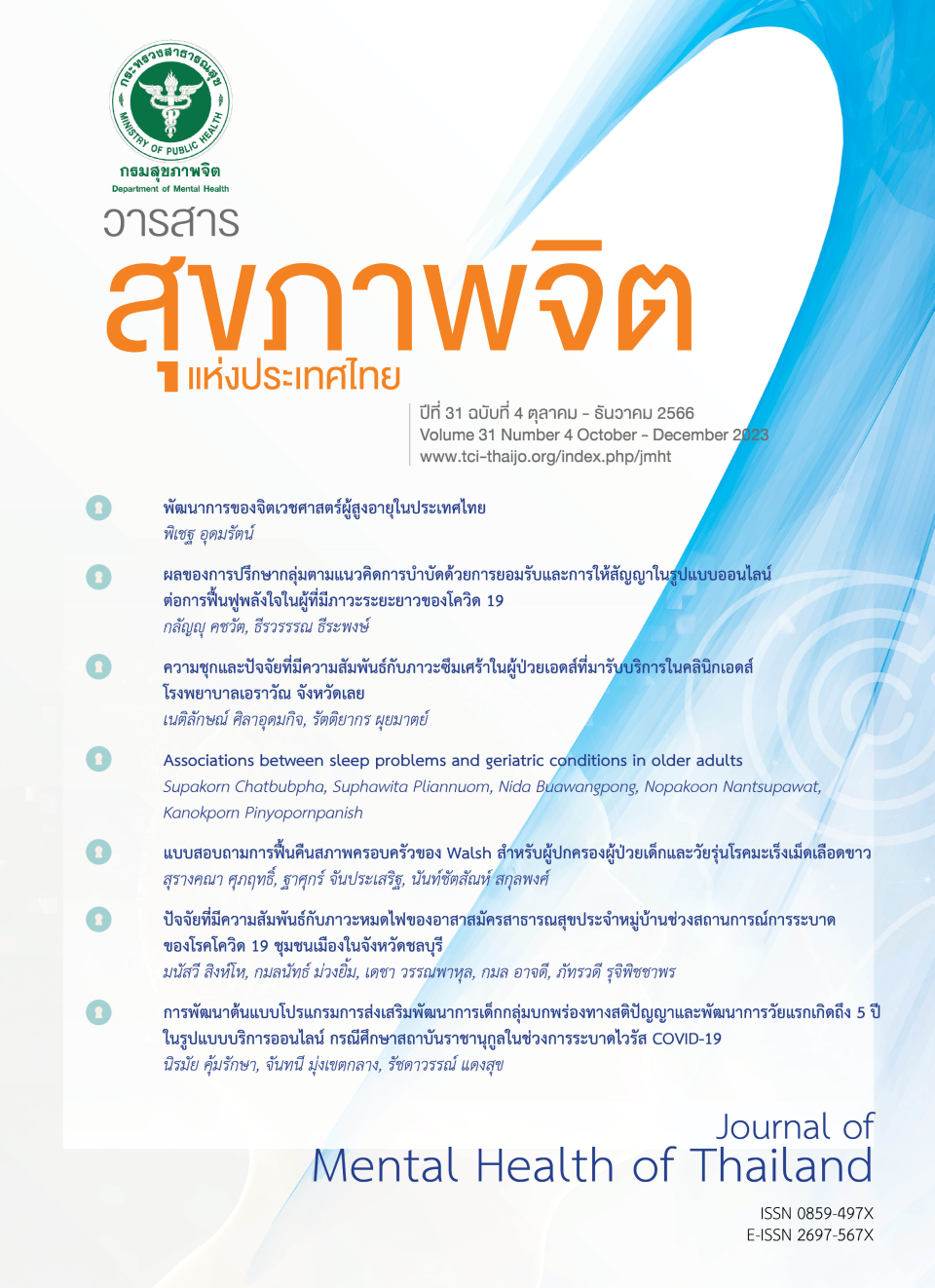
The development of the prototype of an online early intervention program for children aged 0 to 5 years with intellectual and developmental disabilities: a pilot study at Rajanukul Institute during the COVID-19 pandemic
Keywords:
early intervention, intellectual and developmental disabilities, online intervention, parenting skillsAbstract
Objective: To develop the prototype of the Thai Early Developmental Assessment for Intervention (TEDA4I) online version and assess its effects on the developmental level of children with intellectual and developmental disabilities and parenting skills on child development assessment and enhancement.
Methods: A research and development study was divided into 3 phases; 1) a descriptive study on the situation and need using content analysis and systematic synthesis, 2) a participatory research to develop and validate the online and onsite adapted versions of the TEDA4I, and 3) a quasi-experimental research with two groups pretest and posttest design to assess and compare the effects of both versions of the program on parenting skills and developmental level among children aged 0 - 5 years with intellectual and developmental disabilities and their parents, using descriptive statistics, paired t-test, and independent t-test.
Results: Interviews with stakeholders revealed the need for child development services to be continuous and flexible regardless of social and personal circumstances, specifically the service that can be delivered online. Assessment by the experts showed that the developed online and onsite versions of the TEDA4I both showed an acceptable level of content validity. Thirty-nine (19 parents and 20 children) and 41 participants (20 parents and 21 children) attended the TEDA4I online and onsite, respectively. After the programs, the mean scores of parenting skills and developmental levels in both groups were significantly improved compared to those before the programs. There was no statistically significant difference in the post-program mean scores between those who attended the TEDA4I online and onsite.
Conclusion: Both adapted versions of the TEDA4I could improve the assessment and early stimulation skills of caregivers as well as the developmental level of their children with intellectual and developmental disabilities.
Downloads
References
นิรมัย คุ้มรักษา, รัชดาวรรณ์ แดงสุข, ธัญหทัย จันทะโยธา. ผลของโปรแกรม TEDA4I ในเด็กที่มีปัญหาพัฒนาการในจังหวัดกาญจนบุรี [Effect of TEDA4I on child development of children with delay development in Kanchanaburi province]. วารสารราชานุกูล. 2561;33(1):19-29.
สมัย ศิริทองถาวร. การพัฒนาเครื่องมือประเมินเพื่อช่วยเหลือเด็กปฐมวัยที่มีปัญหาพัฒนาการ [Development of assessment tools to assist young children with developmental problems]. เชียงใหม่: สถาบันพัฒนาการเด็กราชนครินทร์; 2562.
ระบบคลังข้อมูลด้านการแพทย์และสุขภาพ กระทรวงสาธารณสุข. ร้อยละของเด็กอายุ 9, 18, 30, 42, 60 เดือน ที่คัดกรองพัฒนาการแล้วพบว่ามีพัฒนาการล่าช้าได้รับการกระตุ้นพัฒนาการด้วย TEDA4I หรือเครื่องมือมาตรฐานอื่น [Percentage of children aged 9, 18, 30, 42, 60 Months in which developmental delays were screened and received developmental stimulation with TEDA4I or other standard tools] [อินเทอร์เน็ต]. นนทบุรี: ศูนย์เทคโนโลยีสารสนเทศและการสื่อสาร สำนักงานปลัดกระทรวงสาธารณสุข; 2565 [สืบค้นเมื่อวันที่ 10 เม.ย. 2565]. จาก: https://hdcservice.moph.go.th/hdc/reports/report.php?cat_id%20=ea11bc4bbf333b78e6f53a26f7ab6c89&id=023dcdc36f90b6b070358fbc6727c768
กลุ่มงานส่งเสริมสุขภาพจิตเด็กปฐมวัย สำนักอนามัย กรุงเทพมหานคร. รายงานร้อยละของเด็กอายุแรกเกิดถึง 5 ปี [Reports the percentage of children ages birth to 5 years]. กรุงเทพฯ: กลุ่มงาน; 2565.
สถาบันราชานุกูล. รายงานข้อมูลพื้นฐานสถาบันราชานุกูล [Basic information report of Rajanukul institute]. กรุงเทพฯ: สถาบัน; 2565.
Zaagsma M, Volkers KM, Swart EAK, Schippers AP, Van Hove G. The use of online support by people with intellectual disabilities living independently during COVID-19. J Intellect Disabil Res. 2020;64(10):750-6. doi:10.1111/jir.12770.
Navas P, Amor AM, Crespo M, Wolowiec Z, Verdugo MÁ. Supports for people with intellectual and developmental disabilities during the COVID-19 pandemic from their own perspective. Res Dev Disabil. 2021;108:103813. doi:10.1016/j.ridd.2020.103813.
Broka A, Mihailova H. Family counselling and flexibility of social services during Covid-19 emergency: case study of Latvian municipalities. SHS Web Conf. 2020;85:01010. doi:10.1051/shsconf/20208501010.
Bernard R. Fundamentals of biostatistics. 5th ed. Pacific Grove CA: Duxbury Press; 2000.
Turner RC, Carlson L. Indexes of item-objective congruence for multidimensional items. Int J Test. 2003;3(2):163-71. doi:10.1207/S15327574IJT0302_5.
Cronbach LJ. Coefficient alpha and the internal structure of tests. Psychometrika. 1951;16(3):297-334. doi:10.1007/BF02310555.
สมัย ศิริทองถาวร. รายงานการวิจัยเรื่อง การพัฒนาเครื่องมือในการคัดกรอง และประเมินความ ผิดปกติของพัฒนาการสําหรับเด็กปฐมวัย (0-5 ปี).[ The development of developmental screening and assessment instruments for children aged birth to 5 years] [อินเทอร์เน็ต]. เชียงใหม่: สถาบันพัฒนาการเด็กราชนครินทร์; 2558 [สืบค้นเมื่อวันที่ 10 เม.ย. 2565]. จาก: https://dmh-elibrary.org/items/show/459
บุษยารัตน์ จันทร์ประเสริฐ, ณัฏฐภรณ์ หลาวทอง, สังวรณ์ งัดกระโทก. ความเที่ยงระหว่างผู้ประเมินของความสอดคล้องในแนวเดียวกันระหว่างข้อสอบกับตัวชี้วัดวิทยาศาสตร์ [Inter-rater reliability of alignment between science items and indices]. วารสารครุศาสตร์จุฬาลงกรณ์มหาวิทยาลัย. 2563;48(3):144-63.
Fleiss JL, Levin B, Paik MC. Statistical methods for rates and proportions. 3rd ed. New Jersey: John Wiley & Sons; 2003.
Bearss K, Burrell TL, Challa SA, Postorino V, Gillespie SE, Crooks C, et al. Feasibility of parent training via telehealth for children with autism spectrum disorder and disruptive behavior: a demonstration pilot. J Autism Dev Disord. 2018;48(4):1020-30. doi:10.1007/s10803-017-3363-2.
Degli Espinosa F, Metko A, Raimondi M, Impenna M, Scognamiglio E. A model of support for families of children with autism living in the COVID-19 lockdown: lessons from Italy. Behav Anal Pract. 2020;13(3):550-8. doi:10.1007/s40617-020-00438-7.
The Illinois interagency council on early intervention (IICEI). Principles of early intervention [Internet]. Illinois: IICEI; 2021 [cited 2023 Apr 10]. Available from: https://providerconnections.org/principles-of-early-intervention/.
Sforzo GA, Kaye MP, Todorova I, Harenberg S. Costello K, Cobus-Kou l, et al. Compendium of the health and wellness coaching literature. Am J Lifestyle Med. 2017;12(6):436-47. doi:10.1177/1559827617708562.
Young HM, Miyamoto S, Dharmar M, Tang-Feldman Y. Nurse coaching and mobile health compared with usual care to improve diabetes self-efficacy for persons with type 2 diabetes: randomized controlled trial. JMIR Mhealth Uhealth. 2020;8(3):e16665. doi:10.2196/16665.
Downloads
Published
How to Cite
Issue
Section
License
Copyright (c) 2023 Journal of Mental Health of Thailand

This work is licensed under a Creative Commons Attribution-NonCommercial-NoDerivatives 4.0 International License.
- Authorization to photocopy items for internal or personal use of specific clients, is granted. The consent does not extend to other kinds of copying, such as for general distribution, for advertising, or for resale.
- Unless otherwise states, the views and opinion expressed in Journal of Mental Health of Thailand are those of authors of the papers, and do not represent those of the editorial board or the Department of Mental Health.