
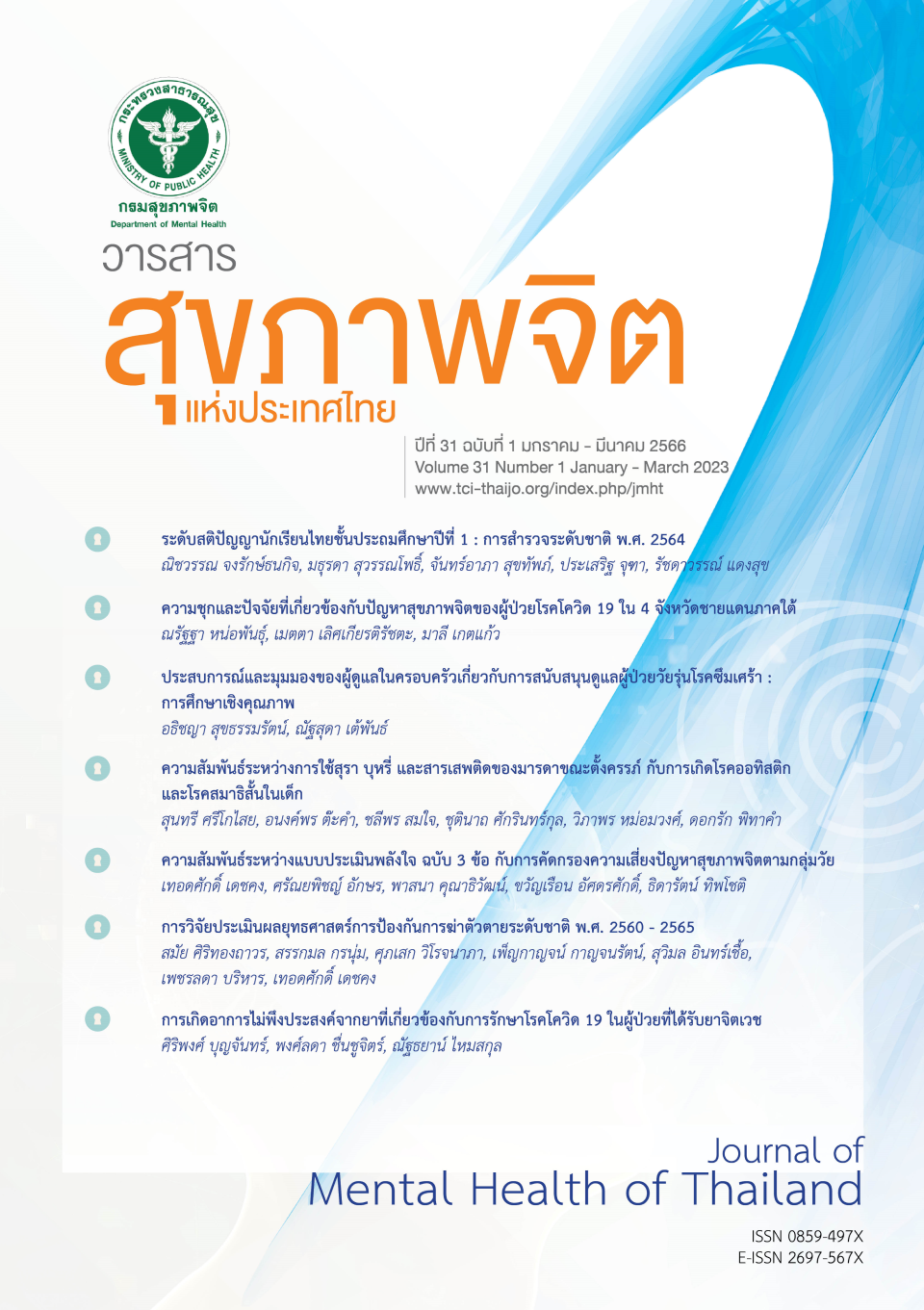
Intelligence quotient of Thai students in the first year of primary school: a national survey 2021
Keywords:
first-year primary school, intellectual disability, Thai studentsAbstract
Objective: To study the average and distribution of intelligence quotient (IQ) among Thai students in the first year of primary school in 2021.
Methods: This study used data from the intellectual quotient (IQ) and emotional quotient (EQ) of Thai students in the first year of primary schools and related factors, national survey 2021, conducted from December 2020 to December 2021. Representatives of the first-year primary school students from each province in Thailand were selected by using stratified three-stage sampling and assessed for IQ by using the standard progressive matrices by psychologists. Data were analyzed by using descriptive statistics with weighting.
Results: A total of 21,901 participants from 69 provinces completed the test, with a weighted average IQ of 102.8 (95% CI = 102.5 - 103.0). Of a total of 77 provinces in Thailand, 36 (46.7%) had an average IQ of higher than 100, 25 (32.4%) had an average IQ of approximately 100, and 8 (10.3%) had an average IQ of lower than 100. According to Wechsler’s IQ classification, 21.7% of the students had IQ lower than normal (IQ < 90), with 4.2% meeting intellectual disability (IQ < 70).
Conclusion: The average IQ of Thai first-year primary school students in 2021 was normal and higher than the international standards. However, the percentage of students with intellectual disability was higher than the international standard. Therefore, the development and intelligence promotion should be more emphasized in this group of children.
Downloads
References
Neisser U, Boodoo G, Bouchard TJ, Boykin AW, Brody N, Ceci SJ, et al. Intelligence: knowns and unknowns. Am Psychol. 1996;51(2):77-101. doi:10.1037/0003-066X.51.2.77.
Sternberg RJ. Intelligence. Dialogues Clin Neurosci. 2012;14(1):19-27. doi:10.31887/DCNS.2012.14.1/rsternberg.
Hindes Y, Schoenberg MR, Saklofske DH. Intelligence. In: Kreutzer JS, Deluca J, Caplan B, editors. Encyclopedia of Clinical Neuropsychology. New York: Springer; 2011. p. 1329-35.
Moore DS, Notz WI, Flinger MA. The Normal Distribution. In: Moore DS, Notz WI, Fligner MA, editors. The basic practice of statistics. 6th ed. New York: W.H.Freeman and Company; 2013.
Lyn R, Vanhanen T. IQ and the wealth of nations. Westport: Praeger Publishers; 2002.
Lynn R, Becker D. The intelligence of nations. London: Ulster Institute for Social Research; 2019.
Rindermann H. Relevance of education and intelligence at the national level for the economic welfare of people. Intelligence. 2008;36(2):127-42. doi:10.1016/j.intell.2007.02.002.
Raven J. Manual for Raven’s progressive matrices and vocabulary scales. Research supplement No.1: the 1979 British standardization of the standard progressive matrices and mill hill vocabulary scales, together with comparative data from earlier studies in the UK, US Canada, Germany and Ireland. Oxford: Oxford University Press; 1981.
Raven J, Raven JC, Court JH. Manual for Raven’s progressive matrices and vocabulary scales. section 3, standard progressive matrices: (including the parallel and plus versions). Oxford: Oxford University Press; 2004.
สุชีรา ภัทรายุตวรรตน์, กนกรัตน์ สุขะตุงคะ, จริยา จันตระ, วิลาสินี ชัยสิทธิ์, กีรติ บรรณกุลโรจน์, สร้อยสุดา อิ่มอรุณรักษ์. การสร้างเกณฑ์ปกติของแบบทดสอบ Standard Progressive Matrices ในกลุ่มประชากรไทย [The normative score of the standard progressive matrices for the Thai population]. วารสารสมาคมจิตแพทย์แห่งประเทศไทยไทย. 2543;45(1):45-57.
อภิชัย มงคล, ทวีศิลป์ วิษณุโยธิน, ปราณี ชาญณรงค์, โชษิตา ภาวสุทธิไพศิฐ, พรทิพย์ วชิรดิลก. สถานการณ์ระดับสติปัญญาเด็กนักเรียนไทย ปี 2554 [National intelligence quotient survey of Thai students in 2011]. วารสารสุขภาพจิตแห่งประเทศไทย. 2555;20(2):79-89.
จันทร์อาภา สุขทัพภ์, อัมพร เบญจพลพิทักษ์, วนิดา ชนินทยุทธวงศ์, ประเสริฐ จุฑา. ระดับสติปัญญานักเรียนไทยชั้นประถมศึกษาปีที่ 1 ประจำปี พ.ศ. 2559 [Intelligence quotient (IQ) of Thai students in the first year of primary school: national survey 2016]. วารสารสุขภาพจิตแห่งประเทศไทย. 2561;26(3):161-73.
กระทรวงสาธารณสุข. โครงการส่งเสริมพัฒนาการเด็กเฉลิมพระเกียรติสมเด็จพระเทพรัตนราชสุดาฯ สยามบรมราชกุมารี เนื่องในโอกาสฉลองพระชนมายุ 5 รอบ 2 เมษายน 2558. นนทบุรี: กระทรวงสาธารณสุข; 2558.
สำนักงานคณะกรรมการพัฒนาเศรษฐกิจและสังคมแห่งชาติ สำนักนายกรัฐมนตรี. แผนพัฒนาเศรษฐกิจและสังคมแห่งชาติ ฉบับที่ 12 พ.ศ. 2560 – 2564 [National economic and social development plan, no. 12, 2017-2021]. กรุงเทพฯ: สำนักงาน; 2559.
Wicherts JM, Dolan CV, Carlson JS, Van der Maas HLJ. Raven’s test performance of sub-Saharan Africans: average performance, psychometric properties and the Flynn effect. Learn Individ Differ. 2010:20(3);135-51. doi:10.1016/j.lindif.2009.12.001.
บัณฑิต ศรไพศาล, ปราณี ชาญณรงค์. การศึกษาทบทวนองค์ความรู้ด้านทฤษฎีและเครื่องมือประเมินระดับสติปัญญาและความฉลาดทางอารมณ์ (IQ และ EQ) เด็ก [A review of theoretical knowledge and a tool to assess intelligence and emotional intelligence (IQ and EQ) levels in children]. ปทุมธานี: โรงพิมพ์มหาวิทยาลัยธรรมศาสตร์; 2552.
ปราณี ชาญณรงค์, บัณฑิต ศรไพศาล. รายงานวิจัยการพัฒนาเครื่องมือวิจัยเชิงสำรวจสถานการณ์ระดับสติปัญญาเด็กไทย [The development of a survey research instrument for Intelligence Quotients (IQ) test of Thai children]. ปทุมธานี: โรงพิมพ์มหาวิทยาลัยธรรมศาสตร์; 2553.
Mungkhetklang C, Crewther SG, Bavin EL, Goharpey N, Parsons C. Comparison of measures of ability in adolescents with intellectual disability. Front Psychol. 2016;7:683. doi:10.3389/fpsyg.2016.00683.
Trahan LH, Stuebing KK, Fletcher JM, Hiscock M. The Flynn effect: a meta-analysis. Psychol Bull. 2014;140(5):1332-60. doi:10.1037/a0037173.
Flynn JR. Requiem for nutrition as the cause of IQ gains: Raven's gains in Britain 1938-2008. Econ Hum Biol. 2009;7(1):18-27. doi:10.1016/j.ehb.2009.01.009.
Lynn R. What has caused the Flynn effect? Secular increases in the Development Quotients of infants. Intelligence. 2009;37(1):16-24. doi:10.1016/j.intell.2008.07.008.
อัญชลี จุมพฎจามีกร. เชาวน์ปัญญาคืออะไร? [What is intelligence?] [อินเทอร์เน็ต]. กรุงเทพฯ: ภาควิชาจิตเวชศาสตร์ คณะแพทยศาสตร์โรงพยาบาลรามาธิบดี มหาวิทยาลัยมหิดล; [เข้าถึงเมื่อวันที่ 28 ก.ย. 2565]. จาก: https://www.rama.mahidol.ac.th/ramamental/generalknowledge/child/05152014-1100#:~:text=90%2D109,80%2D89
Deoni SC, Beauchemin J, Volpe A, Dâ Sa V. Impact of the COVID-19 pandemic on early child cognitive development: initial findings in a longitudinal observational study of child health. medRxiv [Preprint]. 2022:2021.08.10.21261846. doi:10.1101/2021.08.10.21261846.
Downloads
Published
How to Cite
Issue
Section
License
Copyright (c) 2023 Journal of Mental Health of Thailand

This work is licensed under a Creative Commons Attribution-NonCommercial-NoDerivatives 4.0 International License.
- Authorization to photocopy items for internal or personal use of specific clients, is granted. The consent does not extend to other kinds of copying, such as for general distribution, for advertising, or for resale.
- Unless otherwise states, the views and opinion expressed in Journal of Mental Health of Thailand are those of authors of the papers, and do not represent those of the editorial board or the Department of Mental Health.