
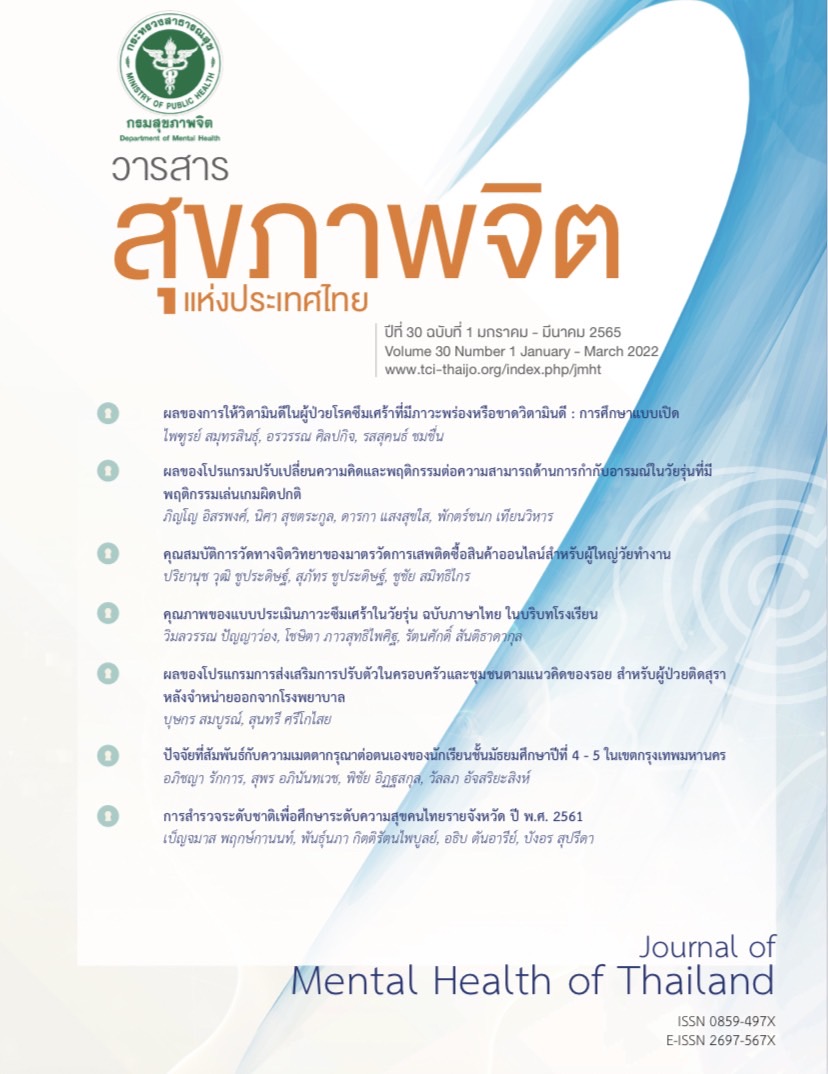
Effect of cognitive behavioral therapy program on emotional regulation in adolescent with gaming disorder
Keywords:
adolescents, cognitive behavioral therapy, emotional regulation, gaming disorderAbstract
Objective: 1) To develop the cognitive behavioral therapy (CBT) program on emotional regulation in adolescent with gaming disorder and 2) to compare the level of emotional regulation between a group that joined the program and a group that received the regular nursing care.
Methods: This research and development consists of two main steps: 1) program development consisting of problem definition, accumulation of building blocks for intervention design, intervention design, and intervention validation and 2) program evaluation. The participants were adolescents aged 15 to 18 years old who received consultation for gaming disorder at Child and Adolescent Mental Health Rajanagarindra Institute. The participants were assigned randomly to the experimental group that received the program (n = 28) and the control group that received the regular nursing care (n = 28). The emotion regulation questionnaire (ERQ) was assessed before joining the program, after the end of the program, within one-month, and three-months follow-up period. Data were analyzed by using independent t-test and repeated measures ANOVA.
Results: The developed CBT program was individual psychotherapy consisting of eight sessions within four weeks (30 - 90 minutes per session). The result showed that the emotional regulation score of the experimental group after the end of program were significantly higher than the score of the control group. Scores of the experimental group within one-month and three-months follow-up periods were significantly higher than before joining the program with a statistical significance at .01.
Conclusion: The CBT program on emotional regulation in adolescent with gaming disorder could be an optional nursing care for adolescents with gaming disorder and emotional regulation problem comorbidity.
Downloads
References
World Health Organization. Inclusion of “gaming disorder” in ICD-11 [Internet]. Geneva: World Health Organization; 2018 [cited 2020 Sep 18]. Available from https://www.who.int/news/item/14-09-2018-inclusion-of-gaming-disorder-in-icd-11
Mihara S, Higuchi S. Cross-sectional and longitudinal epidemiological studies of Internet gaming disorder: a systematic review of the literature. Psychiatry Clin Neurosci. 2017;71(7):425-44. doi:10.1111/pcn.12532.
ชาญวิทย์ พรนภดล, บัณฑิต ศรไพศาล, กุสุมาวดี คำเกลี้ยง, เสาวนีย์ พัฒนอมร. การพัฒนาแบบทดสอบการติดเกม [The development of game addiction screening test (GAST)]. วารสารสมาคมจิตแพทย์แห่งประเทศไทย. 2557;59(1):3-14.
วรุณา กลกิจโกวินท์, ชัยพร วิศิษฎ์พงศ์อารีย์, พิสาส์น เตชะเกษม, ชาญวิทย์ พรนภดล, บุษบา ศุภวัฒน์ธนบดี. การติดเกมส์คอมพิวเตอร์ ปัจจัยเสี่ยงและปัจจัยป้องกันของเด็กนักเรียนในเขตดุสิต กรุงเทพมหานคร [Computer game addiction: risk and protective factors in students in Dusit district, Bangkok]. วชิรเวชสาร. 2558;59(3):1-13.
ขวัญจิต เพ็งแป้น. การป้องกันปัญหาภาวะสุขภาพของเด็กติดเกมออนไลน์ [Preventing health problems of childhood addicted to online games]. วารสารราชธานีนวัตกรรมทางวิทยาศาสตร์สุขภาพ. 2560;1(1):16-30.
สุภาวดี เจริญวานิช. พฤติกรรมการติดเกม: ผลกระทบและการป้องกัน [Game addiction behaviors: impacts and preventions]. วารสารวิทยาศาสตร์และเทคโนโลยี. 2557;22(6 ฉบับพิศษ):871-79.
Fauth-Bühler M, Mann K. Neurobiological correlates of internet gaming disorder: similarities to pathological gambling. Addict Behav. 2017;64:349-56. doi:10.1016/j.addbeh.2015.11.004.
Dong G, Potenza MN. A cognitive-behavioral model of Internet gaming disorder: theoretical underpinnings and clinical implications. J Psychiatr Res. 2014;58:7-11. doi:10.1016/j.jpsychires.2014.07.005.
Carroll KM, Kiluk BD, Nich C, Babuscio TA, Brewer JA, Potenza MN, et al. Cognitive function and treatment response in a randomized clinical trial of computer-based training in cognitive-behavioral therapy. Subst Use Misuse. 2011;46(1):23-34. doi:10.3109/10826084.2011.521069.
Newman CF. Cognitive-behavioral therapy for alcohol and other substance use disorders: the beck model in action. J Cogn Ther. 2019;12:307-26. doi:10.1007/s41811-019-00051-9.
Beck AT, Wright FD, Newman CF, Liese BS. Cognitive therapy of substance abuse. New York: Guilford press; 1993.
ดาราวรรณ ต๊ะปินตา. การให้การปรึกษาโดยการปรับความคิดและพฤติกรรม [Cognitive behavior counseling]. วารสารพยาบาลสาร. 2558;42(ฉบับพิศษ):205-13.
Castagna PJ, Upton SR, Long AC. Cognitive behavior therapy for children with emotion regulation challenges. In Maykel C, Bray MA, editors. Promoting mind–body health in schools: interventions for mental health professionals. Washington: American Psychological Association; 2020. p. 317-33.
Stevens MWR, King DL, Dorstyn D, Delfabbro PH. Cognitive–behavioral therapy for Internet gaming disorder: a systematic review and meta-analysis. Clin Psychol Psychother. 2019;26(2):191-203. doi:10.1002/cpp.2341.
Torres-Rodríguez A, Griffiths MD, Carbonell X. The treatment of Internet gaming disorder: a brief overview of the PIPATIC program. Int J Ment Health Addict. 2018;16(4):1000-15. doi:10.1007/s11469-017-9825-0.
Pornnoppadol C, Ratta-apha W, Chanpen S, Wattananond S, Dumrongrungruang N, Thongchoi K, et al. A comparative study of psychosocial interventions for internet gaming disorder among adolescents aged 13-17 years. Int J Ment Health Addict. 2020;18:932-48. doi:10.1007/s11469-018-9995-4.
Gross JJ, John OP. Individual differences in two emotion regulation processes: implications for affect, relationships, and well-being. J Pers Soc Psychol. 2003;85(2):348-62. doi:10.1037/0022-3514.85.2.348.
van Meijel VB, Gamel C, van Swieten-Duijfjes B, Grypdonck MH. The development of evidence‐based nursing interventions: methodological considerations. J Adv Nurs. 2004;48(1):84-92. doi:10.1111/j.1365-2648.2004.03171.x.
จารุวรรณ ลิ้มไพบูลย์, ปาหนัน พิชยภิญโญ, สุรินธร กลัมพากร. ผลของโปรแกรมลดพฤติกรรมก้าวร้าวในวัยรุ่นตอนต้น [Effect of prevention program on aggressive behavior of early adolescents]. วารสารสุขภาพจิตแห่งประเทศไทย. 2554;19(1):160-170.
ณัฏฐลิณ คุ้มรอด. ผลของโปรแกรมการกำกับอารมณ์ต่ออาการซึมเศร้าในผู้ป่วยโรคซึมเศร้า [The effect of the emotion regulation program on depressive symptoms of patients with depressive disorder] [วิทยานิพนธ์ปริญญามหาบัณฑิต]. กรุงเทพฯ: คณะพยาบาลศาสตร์ จุฬาลงกรณ์มหาวิทยาลัย; 2558.
Hollon SD, Kendall PC. Cognitive self-statements in depression: development of an automatic thoughts questionnaire. Cogn Ther Res. 1980;4(4):383-95. doi:10.1007/BF01178214.
ลัดดา แสนสีหา. ความซึมเศร้าและความคิดอัตโนมัติในทางลบของวัยรุ่นตอนปลาย [Depression and negative automatic thoughts of late adolescents] [วิทยานิพนธ์ปริญญามหาบัณฑิต]. เชียงใหม่: บัณฑิตวิทยาลัย มหาวิทยาลัยเชียงใหม่; 2536.
ศิริไชย หงษ์สงวนศรี, พนม เกตุมาน. Game addiction: the crisis and solution [อินเทอร์เน็ต]. กรุงเทพฯ: คณะแพทยศาสตร์โรงพยาบาลรามาธิบดี มหาวิทยาลัยมหิดล; 2549 [สืบค้นเมื่อวันที่ 4 ก.ย. 2563]. จาก: https://med.mahidol.ac.th/ramamental/psychiatristknowledge/childpsychiatrist/06112015-1432
Mauss IB, Bunge SA, Gross JJ. Automatic emotion regulation. Soc Personal Psychol Compass. 2007;1(1):146-67. doi:10.1111/j.1751-9004.2007.00005.x.
พรพิมล พรมนัส. ผลของโปรแกรมการกำกับอารมณ์ต่อความสามารถทางอารมณ์และสังคมของเด็กที่มาจากครอบครัวหย่าร้าง [The effects of an emotion regulation program on the social and emotional competency of children from divorced families] [วิทยานิพนธ์ปริญญามหาบัณฑิต]. กรุงเทพฯ: คณะพยาบาลศาสตร์ มหาวิทยาลัยธรรมศาสตร์; 2561.
Zakaria S, Sasagawa S, Essau CA. Exploring the impact of a transdiagnostic cognitive behavioural therapy-based intervention on a group of Malaysian adolescents with problematic drug use and emotional problems. Addict Behav Rep. 2021;14:100381. doi:10.1016/j.abrep.2021.100381.
Henggeler SW, Sheidow AJ. Empirically supported family-based treatments for conduct disorder and delinquency in adolescents. J Marital Fam Ther. 2012;38(1):30-58. doi:10.1111/j.1752-0606.2011.00244.x.
Downloads
Published
How to Cite
Issue
Section
License
Copyright (c) 2022 Journal of Mental Health of Thailand

This work is licensed under a Creative Commons Attribution-NonCommercial-NoDerivatives 4.0 International License.
- Authorization to photocopy items for internal or personal use of specific clients, is granted. The consent does not extend to other kinds of copying, such as for general distribution, for advertising, or for resale.
- Unless otherwise states, the views and opinion expressed in Journal of Mental Health of Thailand are those of authors of the papers, and do not represent those of the editorial board or the Department of Mental Health.