
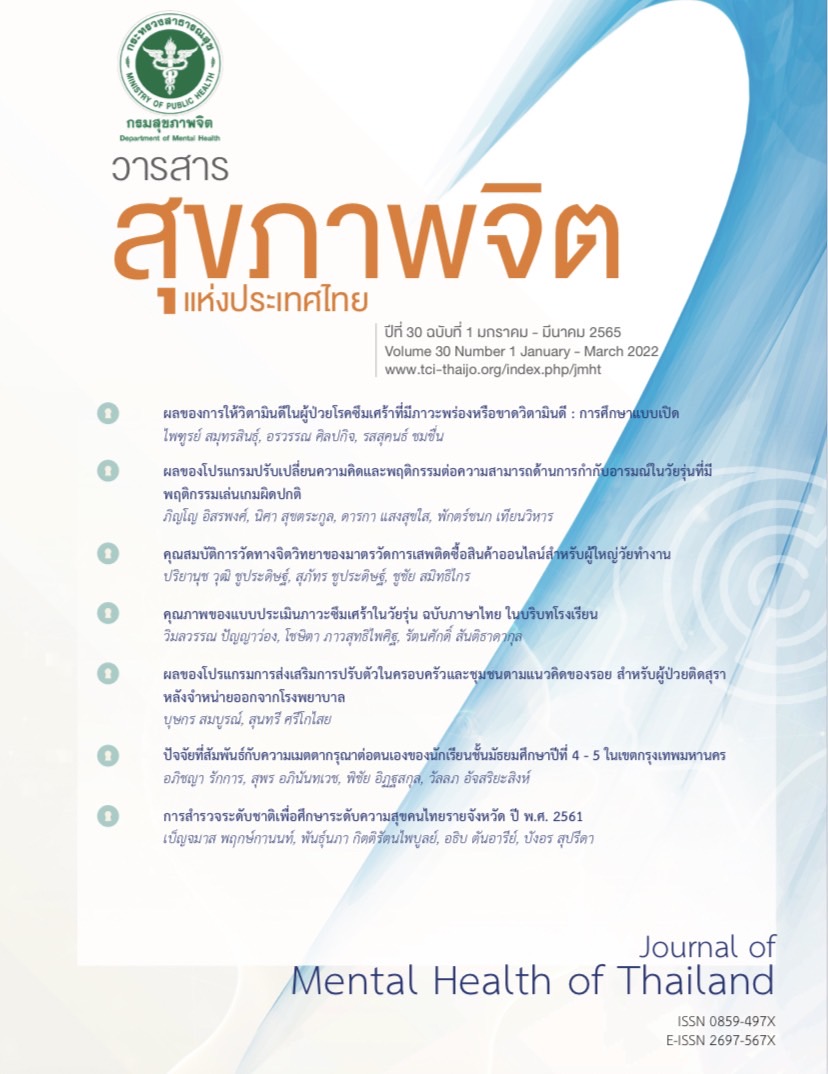
Validation of the Thai version of the Patient Health Questionnaire for Adolescents (PHQ-A) in school setting
Keywords:
adolescents, depression, patient health questionnaire for adolescents (PHQ-A), schoolAbstract
Objective: To examine the psychometric properties of the Thai version of the patient health questionnaire for adolescent (PHQ-A) in school settings.
Methods: This study was the second phase of the national survey on prevalence of depression and suicidal risks in 5,345 students aged 11 - 19 years old. A total of 292 subjects at risk of depression (PHQ-A ≥ 10) and 130 randomly selected controls (10% of those with negative screening results) in central region in the first phase were re-evaluated for depression by using the PHQ-A, and interviewed for clinical diagnosis by the child and adolescent psychiatrists. The validity and reliability tests of the PHQ-A were restricted to 389 subjects (69 depressive and 320 non-depressive subjects), excluding those diagnosed with anxiety or adjustment disorders.
Results: The PHQ-A has good internal consistency with Cronbach’s alpha coefficient of 0.88. According to ROC analysis compared to clinical diagnosis, the area under the curve (AUC) was 0.91 (SD = 0.02, 95% CI 0.88 - 0.94). The optimal cut-off point with preferable psychometric properties was 10 (sensitivity = 93% and specificity = 77%). Approximately 86% of the depressive group had the PHQ-A scores within moderate to severe level (10 - 19), while 77.5% of the non-depressive group had the PHQ-A scores lower than 10.
Conclusion: The Thai version of the PHQ-A is suitable for screening and monitoring depression in adolescents in school settings. The optimal cut-off point of 10 or higher is suggested, though it could be adjusted depending on the purpose of use.
Downloads
References
American Psychological Association. Clinical practice guideline for the treatment of depression across three age cohorts [Internet]. Washington, DC: American Psychological Association; 2019 [cited 2021 Nov 25]. Available from https://www.apa.org/depression-guideline.
Guidelines on mental health promotive and preventive interventions for adolescents: helping adolescents thrive. Executive summary. Geneva: World Health Organization; 2021.
World Health Organization (WHO). Mental health status of adolescents in south-east Asia: evidence for action [Internet]. New Delhi: World Health Organization, Regional Office for South-East Asia; 2017 [cited 2018 Nov 16]. Available from: http://apps.who.int/iris/handle/10665/254982
GBD 2015 Disease and Injury Incidence and Prevalence Collaborators. Global, regional, and national incidence, prevalence, and years lived with disability for 310 diseases and injuries, 1990–2015: a systematic analysis for the global burden of disease study 2015. Lancet. 2016;388(10053):1545-602. doi:10.1016/S0140-6736(16)31678-6.
Jones PB. Adult mental health disorders and their age at onset. Br J Psychiatry Suppl. 2013;54:s5-10. doi:10.1192/bjp.bp.112.119164.
Nelson J, Klumparendt A, Doebler P, Ehring T. Childhood maltreatment and characteristics of adult depression: meta-analysis. Br J Psychiatry. 2017;210(2):96-104. doi:10.1192/bjp.bp.115.180752.
World Health Organization. Health for the world’s adolescents: a second chance in the second decade. Geneva: World Health Organization; 2014.
World Health Organization. Depression and other common mental disorders: global health estimates. Geneva: World Health Organization; 2017.
ราชวิทยาลัยกุมารแพทย์แห่งประเทศไทย, ชมรมจิตแพทย์เด็กและวัยรุ่นแห่งประเทศไทย และสถาบันสุขภาพจิตเด็กและวัยรุ่นราชนครินทร์. คู่มือปฏิบัติการดูแลวัยรุ่นที่มีภาวะซึมเศร้า สำหรับบุคลากรสาธารณสุขและบุคลากรทางการศึกษา ตามแนวทางการดูแลวัยรุ่นที่มีภาวะซึมเศร้า [A practical guide to caring for adolescents with depression]. กรุงเทพฯ: บียอนด์ พับลิชชิ่ง; 2561.
Siu AL, US Preventive Services Task Force. Screening for depression in children and adolescents: US preventive services task force recommendation statement. Pediatrics. 2016;137(3):e20154467. doi:10.1542/peds.2015-4467.
Zuckerbrot RA, Cheung A, Jensen PS, Stein REK, Laraque D, GLAD-PC steering group. Guidelines for adolescent depression in primary care (GLAD-PC): Part I. Practice preparation, identification, assessment, and initial management. Pediatrics. 2018;141(3);e20174081. doi:10.1542/peds.2017-4081.
National Institute for Health and Care Excellence (NICE). Depression in children and young people: identification and management [NICE guideline no. 134]. National Institute for Health and Care Excellence; 2019 [cited 2021 Nov 25]. Available from: www.nice.org.uk/guidance/ng134
Panyawong W, Pavasuthipaisit C, Santitadakul R. Validation of the Thai version of the patient health questionnaire for adolescents (PHQ-A) in adolescent psychiatric patients. Int J Child Dev Ment Health. 2020;8(1);30-40.
Kronke K, Spitzer RL, Williams JB. The PHQ-9: validity of a brief depression severity measure. J Gen Intern Med. 2001;16(9):606-13. doi:10.1046/j.1525-1497.2001.016009606.x.
Johnson JG, Harris ES, Spitzer RL, Williams JBW. The patient health questionnaire for adolescents: validation of an instrument for the assessment of mental disorders among adolescent primary care patients. J Adolesc Health. 2002;30(3):196-204. doi:10.1016/s1054-139x(01)00333-0.
Beirão D, Monte H, Amaral M, Longras A, Matos C, Villas-Boas F. Depression in adolescence: a review. Middle East Curr Psychiatry. 2020;27(50). doi:10.1186/s43045-020-00050-z.
วิมลวรรณ ปัญญาว่อง, รัตนศักดิ์ สันติธาดากุล, โชษิตา ภาวสุทธิไพศิฐ. ความชุกของภาวะซึมเศร้าและความเสี่ยงฆ่าตัวตายในวัยรุ่นไทย: การสำรวจโรงเรียนใน 13 เขตสุขภาพ [Prevalence of depression and suicidal risks in Thai adolescents: a survey in schools from 13 health areas]. วารสารสุขภาพจิตแห่งประเทศไทย. 2563;28(2):136-49.
สำนักนโยบายและยุทธศาสตร์ กระทรวงสาธารณสุข. ประชากรกลางปี 59 [Mid population 2559] [อินเทอร์เน็ต]. นนทบุรี: กระทรวงสาธารณสุข; 2560 [สืบค้นเมื่อวันที่ 15 ม.ค. 2561]. จาก: http://bps.moph.go.th/new_bps/sites/default/files/Mid%20Population%202559.pdf
Krejcie RV, Morgan DW. Determining sample size for research activities. Educ Psychol Meas. 1970;30(3):607-10.
Thapar A, Collishaw S, Pine DS, Thapar AK. Depression in adolescence. Lancet. 2012;379(9820):1056-67. doi:10.1016/S0140-6736(11)60871-4.
Manea L, Gilbody S, McMillan D. Optimal cut-off score for diagnosing depression with the patient health questionnaire (PHQ-9): a meta-analysis. CMAJ. 2012;184(3):e191-6. doi:10.1503/cmaj.110829.
American Psychiatric Association. Diagnostic and statistical manual of mental disorder. 5th ed. Arlington VA: American Psychiatric Association; 2013. p. 155-88.
Busner J, Targum SD. The clinical global impressions scale: applying a research tool in clinical practice. Psychiatry (Edgmont). 2007;4(7):29-37.
Kroenke K, Spitzer RL, Williams JBW, Löwe B. The patient health questionnaire somatic, anxiety, and depressive symptom scales: a systematic review. Gen Hosp Psychiatry. 2010;32:345-59. doi:10.1016/j.genhosppsych.2010.03.006
Richardson LP, McCauley E, Grossman DC, McCarty CA, Richards J, Russo JE, et al. Evaluation of the patient health questionnaire-9 item for detecting major depression among adolescents. Pediatrics. 2010;126(6):1117-23. doi:10.1542/peds.2010-0852.
Tsai FJ, Huang YH, Liu HC, Huang KY, Huang YH, Liu SI. Patient health questionnaire for school-based depression screening among Chinese adolescents. Pediatrics. 2014;133(2):e402e9. doi:10.1542/peds.2013-0204.
Du N, Yu K, Ye Y, Chen. Validity study of patient health questionnaire‐9 items for internet screening in depression among Chinese university students. Asia Pac Psychiatry. 2017;9:e12266. doi:10.1111/appy.12266.
Ganguly S, Samanta M, Roy P, Chatterjee S, Kaplan DW, Basu B. Patient health questionnaire-9 as an effective tool for screening of depression among Indian adolescents. J Adolesc Health. 2013;52:546-51. doi:10.1016/j.jadohealth.2012.09.012.
Naveed S, Waqas A, Memon AR, Jabeen M, Sheikh MH. Cross-cultural validation of the Urdu translation of the patient health questionnaire for adolescents among children and adolescents at a Pakistani school. Public Health. 2019;168:59-66. doi:10.1016/j.puhe.2018.11.022.
Law WC, McClanahan R, Weismuller PC. Depression screening in the school setting identification of the depressed adolescent. NASN Sch Nurse. 2017;32(6):364-70. doi:10.1177/1942602X17726095.
Downloads
Published
How to Cite
Issue
Section
License
Copyright (c) 2022 Journal of Mental Health of Thailand

This work is licensed under a Creative Commons Attribution-NonCommercial-NoDerivatives 4.0 International License.
- Authorization to photocopy items for internal or personal use of specific clients, is granted. The consent does not extend to other kinds of copying, such as for general distribution, for advertising, or for resale.
- Unless otherwise states, the views and opinion expressed in Journal of Mental Health of Thailand are those of authors of the papers, and do not represent those of the editorial board or the Department of Mental Health.