
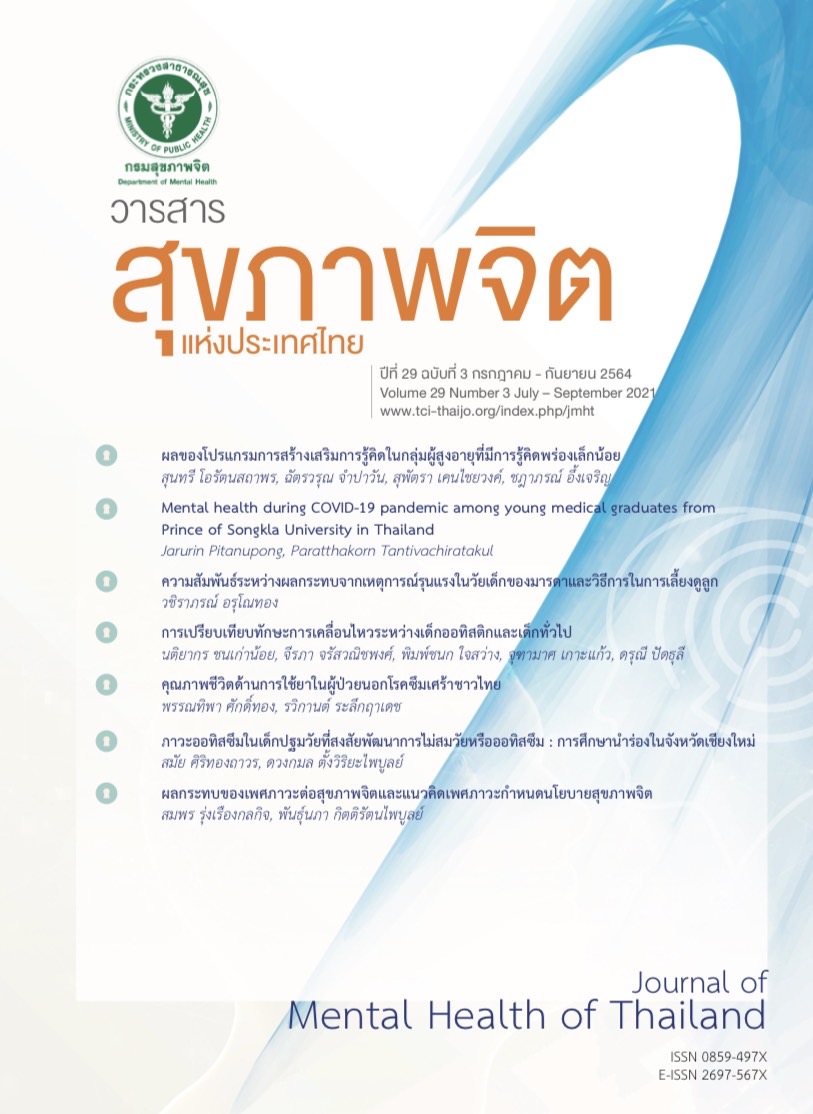
A comparison of motor skills in children with autism spectrum disorder and typically developing children
Keywords:
autism spectrum disorder, developmental age, motor skillAbstract
Objective: To explore the motor skill deficits in children with autism spectrum disorder (ASD) and to compare the motor skills between children with autism spectrum disorder and typically developing children.
Methods: Sixty children (ASD group and typical development group, 30 each) aged between 3 and 5 years old included in this study. Motor skills were assessed using three subtests of the Peabody Development Motor Scale-2 (PDMS-2) as follows; ability to sustain posture when not moving, ability to move from one place to another, and ability to manipulate object. The raw scores were converted to standard scores and developmental age for comparison with chronological age. Sum of score in three subtests was converted to gross motor quotient (GMQ) to indicate level of gross motor skill deficit. Data were analyzed using descriptive statistics and comparative statistics including the independent samples t-test and paired sample t-test.
Results: Children with ASD had lower standard scores in ability to sustain posture when not moving, ability to move from one place to another, and ability to manipulate object than typically developing children of the same age and sex. In addition, their developmental age was significantly less than chronological age in all skills (p < .001). The GMQ scores of children with ASD were mostly in below average level, especially for the ability to sustain posture when not moving.
Conclusion: Children with ASD aged 3 and 5 years old had lower motor skills than typically developing children and all their skills were in deficit level. The physical therapy should be considered to prevent further movement problems.
Downloads
References
Lord C, Bishop SL. Recent advances in autism research as reflected in DSM-5 criteria for autism spectrum disorder. Annu Rev Clin Psychol. 2015;11:53–70. doi:10.1146/annurev-clinpsy-032814-112745.
Christensen DL, Maenner MJ, Bilder D, Constantino JN, Daniels J, Durkin MS, et al. Prevalence and characteristics of autism spectrum disorder among children aged 4 years - early autism and developmental disabilities monitoring network, seven sites, United States, 2010, 2012, and 2014. MMWR Surveill Summ. 2019;68(2):1-19. doi:10.15585/mmwr.ss6802a1.
สถาบันราชานุกูล กรมสุขภาพจิต. เด็กออทิสติก คู่มือสำหรับพ่อแม่/ผู้ปกครอง [Autistic children a parent/guardian's guide]. พิมพ์ครั้งที่ 3. กรุงเทพฯ: โรงพิมพ์ชุมนุมสหกรณ์การเกษตรแห่งประเทศไทยจำกัด; 2557.
เพ็ญแข ลิ่มศิลา. การวินิจฉัยออทิสซึม [Diagnosis of autism]. สมุทรปราการ: ช.แสงงามการพิมพ์; 2540.
Autistic society of America. What is autism? [Internet]. Maryland USA; 2020 [cited 2020 Mar 31]. Available from: http://www.autism-society.org/what-is/.
ศรีวรรณา พูลสรรพสิทธิ์, เบญจพร ปัญญายง, ดุสิต ลิขนะพิชิตกุล, ประยุกต์ เสรีเสถียร, วรรณา จุฑา. การศึกษาภาวะออทิซึมในประเทศไทยและการดูแลรักษาแบบบูรณาการในระดับประเทศ [Holistic care for Thai autism]. วารสารสุขภาพจิตแห่งประเทศไทย. 2548;13(1):10-6.
American Psychiatric Association. Diagnostic and statistical manual of mental disorders. 5th ed. Arlington, VA: American Psychiatric Association; 2013.
Teitelbaum P, Teitelbaum O, Nye J, Fryman J, Maurer RG. Movement analysis in infancy may be useful for early diagnosis of autism. Proc Natl Acad Sci USA. 1998;95(23):13982-7. doi:10.1073/pnas.95.23.13982.
Ketcheson L, Hauck JL, Ulrich D. The levels of physical activity and motor skills in young children with and without autism spectrum disorder, aged 2-5 years. Autism. 2018;22(4):414-23. doi:10.1177/1362361316683889.
Provost B, Lopez BR, Heimerl S. A comparison of motor delays in young children: Autism Spectrum Disorder, Developmental Delay, and Developmental Concerns. J Autism Dev Disord. 2007;37(2):321-8.11. doi:10.1007/s10803-006-0170-6.
Pan CY, Tsai CL, Chu CH. Fundamental movement skills in children diagnosed with autism spectrum disorders and attention deficit hyperactivity disorder. J Autism Dev Disord. 2009;39(12):1694-705. doi:10.1007/s10803-009-0813-5.
Ketcheson. L, Hauck. JL, Ulrich D. The effects of an early motor skill intervention on motor skills, levels of physical activity, and socialization in young children with autism spectrum disorder: A pilot study. Autism. 2017;21(4):481-92. doi:10.1177/1362361316650611.
Holloway JM, Long T, Biasini F. Concurrent validity of two standardized measures of gross motor function in young children with autism spectrum disorder. Phys Occup Ther Pediatr. 2019;39(2):193-203. doi:10.1080/01942638.2018.1432006.
Tavasoli A, Azimi P, Montazari A. Reliability and validity of the peabody developmental motor scales-second edition for assessing motor development of low birth weight preterm infants. Pediatr Neurol. 2014;51(4):522-6. doi:10.1016/j.pediatrneurol.2014.06.010.
Bremer E, Balogh R, Lloyd M. Effectiveness of a fundamental motor skill intervention for 4-year-old children with autism spectrum disorder: A pilot study. Autism. 2015;19(8):980-91. doi:10.1177/1362361314557548.
Wang. H-H, Liao. H-F, Hsieh C-L. Reliability, sensitivity to change, and responsiveness of the peabody developmental motor scales-second edition for children with cerebral palsy. Phys Ther. 2006;86(10):1351-9. doi:10.2522/ptj.20050259.
Folio. MR, Fewell RR. Peabody developmental motor scales examiner's manual. 2nd ed. Texas USA: Pro-Ed; 2000.
พรรณี ปิติสุทธิธรรม, ชยันต์ พิเชียรสุนทร, บรรณาธิการ. ตำราการวิจัยทางคลินิก ฉบับปรับปรุงใหม่ [Textbook of clinical research fourth edition revised and expanded]. พิมพ์ครั้งที่ 4. กรุงเทพฯ: คณะเวชศาสตร์เขตร้อน มหาวิทยาลัยมหิดล; 2561.
Holloway JM, Long TM, Biasini F. Relationships between gross motor skills and social function in young boys with autism spectrum disorder. Pediatr Phys Ther. 2018;30(3):184-90. doi:10.1097/PEP.0000000000000505.
Provost B, Hemimerl S, Lopez BR. Levels of gross and fine motor development in young children with autism spectrum disorder. Phys Occup Ther Pediatr. 2007;27(3):21-36.
Green D, Baird G, Barnett AL, Henderson L, Huber J, Henderson SE. The severity and nature of motor impairment in asperger’s syndrome: a comparison with specific developmental disorder of motor function. J Child Psychol Psychiatry. 2002;43(5):655- 68. doi:10.1111/1469-7610.00054.
Kaur M, Srinivasan S, Bhat A. Comparing motor performance, praxis, coordination, and interpersonal synchrony between children with and without autism spectrum disorder (ASD). Res Dev Disabil. 2018;72:79-95. doi:10.1016/j.ridd.2017.10.025.
Pusponegoro HD, Efar P, Soedjatmiko, Soebadi A, Firmansyah A, Chen HJ, et al. Gross motor profile and its association with socialization skills in children with autism spectrum disorders. Pediatr Neonatol. 2016;57(6):501-507. doi: 10.1016/j.pedneo.2016.02.004.
Wu YT, Tsao CH, Huang HC, Yang TA, Li YJ. Relationship between motor skills and language abilities in children with autism spectrum disorder. Phys Ther. 2021;101(5):pzab033. doi:10.1093/ptj/pzab033.
Lane A, Harpster K, Heathcock J. Motor characteristics of young children referred for possible autism spectrum disorder. Pediatr Phys Ther. 2012;24(1):21-9. doi:10.1097/PEP.0b013e31823e071a.
Lim YH, Partridge K, Girdler S, Morris SL. Standing postural control in individuals with autism spectrum disorder: systematic review and meta-analysis. J Autism Dev Disord. 2017;47(7):2238–53. doi: 10.1007/s10803-017- 3144-y.
Connolly BH, McClune NO, Gatlin R. Concurrent validity of the Bayley-III and the peabody developmental motor scale-2. Pediatr Phys Ther. 2012;24(4):345-52. doi:10.1097/PEP.0b013e318267c5cf.
Downloads
Published
How to Cite
Issue
Section
License
- Authorization to photocopy items for internal or personal use of specific clients, is granted. The consent does not extend to other kinds of copying, such as for general distribution, for advertising, or for resale.
- Unless otherwise states, the views and opinion expressed in Journal of Mental Health of Thailand are those of authors of the papers, and do not represent those of the editorial board or the Department of Mental Health.