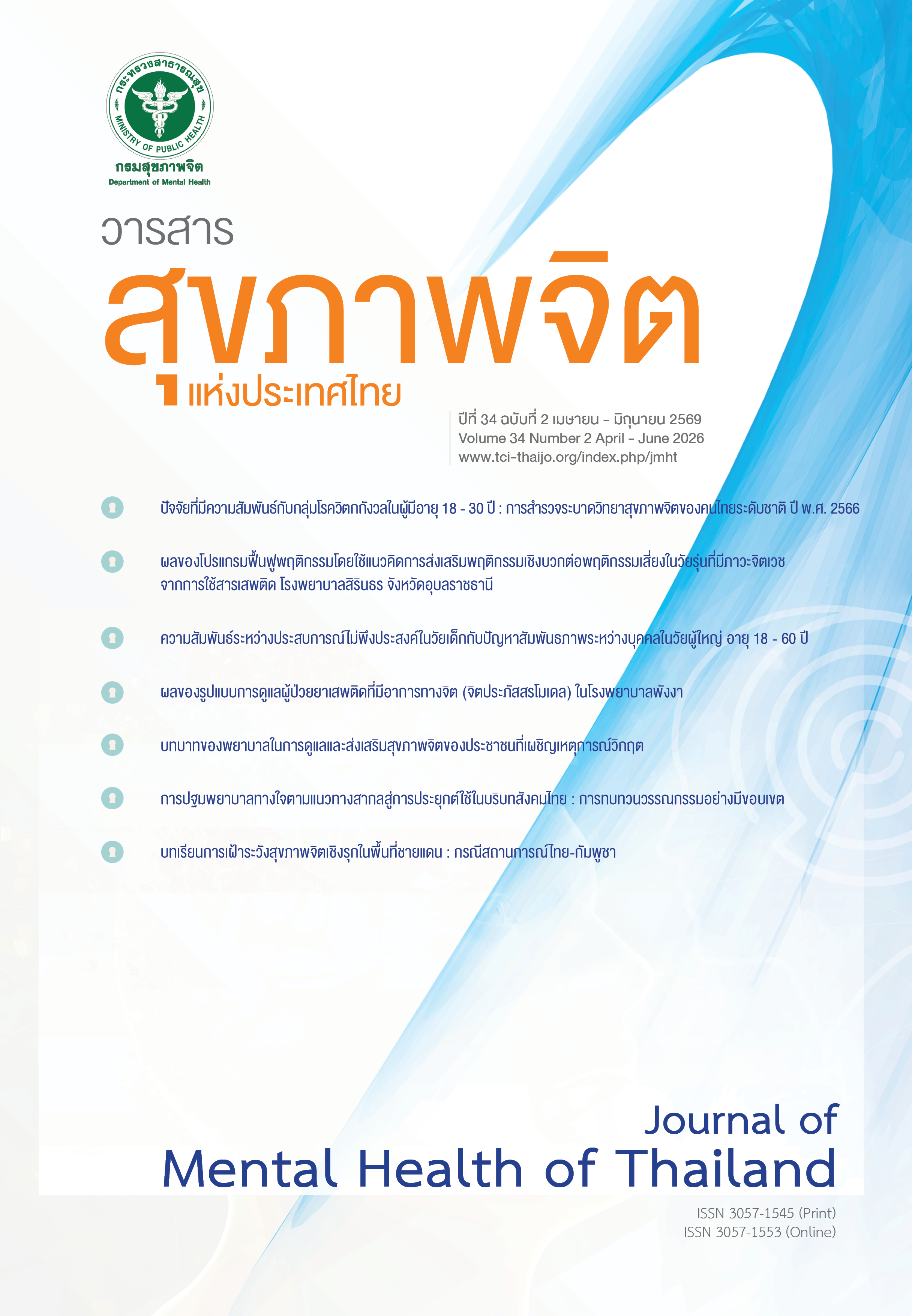
บทบาทของพยาบาลในการดูแลและส่งเสริมสุขภาพจิตของประชาชนที่เผชิญเหตุการณ์วิกฤต
DOI:
https://doi.org/10.64838/jmht.2026.285107คำสำคัญ:
การดูแลสุขภาพจิต, การปฐมพยาบาลทางจิตใจ, บทบาททางการพยาบาล, โรคเครียดหลังเผชิญเหตุการณ์สะเทือนขวัญ, เหตุการณ์วิกฤตบทคัดย่อ
วัตถุประสงค์ : เพื่อทบทวนบทบาทของพยาบาลในการดูแลและส่งเสริมสุขภาพจิตของประชาชนที่เผชิญเหตุการณ์วิกฤต และแนวปฏิบัติเพื่อลดความรุนแรงของปฏิกิริยาความเครียดเฉียบพลันและโรคเครียดหลังเผชิญเหตุการณ์สะเทือนขวัญ (post-traumatic stress disorder: PTSD)
วิธีการ : การทบทวนวรรณกรรมแบบพรรณนาโดยสืบค้นจากฐานข้อมูลวิชาการ PubMed, CINAHL, Scopus และ ThaiJO ครอบคลุมงานวิจัย บทความวิชาการ รวมถึงคู่มือและแนวปฏิบัติขององค์กรระหว่างประเทศ ที่ตีพิมพ์ระหว่างปี พ.ศ. 2558 - 2568 และมีเนื้อหาเกี่ยวข้องกับบทบาทของพยาบาลในการดูแลสุขภาพจิตผู้ประสบเหตุการณ์วิกฤตหรือเป็นแนวปฏิบัติที่ได้รับการยอมรับในระดับสากล
ผล : เอกสารที่ผ่านการคัดเลือกจำนวน 26 รายการ มีเนื้อหาครอบคลุมการดูแลทางการพยาบาลในระยะฉุกเฉิน ระยะเฉียบพลัน และระยะฟื้นฟู โดยพยาบาลมีบทบาทสำคัญในการประเมินความเสี่ยงและคัดกรองอาการทางจิตใจ การให้ความช่วยเหลือทางจิตใจเบื้องต้น การให้สุขภาพจิตศึกษา การสนับสนุนครอบครัว และการส่งเสริมการฟื้นตัว แนวทางสำคัญที่สามารถนำมาประยุกต์ใช้ในการปฏิบัติงาน ได้แก่ การปฐมพยาบาลทางจิตใจ (PFA) การดูแลที่คำนึงถึงบาดแผลทางจิตใจ (TIC) การบำบัดทางความคิดและพฤติกรรมที่มุ่งเน้นบาดแผลทางจิตใจ (TF-CBT) และโปรแกรมปฏิบัติการเพื่อลดช่องว่างทางสุขภาพจิต (mhGAP) อย่างไรก็ตาม ยังพบช่องว่างด้านเครื่องมือคัดกรองและแนวทางการดูแล PTSD ที่สอดคล้องกับบริบทไทย รวมถึงระบบส่งต่อ การดูแลต่อเนื่อง และการดูแลสุขภาพจิตของบุคลากรด่านหน้า
สรุป : พยาบาลเป็นกำลังสำคัญในการดูแลสุขภาพจิตผู้เผชิญเหตุการณ์วิกฤต การเสริมสร้างความรู้และทักษะด้านสุขภาพจิตให้แก่พยาบาล ตลอดจนการพัฒนาแนวทางการดูแลที่เหมาะสมกับบริบทไทย อาจช่วยเสริมสร้างความเข้มแข็งของระบบสุขภาพในการรับมือกับเหตุการณ์วิกฤตในอนาคต
Downloads
เอกสารอ้างอิง
Koenen KC, Ratanatharathorn A, Ng L, McLaughlin KA, Bromet EJ, Stein DJ, et al. Posttraumatic stress disorder in the World Mental Health Surveys. Psychol Med. 2017;47(13):2260-74. DOI: https://doi.org/10.1017/S0033291717000708
World Health Organization. World mental health report: transforming mental health for all. Geneva: World Health Organization; 2022.
Eckstein D, Künzel V, Schäfer L. Global climate risk index 2021. Bonn: Germanwatch; 2021.
American Psychiatric Association. Clinical practice guideline for the treatment of posttraumatic stress disorder (PTSD) in adults [Internet]. Washington, DC: American Psychiatric Association; 2017 [cited 2026 Mar 17]. Available from: https://www.apa.org/ptsd-guideline
Ogińska-Bulik N, Gurowiec PJ, Michalska P, Kędra E. Prevalence and predictors of secondary traumatic stress symptoms in health care professionals working with trauma victims: a cross-sectional study. PLoS One. 2021;16(2):e0247596. DOI: https://doi.org/10.1371/journal.pone.0247596
World Health Organization. Mental health in emergencies [Internet]. Geneva: World Health Organization; 2025 [cited 2026 Mar 17]. Available from: https://www.who.int/news-room/fact-sheets/detail/mental-health-in-emergencies
American Psychiatric Association. Diagnostic and Statistical Manual of Mental Disorders. 5th ed. Text revision (DSM-5-TR). Washington, DC: American Psychiatric Association; 2022. DOI: https://doi.org/10.1176/appi.books.9780890425787
Isobel S, Thomas M. Vicarious trauma and nursing: an integrative review. Int J Ment Health Nurs. 2022;31(2):247-59. DOI: https://doi.org/10.1111/inm.12953
Substance Abuse and Mental Health Services Administration. SAMHSA's concept of trauma and guidance for a trauma-informed approach. Rockville, MD: Substance Abuse and Mental Health Services Administration; 2014.
Udomratn P. Mental health and the psychosocial consequences of natural disasters in Asia. Int Rev Psychiatry. 2008;20(5):441-44. DOI: https://doi.org/10.1080/09540260802397487
Pratummanee W, Sangsuwan T, Jatchavala C, Sirirak T. Facing the pandemic aftermath: exploring depression and mental health service usage among first-year university students in southern Thailand. Front Psychiatry. 2025;16:1555361. DOI: https://doi.org/10.3389/fpsyt.2025.1555361
Gülirmak Güler K, Uzun S, Emirza EG. Secondary traumatic stress and coping experiences in psychiatric nurses caring for trauma victims: a phenomenological study. J Psychiatr Ment Health Nurs. 2025;32(2):402-13. DOI: https://doi.org/10.1111/jpm.13121
Mealer ML, Shelton A, Berg B, Rothbaum B, Moss M. Increased prevalence of post-traumatic stress disorder symptoms in critical care nurses. Am J Respir Crit Care Med. 2007;175(7):693-7. DOI: https://doi.org/10.1164/rccm.200606-735OC
World Health Organization, War Trauma Foundation, World Vision International. Psychological first aid: guide for field workers. Geneva: World Health Organization; 2011.
Songkhla Rajanagarindra Psychiatric Hospital, Mental Health Service System Administration Division, Department of Mental Health. Mental Health Crisis Assessment and Treatment Team (MCATT) operational manual (revised edition) [Internet]. Nonthaburi: Department of Mental Health; 2024 [cited 2026 Jun 14]. Available from: https://www.dmh-elibrary.org/items/show/2103 (in Thai).
World Health Organization. Mental health and social connection in Thailand [Internet]. Geneva: World Health Organization; 2025 [cited 2026 Mar 17]. Available from: https://www.who.int/thailand/news/feature-stories/detail/mental-health-and-social-connection-in-thailand
World Health Organization. mhGAP intervention guide for mental, neurological and substance use disorders in non-specialized health settings: mental health Gap Action Programme (mhGAP) - version 2.0. Geneva: World Health Organization; 2016.
Selçuk AA. A guide for systematic reviews: PRISMA. Turk Arch Otorhinolaryngol. 2019;57(1):57-8. DOI: https://doi.org/10.5152/tao.2019.4058
Forkey H, Szilagyi M, Kelly ET, Duffee J. Trauma-informed care. Pediatrics. 2021;148(2):e2021052580. DOI: https://doi.org/10.1542/peds.2021-052580
Meinhausen C, Fu K, Urbina RD, Gunby T, Perez LA, Wilson PA, et al. Efficacy of interventions for posttraumatic stress disorder symptoms induced by traumatic medical events: a systematic review. Health Psychol Rev. 2025;19(4):820-38. DOI: https://doi.org/10.1080/17437199.2025.2526666
Serpeloni F, Köbach A, Chibashimba A, Crombach A, Domen I, Arango I, et al. Addressing the burden of violence on global mental health: contributions of Narrative Exposure Therapy across different health systems. Cad Saude Publica. 2025;41(9):e00199124. DOI: https://doi.org/10.1590/0102-311xen199124
Delahanty DL, Nugent NR. Predicting PTSD prospectively based on prior trauma history and immediate biological responses. Ann N Y Acad Sci. 2006;1071(1):27-40. DOI: https://doi.org/10.1196/annals.1364.003
Bryant RA. Acute stress disorder as a predictor of posttraumatic stress disorder: a systematic review. J Clin Psychiatry. 2011;72(2): 233-9. DOI: https://doi.org/10.4088/JCP.09r05072blu
Padinha S, Fernandes JB, Castro C. Nursing Interventions in approaching trauma victims: scoping review. J Clin Med. 2025;14(9):3016. DOI: https://doi.org/10.3390/jcm14093016
Bryant RA, Creamer M, O’Donnell M, Forbes D, McFarlane AC, Silove D, et al. Acute and chronic posttraumatic stress symptoms in the emergence of posttraumatic stress disorder: a network analysis. JAMA Psychiatry. 2017;74(2):135-42. DOI: https://doi.org/10.1001/jamapsychiatry.2016.3470
O’Malley KA, Sullivan JL, Mills W, Driver J, Moye J. Trauma-informed care in long-term care settings: from policy to practice. Gerontologist. 2023;63(5):803-11. DOI: https://doi.org/10.1093/geront/gnac072
Rose SC, Bisson J, Churchill R, Wessely S. Psychological debriefing for preventing post traumatic stress disorder (PTSD). Cochrane Database Syst Rev. 2002;(2):CD000560. DOI: https://doi.org/10.1002/14651858.CD000560
Menschner C, Maul A. Key ingredients for successful trauma-informed care implementation [Internet]. Trenton (NJ): Center for Health Care Strategies; 2016 [cited 2026 Jun 14]. Available from: https://www.chcs.org/media/ATC_whitepaper_040616.pdf
Cohen JA, Mannarino AP, Deblinger E. Treating trauma and traumatic grief in children and adolescents. 2nd ed. New York: Guilford Press; 2017.
World Health Organization. mhGAP humanitarian intervention guide (mhGAP-HIG): clinical management of mental, neurological and substance use conditions in humanitarian emergencies [Internet]. Geneva: World Health Organization; 2015 [cited 2026 Jun 14]. Available from: https://www.who.int/publications/i/item/9789241548922
National Institute for Health and Care Excellence. Post-traumatic stress disorder (NICE guideline NG116) [Internet]. London: National Institute for Health and Care Excellence; 2018 [cited 2026 Jun 14]. Available from: https://www.nice.org.uk/guidance/ng116
ดาวน์โหลด
เผยแพร่แล้ว
รูปแบบการอ้างอิง
ฉบับ
ประเภทบทความ
สัญญาอนุญาต
ลิขสิทธิ์ (c) 2026 วารสารสุขภาพจิตแห่งประเทศไทย

อนุญาตภายใต้เงื่อนไข Creative Commons Attribution-NonCommercial-NoDerivatives 4.0 International License.
- ผู้อ่านสามารถนำข้อความ ข้อมูล จากวารสารไปใช้ไปใช้ประโยชน์ทางวิชาการได้ เช่น เพื่อการสอน เพื่อการอ้างอิง แต่การนำไปใช้เพื่อวัตถุประสงค์อื่น เช่น เพื่อการค้า จะต้องได้รับอนุญาตเป็นลายลักษณ์อักษรจากกรมสุขภาพจิตก่อน
- ความคิดเห็น ข้อมูล และบทสรุปต่าง ๆ ที่ลงตีพิมพ์ในวารสารสุขภาพจิตแห่งประเทศไทยเป็นของผู้เขียนบทความและมิได้แสดงว่ากองบรรณาธิการหรือกรมสุขภาพจิตเห็นพ้องด้วย