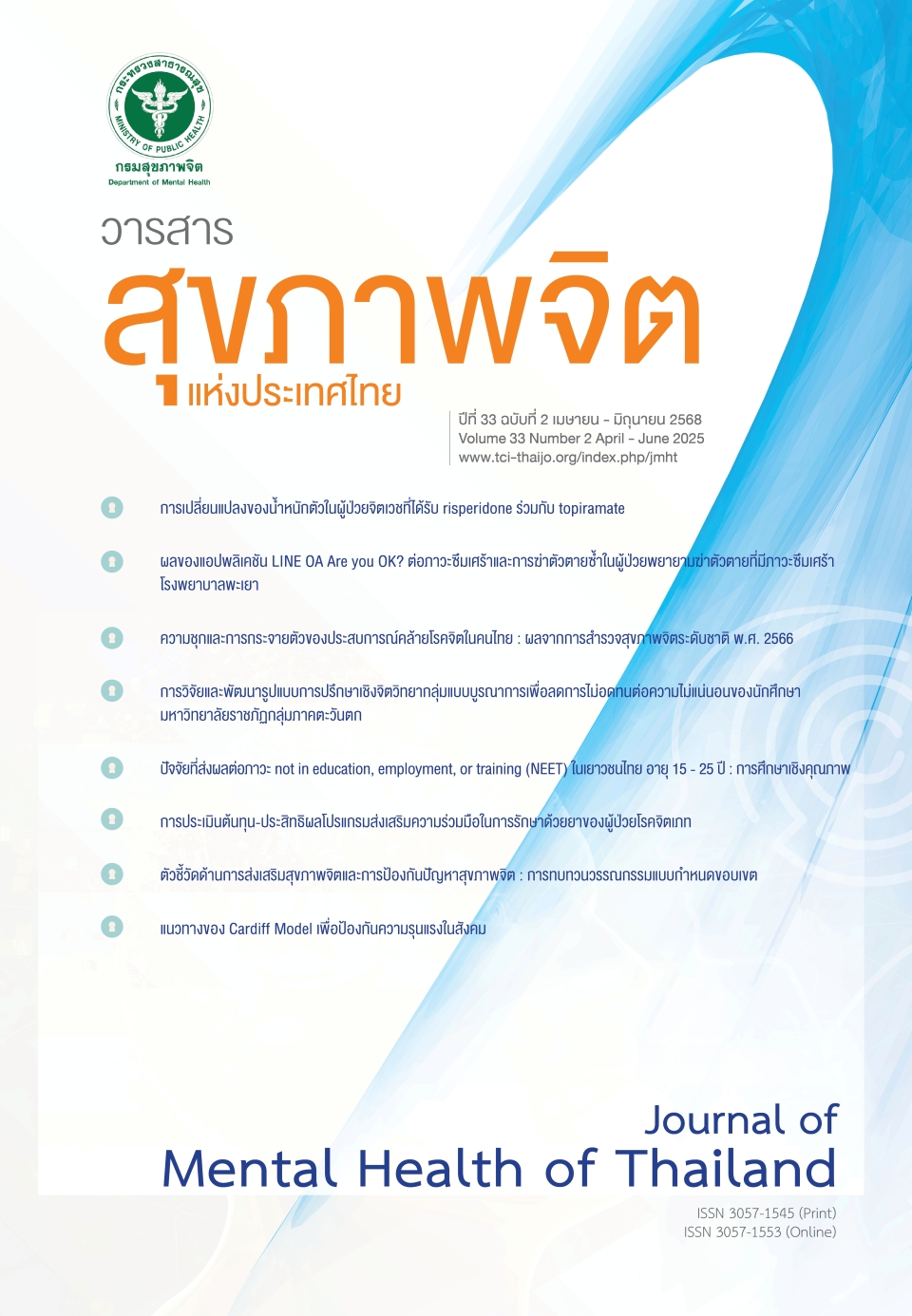
การวิจัยและพัฒนารูปแบบการปรึกษาเชิงจิตวิทยากลุ่มแบบบูรณาการเพื่อลดการไม่อดทนต่อความไม่แน่นอนของนักศึกษามหาวิทยาลัยราชภัฏกลุ่มภาคตะวันตก
DOI:
https://doi.org/10.64838/jmht.2025.275352คำสำคัญ:
การปรึกษาแบบกลุ่ม, การไม่อดทนต่อความไม่แน่นอน, นักศึกษาบทคัดย่อ
วัตถุประสงค์ : เพื่อพัฒนาและทดสอบผลของรูปแบบการปรึกษาเชิงจิตวิทยากลุ่มแบบบูรณาการต่อการไม่อดทนต่อความไม่แน่นอนของนักศึกษา
วิธีการ : การวิจัยและพัฒนาในมหาวิทยาลัยภาคตะวันตก แบ่งเป็น 3 ระยะ ได้แก่ 1) การวิเคราะห์องค์ประกอบเชิงยืนยันของการไม่อดทนต่อความไม่แน่นอนในกลุ่มนักศึกษา 2) การสร้างรูปแบบการปรึกษาเชิงจิตวิทยากลุ่มแบบบูรณาการจากการทบทวนวรรณกรรมร่วมกับผลระยะที่ 1 และตรวจสอบความตรงเชิงเนื้อหา และ 3) การวิจัยกึ่งทดลองเพื่อทดสอบผลของรูปแบบการปรึกษาในกลุ่มนักศึกษาที่มีการไม่อดทนต่อความไม่แน่นอนระดับสูง วัดผลก่อนทดลอง หลังทดลอง และระยะติดตาม 4 สัปดาห์ด้วยแบบวัดการไม่อดทนต่อความไม่แน่นอน เปรียบเทียบคะแนนภายในกลุ่มและระหว่างกลุ่มด้วยการทดสอบ Friedman และ Mann-Whitney U
ผล : การวิเคราะห์องค์ประกอบเชิงยืนยันในกลุ่มตัวอย่าง 420 คนพบว่า การไม่อดทนต่อความไม่แน่นอนมี 2 องค์ประกอบ ได้แก่ การไม่อดทนต่อความไม่แน่นอนในอนาคตและการไม่อดทนต่อความไม่แน่นอนเชิงยับยั้ง ซึ่งสอดคล้องกับข้อมูลเชิงประจักษ์ รูปแบบการปรึกษาเชิงจิตวิทยากลุ่มแบบบูรณาการประกอบด้วย 8 กิจกรรม ประยุกต์ทฤษฎีการปรึกษาแบบผู้รับบริการเป็นศูนย์กลาง การปรึกษาแบบพฤติกรรมนิยม การปรึกษาด้วยการวิเคราะห์สัมพันธภาพระหว่างบุคคล และการปรึกษาแบบเหตุผล อารมณ์ และพฤติกรรม การทดสอบในกลุ่มตัวอย่าง 24 คน แบ่งเป็นกลุ่มทดลอง 16 คนและกลุ่มควบคุม 8 คน พบว่า ที่ระยะติดตามผลกลุ่มทดลองมีคะแนนการไม่อดทนต่อความไม่แน่นอนลดลงและต่ำกว่ากลุ่มควบคุมอย่างมีนัยสำคัญทางสถิติ
สรุป : รูปแบบการปรึกษาเชิงจิตวิทยากลุ่มแบบบูรณาการสามารถช่วยให้นักศึกษาจัดการและรับมือกับการไม่อดทนต่อความไม่แน่นอน
Downloads
เอกสารอ้างอิง
Carleton RN, Gosselin P, Asmundson GJG. The intolerance of uncertainty index: replication and extension with an English sample. Psychol Assess. 2010;22(2):396-406. DOI: https://doi.org/10.1037/a0019230
Carleton RN. Into the unknown: a review and synthesis of contemporary models involving uncertainty. J Anxiety Disord. 2016;39:30-43. DOI: https://doi.org/10.1016/j.janxdis.2016.02.007
Carleton RN, Mulvogue MK, Thibodeau MA, McCabe RE, Antony MM, Asmundson GJG. Increasingly certain about uncertainty: intolerance of uncertainty across anxiety and depression. J Anxiety Disord. 2012;26(3):468-79. DOI: https://doi.org/10.1016/j.janxdis.2012.01.011
McEvoy PM, Mahoney AEJ. Achieving certainty about the structure of intolerance of uncertainty in a treatment-seeking sample with anxiety and depression. J Anxiety Disord. 2011;25(1):112-22. DOI: https://doi.org/10.1016/j.janxdis.2010.08.010
Tan Y, Huang C, Geng Y, Cheung SP, Zhang S. Psychological well-being in Chinese college students during the COVID-19 pandemic: roles of resilience and environmental stress. Front Psychol. 2021;12:671553. DOI: https://doi.org/10.3389/fpsyg.2021.671553
Faisal RA, Jobe MC, Ahmed O, Sharker T. Mental health status, anxiety, and depression levels of Bangladeshi university students during the COVID-19 pandemic. Int J Ment Health Addict. 2022;20(3):1500-15. DOI: https://doi.org/10.1007/s11469-020-00458-y
Shah N, Kumar N. Intolerance of uncertainty and defense styles in young adults. Int J Indian Psychol. 2021;9(2):1543-54.
Boelen PA, Lenferink LIM. Latent class analysis of indicators of intolerance of uncertainty. Scand J Psychol. 2018;59(3):243-51. DOI: https://doi.org/10.1111/sjop.12440
Wilson EJ, Abbott MJ, Norton AR. The impact of psychological treatment on intolerance of uncertainty in generalized anxiety disorder: a systematic review and meta-analysis. J Anxiety Disord. 2023;97:102729. DOI: https://doi.org/10.1016/j.janxdis.2023.102729
Corey G. Theory and practice of group counseling. 8th ed. Belmont (CA): Thomson Brooks/Cole; 2012.
Miller TR, Munoz-Erickson TA, Redman CL. Transforming knowledge for sustainability: fostering adaptability in academic institutions. Int J Sustain High Educ. 2011;12(2):177-92. DOI: https://doi.org/10.1108/14676371111118228
Boocha P, Seangduang N. Research and development: process and application. Journal of Phrae Public Health for Development. 2021;1(1):77-89. (in Thai)
Panyawong W, Santitadakul R, Pavasuthipaisit C. Prevalence of depression and suicidal risks in Thai adolescents: a survey in schools from 13 Public Health Region. Journal of Mental Health of Thailand. 2020;28(2):136-49. (in Thai)
Faul F, Erdfelder E, Lang AG, Buchner A. G*Power 3: a flexible statistical power analysis program for the social, behavioral, and biomedical sciences. Behav Res Methods. 2007;39(2):175-91. DOI: https://doi.org/10.3758/BF03193146
Rogers CR. On becoming a person: a therapist's view of psychotherapy. Boston: Houghton Mifflin; 1961.
Skinner BF. The behavior of organisms: an experimental analysis. New York: Appleton-Century; 1938.
Corey G. Theory and practice of group counseling. 7th ed. Belmont (CA): Thomson Brooks/Cole; 2008.
Boswell JF, Thompson-Hollands J, Farchione TJ, Barlow DH. Intolerance of uncertainty: a common factor in the treatment of emotional disorders. J Clin Psychol. 2013;69(6):630-45. DOI: https://doi.org/10.1002/jclp.21965
Wheaton MG, Messner GR, Marks JB. Intolerance of uncertainty as a factor linking obsessive-compulsive symptoms, health anxiety and concerns about the spread of the novel coronavirus (COVID-19) in the United States. J Obsessive Compuls Relat Disord. 2021;28:100605. DOI: https://doi.org/10.1016/j.jocrd.2020.100605
Carleton RN, Norton MAPJ, Asmundson GJG. Fearing the unknown: a short version of the Intolerance of Uncertainty Scale. J Anxiety Disord. 2007;21(1):105-17. DOI: https://doi.org/10.1016/j.janxdis.2006.03.014
Freeston MH, Rhéaume J, Letarte H, Dugas MJ, Ladouceur R. Why do people worry? Pers Individ Dif. 1994;17(6):791-802. DOI: https://doi.org/10.1016/0191-8869(94)90048-5
Buhr K, Dugas MJ. The intolerance of uncertainty scale: psychometric properties of the English version. Behav Res Ther. 2002;40(8):931-45. DOI: https://doi.org/10.1016/S0005-7967(01)00092-4
Piyakun A. University students’ intolerance of uncertainty and psychological well-being in an uncertain time from the COVID-19 pandemic. Journal of Education Studies. 2022;50(2):1-14. (in Thai)
Kartol A. The investigation of effect of group psychological counseling application on adolescents’ depression and anxiety symptoms. European Journal of Education Studies. 2019;6(7):293-308.
Wang K, Zhao A, Wang C, Cao Y, Liu X. A study on the effect of group psychological counseling on improving college students’ social adaptability. In: Proceedings of the 4th International Conference on Culture, Education and Economic Development of Modern Society (ICCESE 2020). Moscow: Atlantis Press; 2020. p. 1268-71. DOI: https://doi.org/10.2991/assehr.k.200316.276
ดาวน์โหลด
เผยแพร่แล้ว
รูปแบบการอ้างอิง
ฉบับ
ประเภทบทความ
สัญญาอนุญาต
ลิขสิทธิ์ (c) 2025 วารสารสุขภาพจิตแห่งประเทศไทย

อนุญาตภายใต้เงื่อนไข Creative Commons Attribution-NonCommercial-NoDerivatives 4.0 International License.
- ผู้อ่านสามารถนำข้อความ ข้อมูล จากวารสารไปใช้ไปใช้ประโยชน์ทางวิชาการได้ เช่น เพื่อการสอน เพื่อการอ้างอิง แต่การนำไปใช้เพื่อวัตถุประสงค์อื่น เช่น เพื่อการค้า จะต้องได้รับอนุญาตเป็นลายลักษณ์อักษรจากกรมสุขภาพจิตก่อน
- ความคิดเห็น ข้อมูล และบทสรุปต่าง ๆ ที่ลงตีพิมพ์ในวารสารสุขภาพจิตแห่งประเทศไทยเป็นของผู้เขียนบทความและมิได้แสดงว่ากองบรรณาธิการหรือกรมสุขภาพจิตเห็นพ้องด้วย