ความสัมพันธ์ระหว่างแรงบีบมือต่อความสามารถในการเคลื่อนไหวในผู้ป่วยโรคอ้วน: การศึกษาแบบย้อนหลัง
คำสำคัญ:
โรคอ้วน, แรงบีบมือ, ความสามารถในการเคลื่อนไหวบทคัดย่อ
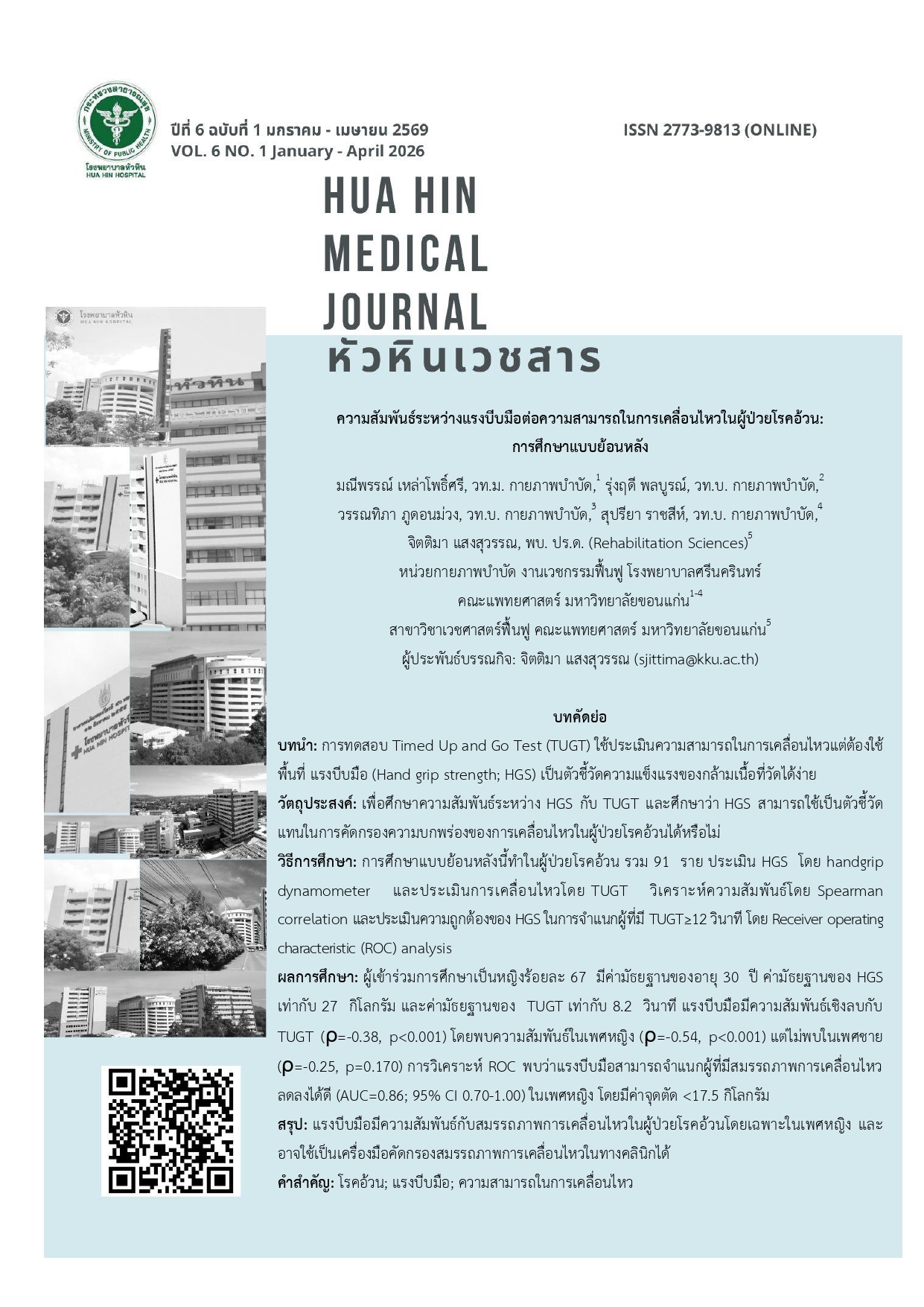
บทนำ: การทดสอบ Timed Up and Go Test (TUGT) ใช้ประเมินความสามารถในการเคลื่อนไหวแต่ต้องใช้พื้นที่ แรงบีบมือ (Hand grip strength; HGS) เป็นตัวชี้วัดความแข็งแรงของกล้ามเนื้อที่วัดได้ง่าย
วัตถุประสงค์: เพื่อศึกษาความสัมพันธ์ระหว่าง HGS กับ TUGT และศึกษาว่า HGS สามารถใช้เป็นตัวชี้วัดแทนในการคัดกรองความบกพร่องของการเคลื่อนไหวในผู้ป่วยโรคอ้วนได้หรือไม่
วิธีการศึกษา: การศึกษาแบบย้อนหลังนี้ทำในผู้ป่วยโรคอ้วน รวม 91 ราย ประเมิน HGS โดย handgrip dynamometer และประเมินการเคลื่อนไหวโดย TUGT วิเคราะห์ความสัมพันธ์โดย Spearman correlation และประเมินความถูกต้องของ HGS ในการจำแนกผู้ที่มี TUGT≥12 วินาที โดย Receiver operating characteristic (ROC) analysis
ผลการศึกษา: ผู้เข้าร่วมการศึกษาเป็นหญิงร้อยละ 67 มีค่ามัธยฐานของอายุ 30 ปี ค่ามัธยฐานของ HGS เท่ากับ 27 กิโลกรัม และค่ามัธยฐานของ TUGT เท่ากับ 8.2 วินาที แรงบีบมือมีความสัมพันธ์เชิงลบกับ TUGT (ρ=-0.38, p<0.001) โดยพบความสัมพันธ์ในเพศหญิง (ρ=-0.54, p<0.001) แต่ไม่พบในเพศชาย (ρ=-0.25, p=0.170) การวิเคราะห์ ROC พบว่าแรงบีบมือสามารถจำแนกผู้ที่มีสมรรถภาพการเคลื่อนไหวลดลงได้ดี (AUC=0.86; 95% CI 0.70-1.00) ในเพศหญิง โดยมีค่าจุดตัด <17.5 กิโลกรัม
สรุป: แรงบีบมือมีความสัมพันธ์กับสมรรถภาพการเคลื่อนไหวในผู้ป่วยโรคอ้วนโดยเฉพาะในเพศหญิง และอาจใช้เป็นเครื่องมือคัดกรองสมรรถภาพการเคลื่อนไหวในทางคลินิกได้
เอกสารอ้างอิง
World Health Organization. (2025). Obesity and overweight. [Cited March 14, 2026] accessed from https://www.who.int/news-room/fact-sheets/detail/obesity-and-overweight
Wearing SC, Hennig EM, Byrne NM, Steele JR, Hills AP. Musculoskeletal disorders associated with obesity: a biomechanical perspective. Obes Rev. 2006;7(3):239-50.
Tomlinson DJ, Erskine RM, Morse CI, Winwood K, Onambélé-Pearson G. The impact of obesity on skeletal muscle strength and structure through adolescence to old age. Biogerontology. 2016;17(3):467-83.
Head GA. Cardiovascular and metabolic consequences of obesity. Front Physiol. 2015;6:32.
Pojednic R, D'Arpino E, Halliday I, Bantham A. The Benefits of Physical Activity for People with Obesity, Independent of Weight Loss: A Systematic Review. Int J Environ Res Public Health. 2022;19(9).
Cash SW, Duncan GE, Beresford SA, McTiernan A, Patrick DL. Increases in physical activity may affect quality of life differently in men and women: the PACE project. Qual Life Res. 2013;22(9):2381-8.
Podsiadlo D, Richardson S. The timed "Up & Go": a test of basic functional mobility for frail elderly persons. J Am Geriatr Soc. 1991;39(2):142-8.
Bohannon RW. Grip Strength: An Indispensable Biomarker For Older Adults. Clin Interv Aging. 2019;14:1681-91.
Soyuer F, Cankurtaran F, Menevşe Ö, Zararsız GE. Examination of the correlation between hand grip strength and muscle mass, balance, mobility, and daily life activities in elderly individuals living in nursing homes. Work. 2023;74(4):1371-8.
Hulley SB, Cummings SR, Browner WS, Grady D, Newman TB. Designing clinical research: an epidemiologic approach. 4th ed. ed. Philadelphia: Lippincott Williams & Wilkins; 2013.
Hamdani R, Florencia Leona D. Relationship Between Handgrip Strength with the 6-Minute Walking Test Distance in Heart Failure Patients. INSOLOGI: Jurnal Sains dan Teknologi. 2023.
Zhang Q, Lu H, Pan S, Lin Y, Zhou K, Wang L. 6MWT Performance and its Correlations with VO₂ and Handgrip Strength in Home-Dwelling Mid-Aged and Older Chinese. Int J Environ Res Public Health. 2017;14(5).
Gatenio-Hefling O, Tzemah-Shahar R, Asraf K, Dilian O, Gil E, Agmon M. Revisiting the "Timed Up and Go" test: a 12-s cut-off can predict Hospitalization Associated Functional Decline in older adults. Geroscience. 2025;47(1):1039-48.
Bischoff HA, Stähelin HB, Monsch AU, Iversen MD, Weyh A, von Dechend M, et al. Identifying a cut-off point for normal mobility: a comparison of the timed 'up and go' test in community-dwelling and institutionalised elderly women. Age Ageing. 2003;32(3):315-20.
Hajian-Tilaki K. The choice of methods in determining the optimal cut-off value for quantitative diagnostic test evaluation. Statistical Methods in Medical Research. 2018;27(8):2374-83.
Roberts HC, Denison HJ, Martin HJ, Patel HP, Syddall H, Cooper C, et al. A review of the measurement of grip strength in clinical and epidemiological studies: towards a standardised approach. Age Ageing. 2011;40(4):423-9.
Chen LK, Hsiao FY, Akishita M, Assantachai P, Lee WJ, Lim WS, et al. A focus shift from sarcopenia to muscle health in the Asian Working Group for Sarcopenia 2025 Consensus Update. Nat Aging. 2025;5(11):2164-75.
Bohannon RW. Hand-grip dynamometry predicts future outcomes in aging adults. J Geriatr Phys Ther. 2008;31(1):3-10.
Pavasini R, Guralnik J, Brown JC, di Bari M, Cesari M, Landi F, et al. Short Physical Performance Battery and all-cause mortality: systematic review and meta-analysis. BMC Med. 2016;14(1):215.
Al Snih S, Markides KS, Ray L, Ostir GV, Goodwin JS. Handgrip strength and mortality in older Mexican Americans. J Am Geriatr Soc. 2002;50(7):1250-6.
Porto JM, Nakaishi APM, Cangussu-Oliveira LM, Freire Júnior RC, Spilla SB, Abreu DCC. Relationship between grip strength and global muscle strength in community-dwelling older people. Arch Gerontol Geriatr. 2019;82:273-8.
Trajkov M, Cuk I, Eminovic F, Kljajic D, Dopsaj M. Relationship between hand grip strength and endurance and postural stability in active and sedentary older women. J Electromyogr Kinesiol. 2018;43:62-7.
Rantanen T, Guralnik JM, Foley D, Masaki K, Leveille S, Curb JD, et al. Midlife hand grip strength as a predictor of old age disability. JAMA. 1999;281(6):558-60.
Karlsen T, Nauman J, Dalen H, Langhammer A, Wisløff U. The Combined Association of Skeletal Muscle Strength and Physical Activity on Mortality in Older Women: The HUNT2 Study. Mayo Clin Proc. 2017;92(5):710-8.
Leong DP, Teo KK, Rangarajan S, Lopez-Jaramillo P, Avezum A, Orlandini A, et al. Prognostic value of grip strength: findings from the Prospective Urban Rural Epidemiology (PURE) study. Lancet. 2015;386(9990):266-73.
Bohannon RW. Reference values for the timed up and go test: a descriptive meta-analysis. J Geriatr Phys Ther. 2006;29(2):64-8.
Savva GM, Donoghue OA, Horgan F, O'Regan C, Cronin H, Kenny RA. Using timed up-and-go to identify frail members of the older population. J Gerontol A Biol Sci Med Sci. 2013;68(4):441-6.
Lauretani F, Russo CR, Bandinelli S, Bartali B, Cavazzini C, Di Iorio A, et al. Age-associated changes in skeletal muscles and their effect on mobility: an operational diagnosis of sarcopenia. J Appl Physiol (1985). 2003;95(5):1851-60.
Chen LK, Woo J, Assantachai P, Auyeung TW, Chou MY, Iijima K, et al. Asian Working Group for Sarcopenia: 2019 Consensus Update on Sarcopenia Diagnosis and Treatment. Journal of the American Medical Directors Association. 2020;21(3):300-+.
Dodds RM, Syddall HE, Cooper R, Benzeval M, Deary IJ, Dennison EM, et al. Grip strength across the life course: normative data from twelve British studies. PLoS One. 2014;9(12):e113637.
ดาวน์โหลด
เผยแพร่แล้ว
รูปแบบการอ้างอิง
ฉบับ
ประเภทบทความ
สัญญาอนุญาต
ลิขสิทธิ์ (c) 2026 โรงพยาบาลหัวหิน

อนุญาตภายใต้เงื่อนไข Creative Commons Attribution-NonCommercial-NoDerivatives 4.0 International License.
บทความที่ได้รับการตีพิมพ์ในวารสารหัวหินเวชสาร เป็นลิขสิทธิ์ของโรงพยาบาลหัวหิน
บทความที่ลงพิมพ์ใน วารสารหัวหินเวชสาร ถือว่าเป็นความเห็นส่วนตัวของผู้เขียนคณะบรรณาธิการไม่จำเป็นต้องเห็นด้วย ผู้เขียนต้องรับผิดชอบต่อบทความของตนเอง