
The Development of Educational Breast Cancer Surgery Preprograms for Modified Radical Mastectomy Patients at Surin Hospital
Keywords:
Educational program, Breast cancer, Modified radical mastectomyAbstract
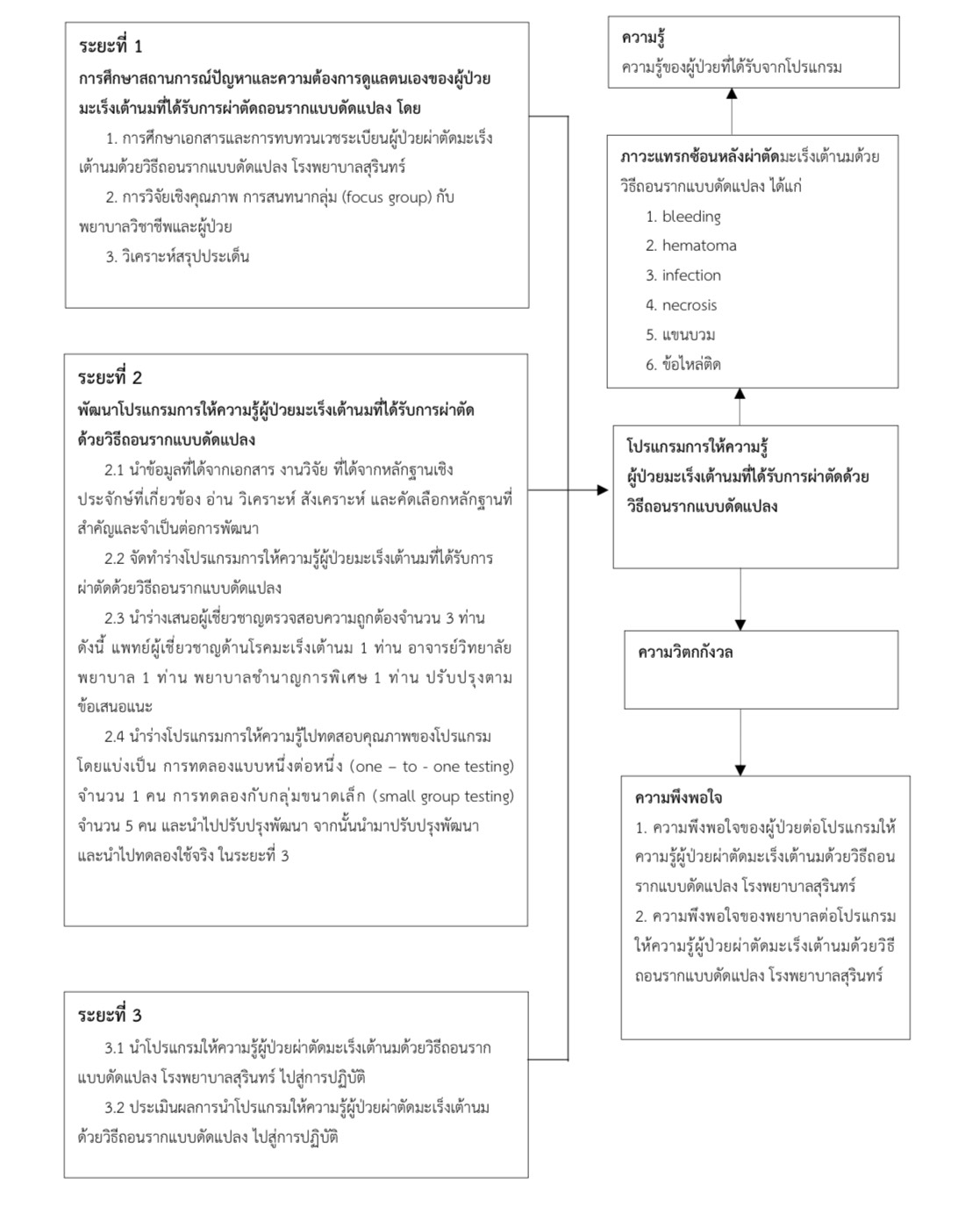
This research and development study aimed to develop and evaluate an educational program for patients undergoing modified radical mastectomy (MRM) at Surin Hospital. The program was designed to improve patients’ knowledge, satisfaction, anxiety, postoperative complications, and professional nurses’ satisfaction. The study consisted of three phases. Phase 1 employed qualitative methods to explore problems and needs through focus group discussions with 8 patients and 8 professional nurses. Phase 2 involved developing the educational program and pilot testing it with eight patients, followed by program refinement. Phase 3 used a one-group pretest–posttest quasi-experimental design to evaluate the program among 30 patients undergoing MRM and 18 professional nurses. The research instruments included a demographic questionnaire, a knowledge test, patient and nurse satisfaction questionnaires, the Thai version of the Hospital Anxiety and Depression Scale (Thai HADS), a postoperative complication record form, a semi-structured Interview guide, and an educational program. Instrument reliability coefficients ranged from 0.83 to 0.93. Data were analyzed using descriptive statistics, content analysis, and paired t-test.
The educational program consisted of nine steps implemented in three phases: pre-education, multimedia education, and skills practice with evaluation. Following the intervention, patients demonstrated significantly higher knowledge scores than before participation (p< .001). Patient satisfaction was at a high level, while professional nurses’ satisfaction was at the highest level. Most patients had no symptoms of anxiety or depression after the intervention, and only two patients developed postoperative lymphedema. The findings indicate that the educational program effectively improved patients’ knowledge, enhanced satisfaction among patients and nurses, promoted psychological well-being, and reduced preventable postoperative complications. The program may serve as an evidence-based nursing intervention to improve the quality of postoperative care for patients undergoing modified radical mastectomy
References
ธวัช อิงศิโรรัตน์, และสิทธิ เชาว์ชื่น. (2563). การศึกษาเปรียบเทียบผลการป้องกันการเกิดภาวะแทรกซ้อนหลังการผ่าตัดมะเร็งเต้านมวิธี Modified Radical Mastectomy โดยการใส่สายระบาย 2 วิธี. วารสารกรมการแพทย์, 45(2), 66-73.
นิภา ใจสมคม, และบังอร หนูบรรจง. (2566). ผลของการใช้รูปแบบการดูแลผู้ป่วยมะเร็งเต้านมที่ได้รับการผ่าตัด จังหวัดชุมพร. วารสารมหาจุฬานาคทรรศน์, 10(2), 435-451.
ประวีณา อัศวพลไพศาล, และศศิธร แก้วกล้า. (2563). ประสิทธิผลของโปรแกรมการสอนสาธิตในผู้ป่วยผ่าตัดมะเร็งเต้านมเพื่อลดการเกิดท่อระบายเลื่อนหลุดและข้อไหล่ติดในหอผู้ป่วยศัลยกรรมหญิง โรงพยาบาลแพร่. วารสารโรงพยาบาลแพร่, 28(1), 68-80.
พาศนา บุณยะมาน. (2560). ผลการวางแผนจำหน่ายผู้ป่วยผ่าตัดมะเร็งเต้านมแบบถอนรากชนิดดัดแปลง พร้อมขวดระบายสุญญากาศต่อความสามารถในการดูแลตนเอง ภาวะแทรกซ้อน และความพึงพอใจ หอผู้ป่วยศัลยกรรมหญิง โรงพยาบาลสงขลา. วารสารสมาคมเวชศาสตร์ป้องกันแห่งประเทศไทย, 7(1), 95-103.
มลฤดี เกษเพชร, นิโรบล กนกสุนทรรัตน์, และประกาศิต จิรัปปภา. (2563). โปรแกรมพัฒนาคุณภาพการดูแลกลุ่มผู้ป่วยมะเร็งเต้านม อาคารศูนย์การแพทย์สมเด็จพระเทพรัตน์. วารสารการปฏิบัติการพยาบาลและการผดุงครรภ์ไทย, 7(2), 41-56.
สถิติเวชระเบียน โรงพยาบาลสุรินทร์. (2567). หน่วยเวชระเบียน โรงพยาบาลสุรินทร์.
สุกาญจนา จุลโนนยาง. (2566). การพัฒนารูปแบบการจัดการรายกรณีในผู้ป่วยมะเร็งเต้านมที่ได้รับการผ่าตัดแบบเอ็มอาร์เอ็ม โรงพยาบาลสกลนคร. วารสารการพยาบาลและวิทยาศาสตร์สุขภาพ มหาวิทยาลัยนครพนม, 1(2), 13-24.
อนุชา ไทยวงศ์, นฤมล เอนกวิทย์, วิรัตน์ดา สาระโภค, นัธทวัฒน์ อุราแก้ว, นฤมล จิตสวา, น้ำฝน แผ้วพลสง, เบญจวรรณ จันที, มาลินี ปฏิทันโต, ลักขณา รัตนพลแสน, และสุนิสา มาแก้ว. (2560). ชุดนวัตกรรมส่งเสริมการบริหารแขนและไหล่หลังการผ่าตัดเต้านม: จากหลักฐานเชิงประจักษ์สู่การสร้างนวัตกรรม. วารสารโรงพยาบาลมหาสารคาม, 14(3), 114-124.
อาภา ศรีสร้อย, และอมรรัตน์ อัครเศรษฐสกุล. (2565). การศึกษาเปรียบเทียบประสิทธิผลของสื่อแผ่นพับกับวีดิทัศน์ต่อการสอนผู้ป่วยที่ได้รับการผ่าตัดเต้านม หอผู้ป่วยศัลยกรรมหญิง โรงพยาบาลอุดรธานี. วารสารการแพทย์โรงพยาบาลอุดรธานี, 28(2), 203-211.
Bloom, B. S. (1956). Taxonomy of Education Objectives : The classification of education goal. Longman.
De Groef, A., Van Kampen, M., Dieltjens, E., Christiaens, M. R., Neven, P., Geraerts, I., & Devoogdt, N. (2015). Effectiveness of postoperative physical therapy for upper-limb impairments after breast cancer treatment: a systematic review. Archives of Physical Medicine and Rehabilitation, 96(6), 1140–1153. https://doi.org/10.1016/j.apmr.2015.01.006
Fallowfield, L. J., Jenkins, V. A., & Beveridge, H. A. (2002). Truth may hurt but deceit hurts more: communication in palliative care. Palliative Medicine, 16(4), 297–303. https://doi.org/10.1191/0269216302pm575oa
Knowles, M. S., Holton, E. F., & Swanson, R. A. (2015). The adult learner: The definitive classic in adult education and human resource development (8th ed.). Routledge.
Koinberg, I., Langius-Eklöf, A., Holmberg, L., & Fridlund, B. (2006). The usefulness of a multidisciplinary educational programme after breast cancer surgery: A prospective and comparative study. European Journal of Oncology Nursing, 10(4), 273-282.
McCorkle, R., Ercolano, E., Lazenby, M., Schulman-Green, D., Schilling, L. S., Lorig, K., & Wagner, E. H. (2011). Self-management: Enabling and empowering patients living with cancer as a chronic illness. CA: A Cancer Journal for Clinicians, 61(1), 50–62. https://doi.org/10.3322/caac.20093
McNeely, M. L., Campbell, K., Ospina, M., Rowe, B. H., Dabbs, K., Klassen, T. P., Mackey, J., & Courneya, K. (2010). Exercise interventions for upper-limb dysfunction due to breast cancer treatment. The Cochrane Database of Systematic Reviews, 2010(6), CD005211. https://doi.org/10.1002/14651858.CD005211.pub2
Nilchaikovit, T., Lortrakul, M., & Phisansuthideth, U. (1996). Development of Thai version of hospital anxiety and depression scale in cancer patients. Journal of the Psychiatric Association of Thailand, 41(1), 18-30.
Orem, D. E. (2001). Nursing: Concepts of practice (6th ed.). Mosby.
Polit, D. F., & Beck, C. T. (2021). Nursing research: Generating and assessing evidence for nursing practice (11th ed.). Wolters Kluwer.
Richey, R. C., & Klein, J. D. (2007). Design and development research: Methods, strategies, and issues. Lawrence Erlbaum Associates.
Sheehy, E. M., Lehane, E., Quinn, E., Livingstone, V., Redmond, H. P., & Corrigan, M. A. (2018). Information needs of patients with breast cancer at years one, three, and five after diagnosis. Clinical Breast Cancer, 18(6), e1269–e1275. https://doi.org/10.1016/j.clbc.2018.06.007
Stanton, A. L., Rowland, J. H., & Ganz, P. A. (2015). Life after diagnosis and treatment of cancer in adulthood: Contributions from psychosocial oncology research. The American Psychologist, 70(2), 159–174. https://doi.org/10.1037/a0037875
Titler, M. G., Everett, L. Q., & Adams, S. (2007). Implications for implementation science. Nursing Research, 56(4 Suppl), S53–S59. https://doi.org/10.1097/01.NNR.0000280636.78901.7f
Downloads
Published
How to Cite
Issue
Section
License
Copyright (c) 2026 Journal of Boromarajonani College of Nursing, Surin

This work is licensed under a Creative Commons Attribution-NonCommercial-NoDerivatives 4.0 International License.
เนื้อหาและข้อมูลในบทความที่ตีพิมพ์ในราชาวดีสาร วิทยาลัยพยาบาลบรมราชชนนี สุรินทร์ ถือเป็นข้อคิดเห็นและความรับผิดชอบของผู้เขียนบทความโดยตรง ซึ่งกองบรรณาธิการวารสารไม่จำเป็นต้องเห็นด้วย หรือร่วมรับผิดชอบใดๆ
บทความ ข้อมูล เนื้อหา รูปภาพ ฯลฯ ที่ได้รับการตีพิมพ์ในราชาวดีสาร วิทยาลัยพยาบาลบรมราชชนนี สุรินทร์ หากบุคคลหรือหน่วยงานใดต้องการนำทั้งหมดหรือส่วนหนึ่งส่วนใดไปเผยแพร่หรือกระทำการใดๆ จะต้องได้รับอนุญาตเป็นลายลักษณ์อักษรจากราชาวดีสาร วิทยาลัยพยาบาลบรมราชชนนี สุรินทร์ ก่อนเท่านั้น