
The Effectiveness of the Emotional Intelligence and Soft Power Enhancement Program for Preschool Children in Yasothon Province
Keywords:
Emotional intelligence, Soft power, Preschool childrenAbstract
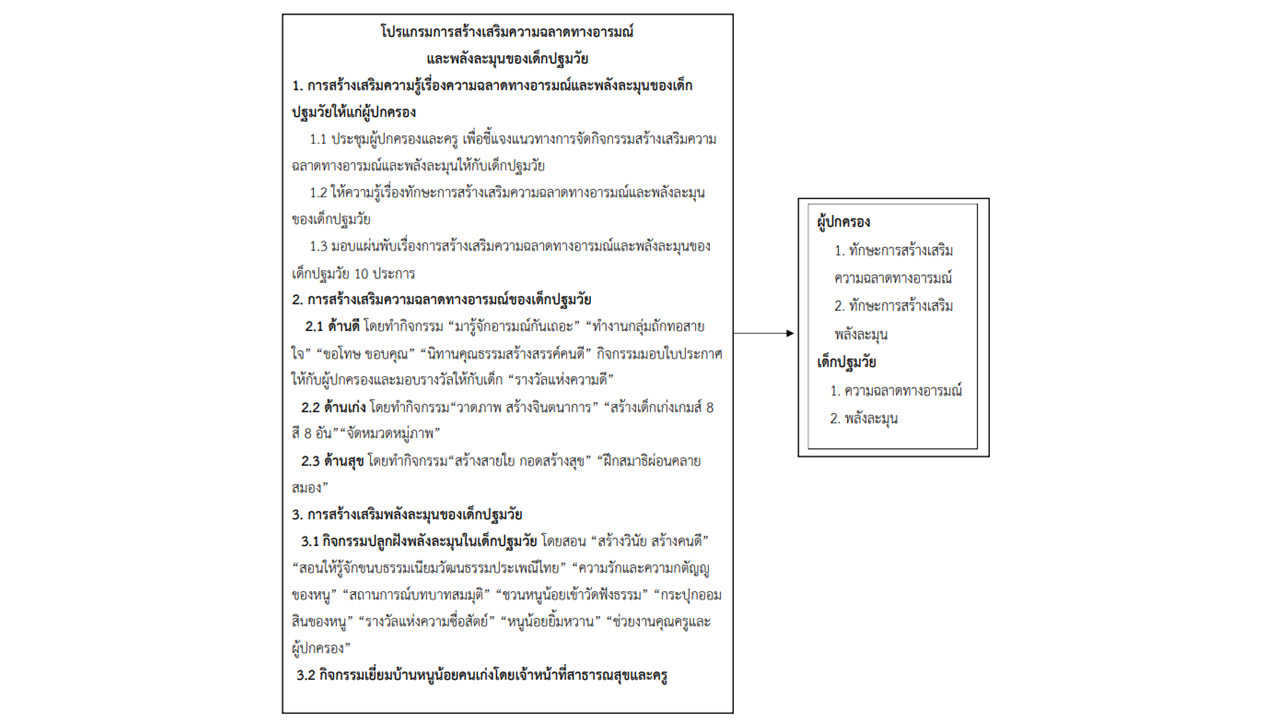
This quasi-experimental study, employing a two-group pretest–posttest design, aimed to examine the effects of an enhancement program for emotional intelligence and “Palung La-Mun” (gentle power) among early childhood children on: (1) parents’ skills in fostering emotional intelligence and gentle power, and (2) children’s emotional intelligence and gentle power. The sample was purposively selected and consisted of 70 parents and their children aged 3–5 years in Yasothon Province. Participants were randomly assigned to the experimental group (n = 35) and the control group (n = 35). The research instruments comprised: (1) the intervention tools, including an eight-week enhancement program for emotional intelligence and gentle power among early childhood children, developed by integrating the Department of Mental Health’s emotional intelligence framework with gentle power activities through the song “Dek Aey Dek Dee”; and (2) data collection tools, including (a) a parental skill questionnaire for fostering emotional intelligence and gentle power in young children, and (b) a parental questionnaire assessing children’s emotional intelligence and gentle power. Content validity was verified with a CVI of 1.00. Reliability, examined using Cronbach’s alpha coefficient, ranged from 0.91 to 0.96. Data were analyzed using descriptive statistics and t-tests.
The results demonstrated that, after participation in the program, parents in the experimental group exhibited significantly higher skills in fostering emotional intelligence and gentle power compared to their pre-intervention scores and to those of the control group
(p < 0.05). Likewise, children in the experimental group showed significantly higher emotional intelligence and gentle power compared to their pre-intervention scores and to those of the control group (p < 0.05). The findings suggest that this program can be effectively applied to promote early childhood development.
References
กระทรวงสาธารณสุข, กรมสุขภาพจิต. (2547). แนวคิดการพัฒนาความฉลาดทางอารมณ์. กรมสุขภาพจิต.
กระทรวงสาธารณสุข, กรมสุขภาพจิต, สถาบันราชานุกูล. (2564). รายงานสถานการณ์ความฉลาดทางอารมณ์เด็กไทยชั้นประถมศึกษาปีที่ 1 ประจำปี พ.ศ. 2564.
จตุพร อุ่นประเสริฐสุข. (2564). ผลของโปรแกรมการพัฒนาความฉลาดทางอารมณ์ในเด็กปฐมวัย [วิทยานิพนธ์ปริญญามหาบัณฑิต]. มหาวิทยาลัยสุโขทัยธรรมาธิราช.
ชนาธิป กุลจิรากูล, และศันสนีย์ เมฆรุ่งเรืองวงศ์. (2564). ผลของโปรแกรมการประยุกต์หลักแนวคิดสมรรถนะทางอารมณ์เพื่อเสริมสร้างความฉลาดทางอารมณ์นักเรียนชั้นประถมศึกษา. วารสารสาธารณสุขไทย, 51(2), 101-109.
ชญานนท์ สุวรรณเพชร, และพีระพร รัตนาเกียรติ์ (2563). การพัฒนาความฉลาดทางอารมณ์ของเด็กปฐมวัยโดยการจัดกิจกรรมทางกายประสานการชี้แนะ. วารสารมหาวิทยาลัยราชภัฏร้อยเอ็ด, 17(1), 180–192.
ชอุ่ม ปัญจพรรค์. (2498). เด็กเอ๋ยเด็กดี [เพลง]. กรมศิลปากร.
ณัฐริกานต์ อ่ำเจ๊ก, ศิริโรจน์ นามเสนา, และสามารถ สุขุประการ. (2568). การปลูกฝังคุณธรรมในวัยเด็ก
ผ่านการปฏิบัติ. วารสารวิจยวิชาการ, 8(3), 377-394.
แผนพัฒนาจังหวัดยโสธร. (2566). รายงานสถานการณ์ความฉลาดทางอารมณ์ของเด็กจังหวัดยโสธร.
รุ้งทิวา จันทร์งาม, และรุ่งนภา พรหมสาขา ณ สกลนคร. (2566). ผลของโปรแกรมการส่งเสริมพัฒนาการและสร้างวินัยเชิงบวกโดยครอบครัวมีส่วนร่วม ต่อความรู้และทักษะของผู้ปกครองในการส่งเสริมพัฒนาการและความฉลาดทางอารมณ์ เด็กปฐมวัย อำเภอบ้านแพง จังหวัดนครพนม. วารสารอนามัยสิ่งแวดล้อมและสุขภาพชุมชน, 8(3), 302-312.
วัลภา ไชยยะ, และทัศนีย์ นาคุณทรง. (2568). การส่งเสริมความมีวินัยในตนเองของเด็กปฐมวัย ด้วยการจัดประสบการณ์การเรียนรู้โดยใช้แหล่งเรียนรู้ในท้องถิ่น. วารสารครุศาสตร์ มหาวิทยาลัยนเรศวร, 15(1), 121–130.
วิชัย วงษ์ใหญ่, และมารุต พัฒผล. (2565). การเรียนรู้ด้วยพลังแห่งความอ่อนโยน (soft power). https://ird.mcu.ac.th/wp-content/uploads/2022/05/การเรียนรู้ด้วยพลังแห่งความอ่อนโยน.pdf
สำนักงานสาธารณสุขจังหวัดยโสธร. (2566). รายงานผลการสำรวจ EQ เด็กประถมศึกษาปีที่ 1 จังหวัดยโสธร.
อนุพงษ์ ช่วยชาติ, และอุทัยวรรณ สายพัฒนะ. (2566). ความสัมพันธ์ระหว่างความฉลาดทางอารมณ์กับความสามารถในการตัดสินใจของนักเรียนชั้นมัธยมศึกษาปีที่ 6 โรงเรียนในเขตสายไหม กรุงเทพมหานคร. วารสารมณีเชษฐาราม วัดจอมมณี, 8(1), 44-62.
Aksoy, P., & Gresham, F. M. (2024). Evidence-based social-emotional learning intervention programs for preschool children: An important key to development and learning. International Journal of Psychology and Educational Studies, 11(3), 201–217. https://doi.org/10.52380/ijpes.2024.11.3.1227
Bandura, A. (1986). Social foundations of thought and action: A social cognitive theory. Prentice-Hall.
Domitrovich, C. E., Durlak, J. A., Staley, K. C., & Weissberg, R. P. (2017). Social-emotional competence: An essential factor for promoting positive adjustment and reducing risk in school children. Child Development, 88(2), 408–416. https://doi.org/10.1111/cdev.12739
Goleman, D. (1995). Emotional intelligence. Bantam Books.
Nilfyr, K., & Ewe, L. P. (2025). Thriving children’s emotional self-regulation in preschool: A systematic review discussed from an interactionist perspective. Education Sciences, 15(2), 137. https://doi.org/10.3390/educsci15020137
Nye, J. S. (1990). Soft power: The means to success in world politics. PublicAffairs.
Yin, W., Li, T., Wu, Z., Hung, S. C., Hu, D., Gui, Y., Cho, S., Sun, Y., Woodburn, M. A., Wang, L., Li, G., Piven, J., Elison, J. T., Wu, C. W., Zhu, H., Cohen, J. R., Lin, W., & UNC/UMN Baby Connectome Project Consortium (2025). Charting brain functional development from birth to 6 years of age. Nature Human Behaviour, 9(6), 1246–1259. https://doi.org/10.1038/s41562-025-02160-2
Downloads
Published
How to Cite
Issue
Section
License
Copyright (c) 2025 Journal of Boromarajonani College of Nursing, Surin

This work is licensed under a Creative Commons Attribution-NonCommercial-NoDerivatives 4.0 International License.
เนื้อหาและข้อมูลในบทความที่ตีพิมพ์ในราชาวดีสาร วิทยาลัยพยาบาลบรมราชชนนี สุรินทร์ ถือเป็นข้อคิดเห็นและความรับผิดชอบของผู้เขียนบทความโดยตรง ซึ่งกองบรรณาธิการวารสารไม่จำเป็นต้องเห็นด้วย หรือร่วมรับผิดชอบใดๆ
บทความ ข้อมูล เนื้อหา รูปภาพ ฯลฯ ที่ได้รับการตีพิมพ์ในราชาวดีสาร วิทยาลัยพยาบาลบรมราชชนนี สุรินทร์ หากบุคคลหรือหน่วยงานใดต้องการนำทั้งหมดหรือส่วนหนึ่งส่วนใดไปเผยแพร่หรือกระทำการใดๆ จะต้องได้รับอนุญาตเป็นลายลักษณ์อักษรจากราชาวดีสาร วิทยาลัยพยาบาลบรมราชชนนี สุรินทร์ ก่อนเท่านั้น