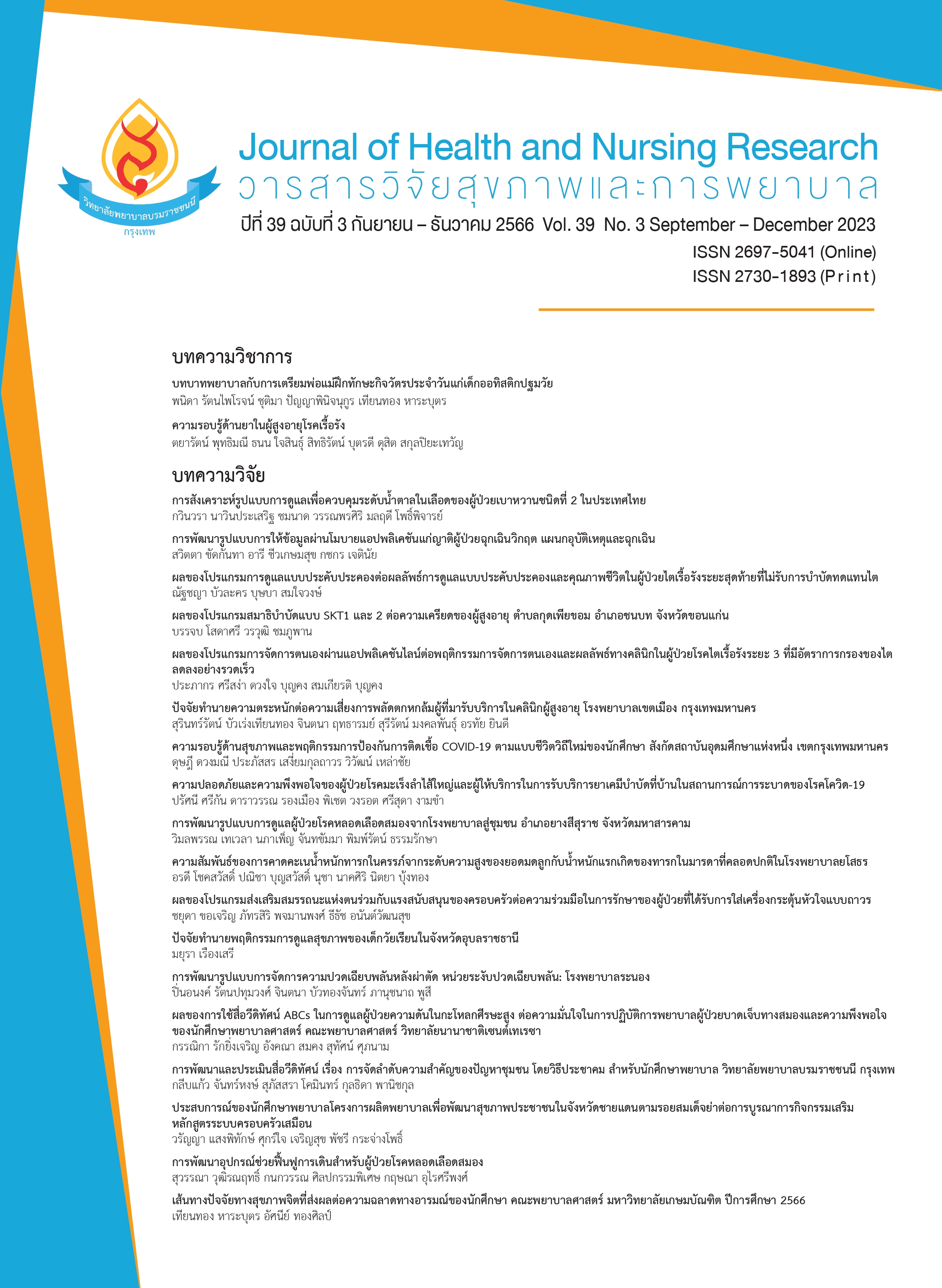
Effects of the Self-Management Program via Line Application on Self-Management Behaviors and Clinical Outcomes among Chronic Kidney Disease Stage 3 Patients with a Rapid Declined of Kidney Function
Keywords:
self-management program, Line application, self-management behaviors, clinical outcomesAbstract
Introduction: Chronic kidney disease (CKD) is an incurable disease. Engaging in appropriate self-management behaviors can slow the progression of kidney deterioration and improve clinical outcomes.
Research objectives: This study aimed to examine the effects of a self-management program via a line application on self-management behaviors in patients with stage 3 CKD.
Research methodology: This was a quasi-experimental study. The sample consisted of patients with stage 3 CKD who experienced a rapid decline in kidney function at Renu Nakhon Hospital. Sixty individuals were selected using simple random sampling and divided into an experimental group and a control group, each consisting of 30 participants. The experimental group underwent the self-management program for 12 weeks, while the control group received standard care. Research instruments included a personal data form, Self-Management Behavior Questionnaire, LINE application, laboratory procedures testing for eGFR, and serum creatinine. Data were analyzed using descriptive statistics, the Mann-Whitney U test, and independent t-test.
Results: After the program, the experimental group had significantly higher overall mean scores for self-management behaviors (M=80.73, SD=8.72) and eGFR (M=60.84, SD=5.62) than the control group (M=57.76, SD=13.24; M=44.83, SD=9.40, respectively) (p<.01). Additionally, they had a significantly lower mean serum creatinine score (M=1.03, SD=.28) than the control group (M=1.58, SD=.33) (p<.01).
Conclusions: The self-management program via the LINE application is effective for improving self-management behaviors, increasing eGFR, and decreasing serum creatinine in patients with stage 3 CKD.
Implications: According to our results, using a self-management program via the LINE application should be applied to nursing care to improve self-management behaviors and slow the deterioration in the condition of stage 3 CKD patients with rapidly declining kidney function.
Downloads
References
Kovesdy C. Epidemiology of chronic kidney disease: an update 2022. Kidney International Supplements 2022;12(1):7-11.
Division of non-communicable disease. Annual Report 2022. Bangkok: Graphic design; 2022. (in Thai)
Kefale B, Alebachew M, Tadesse Y, Engidawork E. Quality of life and its predictors among patients with chronic kidney disease: A hospital-based cross sectional study. PLoS One. 2019;14(2):1-16.
Kalantar-Zadeh K, Lockwood M, Rhee C, Tantisattamo E, Andreoli S, Balducci A, et al. Patient-centered approaches for the management of unpleasant symptoms in kidney disease. Nature Reviews Nephrology 2022;18(3):185-98.
Brad H, Sharon G, Jonathan B, Frank B, Kelly A, Burdge T, et al. KDIGO 2021 clinical practice guideline for the management of glomerular diseases. Kidney International. 2021;100(4):1-276.
Coresh J, Turin T, Matsushita K, Sang Y, Ballew S, Appel L, et al. Decline in estimated glomerular filtration rate and subsequent risk of end-stage renal disease and mortality. Journal American Medical Association 2014;311(24):2518–31.
Oshima M, Toyama T, Haneda M, Furuichi K, Babazono T, Yokoyama H, et al. Estimated glomerular filtration rate decline and risk of end-stage renal disease in type 2 diabetes. Public Library of Science 2018;13(8):1-15.
Teerasiriroj T, Lertlum L. The role of nurses in health promotion and prevention for slowing progression of chronic kidney disease in stage 3-4 CKD patient. Nursing, Health, and Education Journal 2023;6(1):76-85. (in Thai)
Lorig K, Holman H. Self-management education: history, definition, outcomes, and mechanisms. Annals of Behavioral Medicine 2003;26(1):1-7.
Methakanjanasak N. Self-management of end-stage renal failure patients treated by hemodialysis [doctoral’s thesis]. Chiang Mai: Chiang Mai University; 2005. (in Thai)
Sonja W. The effects of self-management on health behaviors and kidney function of patients with chronic kidney injury stage 3. Health Science Research 2021;15(3):120-32. (in Thai)
Klatinpoo B, Oba N, Neawbood S. Effect of a behavioral modification program in complication control of diabetes patients with chronic kidney complication. Journal of Health and Nursing Education 2020;26(1):58-70. (in Thai)
Nakhonphanom provincial health office. Health data center [internet]. 2023 [cite 2023 Aug 1]. Available from: https://golink.icu/s4mtbai.
Silapavitayatorn B, Chitpakdee B. The use of health information technology in nursing for patient safety. Journal of Nursing and Health Care 2020;38(2):6-14. (in Thai)
Vadtanapong O. Nursing informatics: trends and application. Nursing journal 2021;48(2):295-304. (in Thai)
Kidney disease improving global outcome. KDIGO 2021 Clinical practice guideline for the management of blood pressure in chronic kidney disease. Kidney International Supplements 2021;99(3):1-87.
Phongissaranuporn S, Laipoonsawad S, Supachaipanichpong P. Outputs of self-management support program for delayed-progression of diabetes nephropathy and clinical outcomes in patients type 2 diabetes mellitus Damnoen Saduak hospital. Medical Journal 2018;37(2):148-58. (in Thai)
Chuwongin D, Molek R, Boonprajak K, Sombutboon M, Preechakoon B. Nursing communication; in disruptive medicine. The Journal of Chulabhorn Royal Academy 2020;2(2):25-38. (in Thai)
Vainauskien V, Vaitkien R. Enablers of patient knowledge empowerment for self-management of chronic disease: an integrative review. International Journal of Environmental Research and Public Health 2021;18(5):2247-59.
Chaodamrongsakul C. Development of the self-care promoting model for diabetes mellitus patients at Sida hospital. Regional Health Promotion Center 9 2020;14(35):314-29. (in Thai)
Ratanasri P. Outcomes of self-management support program for delayed progression of diabetic nephropathy on self-management behaviors and clinical outcome in patients type 2 diabetes mellitus in Samran subdistrict health promoting hospital. Khon Kaen provincial health office 2022;4(2):209-24. (in Thai)
Phuntanasiri S. Correlation of renal function tests with ultrasonographic findings in chronic kidney disease. Department of medical services 2020;45(4).44-54.
Lee M, Wu S, Lu K, Wang W, Chen Y, Tai C. Effect of patient-centered self-management program on blood pressure, renal function control, and the quality of life of patients with hypertensive nephropathy: A longitudinal randomized controlled trial. Biological Research for Nursing 2022;24(2):216-25.
Downloads
Published
How to Cite
Issue
Section
License
Copyright (c) 2023 Journal of Health and Nursing Research (Journal of Boromarajonani College of Nursing, Bangkok)

This work is licensed under a Creative Commons Attribution-NonCommercial 4.0 International License.
Article published Is the copyright of the Journal of Health and Nursing Research (Boromarajonani College of Nursing, Bangkok) Cannot be republished in other journals