The Development of an Information Provision Model via Mobile Application for Relatives of Critical Emergency Patients at an Accident and Emergency Department
Keywords:
Information, mobile application, relatives, critical emergency, accidentAbstract
Introduction: Providing information that meets the needs of critically emergency patients' relatives will lead to their satisfaction with the service.
Research Objectives: To examine the situation of providing information to the relatives of critical emergency patients, developing a model for providing information through a mobile application, and the outcomes of using the developed model.
Research methodology: This research and development consisted of three phases. Phase 1: Exploring the situation of information provision for relatives of the patients, the sample included eight persons who were selected by purposive sampling: two emergency medical physicians, a head nurse, two staff nurses, and three emergency patients' relatives that had been selected specifically. In Phase 2, developing the information provision model, the sample was the same as in Phase 1. Phase 3: Studying the outcomes of using the new model. The sample was divided into an experimental group and a comparison group of 70 individuals, each systematically randomized. The research tools consisted of group discussion guidelines, the information provision model through a mobile application, and a satisfaction of information provision questionnaire with a reliability of .85. Data were analyzed using descriptive statistics, Mann-Whitney U test, and content analysis.
Results: The results were as follows: 1) In the information provision model, there were inadequate personnel, informants were not definitely assigned, the area for providing information was inappropriate, information provision guidelines were unclear and inconsistent, and uncertain frequency. Relative satisfaction with information provision was lower than that of the standard. 2) The developed model was created by a Line Official Account in two-way and real-time analysis of symptoms, disease diagnosis, treatment plan, and prognosis. 3) The satisfaction of relatives of patients who received information through the mobile application was statistically higher than that of the comparative group at a significance level of .01.
Conclusions: The relatives of critical emergency patients who received information through a mobile application were more satisfied than those who received traditional.
Implications: This model should be used for adaptation in other departments that care for critically ill patients.
Downloads
References
Institute of Emergency Medicine. Emergency medicine act. Nonthaburi: Institute of Emergency Medicine. 2009. (in Thai)
National Institute for Emergency Medicine. Performance of the emergency medical service system [Internet]. 2022 [cited 2022 Nov 6]. Available from: https://ws.niems.go.th/ITEMS_DWH/report003.aspx. (in Thai)
Division of Nursing. Nursing standards. 2nded . Bangkok: Office of the Permanent Secretary Ministry of Public Health. 2008. (in Thai)
Bureau of Nursing. Standards of nursing in hospitals. Bangkok: Veterans Organization Printing House. 2008. (in Thai)
Department of Medical Services and Information Strategy. Emergency patient statistics 2020. Chiang Rai. Chiang Rai Prachanukroh Hospital. 2021. (in Thai)
Hsiao PR, Redley B, Hsiao YC, Lin CC, Han CY, Lin HR. Family needs of critically ill patients in the emergency department. International Emergency Nursing. 2017;30:3-8.
Barreto MD, Marcon SS, Garcia-Vivar C. Patterns of behavior in families of critically ill patients in the emergency room: a focused ethnography. Journal of Advanced Nursing 2017;3:633-42.
Maliwan A, Sripanyawutthisak Y, Attakamol S. The effectiveness of a structured information program on family members' anxiety in the intensive care unit. Journal of Nursing and Education 2014;7(2):95-108. (in Thai)
Yildirim T, Özlü ZK. Need of critically iII patients' relatives in emergency department. Nursing and Midwifery Studies 2018;7(1):33-8.
Botes ML, Langley G. Botes and Gayle. The needs of families accompanying injured patients into the emergency department in a tertiary hospital in Gauteng. Curationis. 2016;24;39(1):1567. doi: 10.4102/curationis.v39i1.1567
Dangsuwan K, Phongsuwan C, Gaseng S, Srichai P, Jeankong B, Masae R, et al . Perceived information of relatives at emergency pepartment, Naradhiwasrajanagarindra hospital. Princess of Naradthiwas University Journal 2012;4(2):16-28. (in Thai)
Rattanasakul N, Dangsuwan D. Development of caring system for patient with life-threatening in emergency department, Naradhiwasrajanakrindra Hospital. Princess of Naradthiwas University Journal 2016;8(2):1–15. (in Thai)
Sangkanom P, Punthmatharith B, Wattanasit P. Effect of information provision via mobile application on anxiety of mothers having children admitted in a pediatric intensive care unit and preparation for transferring from a pediatric intensive care unit. Songklanagarind Journal of Nursing 2020;40(4):97-110. (in Thai)
Suttisaksunthron W, Chuanarram N, Suparasri P. Effects of information management program on the stress and satisfaction of caregivers of critical ill children. Multidisciplinary Journal for Health 2022;4(1):1-17. (in Thai)
Donabedian A. Evaluating the quality of medical care. 1966. The Milbank quarterly 2005;83(4), 691–729. https://doi.org/10.1111/j.1468-0009.2005.00397.
Epperson MM. Families in sudden crisis: process and intervention in a critical care center. Social Work Health Care. 1977; Spring;2(3):265-73. doi: 10.1300/J010v02n03_02.
Sethakul C, Aumpload P. Line OA user manual for front manager. Bangkok: Office of the Official Information Commission. 2020. (in Thai)
Sanitlou N, Sartphet W, Naphaarrak Y. Sample size calculation using G*power program Journal of Suvarnabhumi Institute of Technology (Humanities and Social Sciences) 2019;5:496-507. (in Thai)
Seels B. & Glasgow Z. Making Instructional design decisions. 2nded. Merrill: Prentice Hall; 1998.
Umut O, Avşaroğulları L. Expectations and needs of relatives of critically ill patients in the emergency department. Hong Kong Journal of Emergency Medicine. 2019;26(6):328-35. doi: 10.1177/1024907918802737
Botes ML, Langley G. The needs of families accompanying injured patients into the emergency department in a tertiary hospital in Gauteng [Internet].2016. [cited 2022 November 6] Available from: https://doi.org/10.4102/curationis.v39i1.1567
Boonyarat P, Pachanut N. The effect of family supportive need-based program on anxiety and satisfaction among family members of head Injury patients, accident and emergency department. Kuakarun Journal of Nursing 2021;28(2):36-47. (in Thai)
Binsa F, Khupantavee N, Naka K. Developing discharged instructive application of mild traumatic brain injury in low risk caregiver on mobile devices. Proceedings of 4th KU SRC Annual Conference; 2020 August 28; Chonburi: Kasetsart University Sriracha Campus. 2020. p. 17-26. (in Thai)
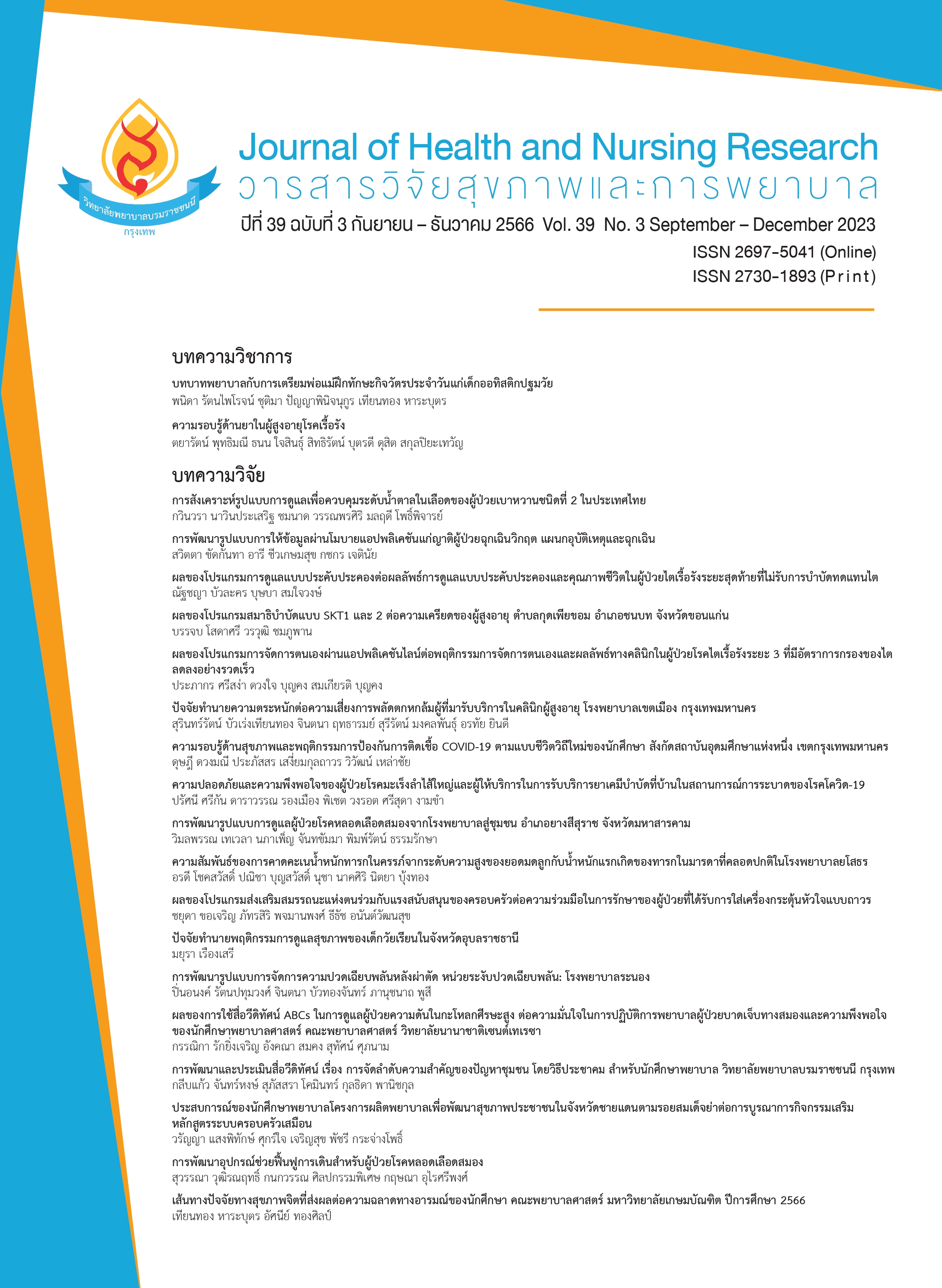
Downloads
Published
How to Cite
Issue
Section
License
Copyright (c) 2023 Journal of Health and Nursing Research (Journal of Boromarajonani College of Nursing, Bangkok)

This work is licensed under a Creative Commons Attribution-NonCommercial 4.0 International License.
Article published Is the copyright of the Journal of Health and Nursing Research (Boromarajonani College of Nursing, Bangkok) Cannot be republished in other journals