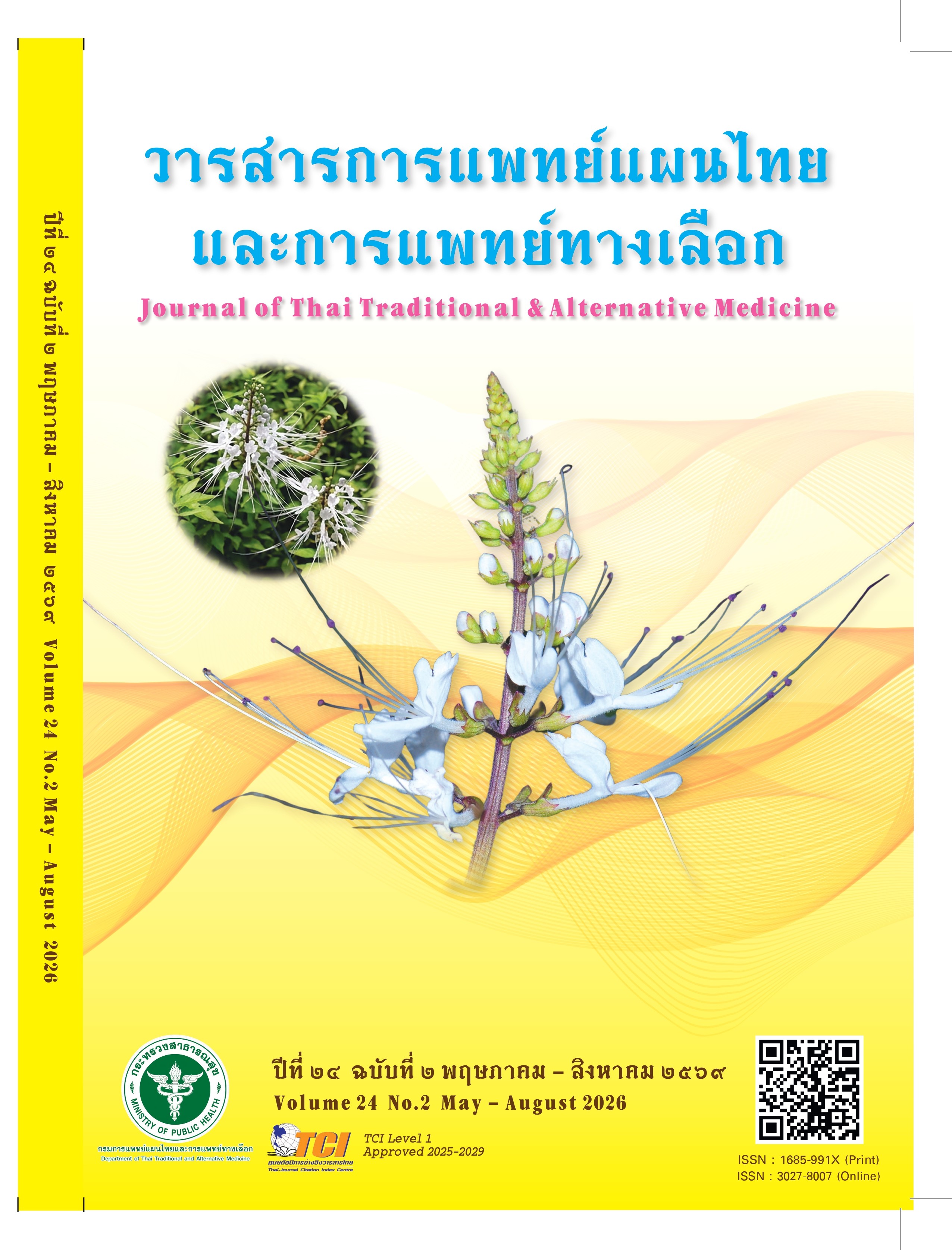
ปริมาณสารฟีนอลิกและเฟลโวนอยด์และฤทธิ์ต้านออกซิเดชัน ของตำรับยาซานไป๋ทังและสมุนไพรในตำรับ
Article Sidebar
Main Article Content
บทคัดย่อ
บทนำและวัตถุประสงค์: ตำรับยา "ซานไป๋ทัง" (San–Bai–Tang) เป็นตำรับยาจีนโบราณที่มีประวัติการใช้ดั้งเดิมในรูปแบบยารับประทานเพื่อปรับสมดุลชี่และเลือด บำรุงม้าม และเสริมสร้างสุขภาพผิวพรรณให้แลดูสดใสกระจ่างใสจากภายใน ประกอบด้วยตัวยาสมุนไพร 4 ชนิด ได้แก่ ไป๋จู๋ (Atractylodes macrocephala Koidz.), ไป๋เสา (Paeonia lactiflora Pall.), ฝูหลิง (Poria cocos (Schw.) Wolf) และกันเฉ่า (Glycyrrhiza uralensis Fisch.) ที่ผ่านมาการศึกษาเกี่ยวกับยาตำรับนี้ส่วนใหญ่มุ่งเน้นด้านสรรพคุณทางยาเพื่อการรักษาโรค การศึกษานี้มีวัตถุประสงค์เพื่อประเมินคุณลักษณะทางพฤกษเคมีและศักยภาพการต้านออกซิเดชันเบื้องต้นของสารสกัดตำรับยาซานไป๋ทังและสมุนไพรเดี่ยวองค์ประกอบเมื่อสกัดด้วยตัวทำละลายที่มีขั้วต่างกัน เพื่อประเมินศักยภาพในการพัฒนาเป็นส่วนประกอบในผลิตภัณฑ์เวชสำอางสมุนไพร (herbal cosmeceuticals) โดยประเมินปริมาณสารฟีนอลิกรวม (total phenolic content: TPC) ปริมาณสารเฟลโวนอยด์รวม (total flavonoid content: TFC) และประเมินฤทธิ์ต้านออกซิเดชันผ่าน 2 กลไก คือ ฤทธิ์กำจัดอนุมูลอิสระ (DPPH assay) และความสามารถในการส่งผ่านอิเล็กตรอนเดี่ยว (FRAP assay)
วิธีศึกษา: สกัดสมุนไพรเดี่ยวแต่ละชนิดและตำรับยาซานไป๋ทังด้วยตัวทำละลาย 2 ชนิด คือ สกัดด้วยน้ำด้วยวิธีต้ม (decoction) และสกัดด้วยเอทานอล 95% ด้วยการแช่สกัดร่วมกับการเขย่า (agitated maceration) จากนั้นนำสารสกัดที่ได้มาวิเคราะห์หาปริมาณสารกลุ่มฟีนอลิกรวม (TPC) และปริมาณสารกลุ่มเฟลโวนอยด์รวม (TFC), ประเมินฤทธิ์ต้านออกซิเดชันผ่าน 2 กลไก คือฤทธิ์ต้านอนุมูลอิสระด้วยวิธีการทดสอบการกำจัดอนุมูลอิสระ (free radical scavenging) โดยใช้สาร 2,2–diphenyl–1–picrylhydrazyl (DPPH assay) และความสามารถในการส่งผ่านอิเล็กตรอนเดี่ยวด้วยการทดสอบความสามารถในการรีดิวซ์เฟอร์ริกไอออน (ferric reducing antioxidant power, FRAP assay)
ผลการศึกษา: สารสกัดด้วยเอทานอล 95% ของตำรับยาซานไป๋ทังมีปริมาณ TPC และ TFC สูงกว่าสารสกัดด้วยน้ำประมาณ 2 เท่า (TPC: 52.60 ± 3.48 vs 28.11 ± 1.31 mg GAE/g extract; TFC: 47.16 ± 1.77 vs 20.41 ± 1.06 mg QE/g extract ตามลำดับ) อย่างไรก็ตาม เมื่อทดสอบฤทธิ์ต้านออกซิเดชันพบว่า สารสกัดด้วยน้ำของตำรับยาและสมุนไพรเดี่ยวเกือบทุกชนิดกลับแสดงฤทธิ์ต้านออกซิเดชันสูงกว่าสารสกัดด้วยเอทานอล 95% ในทั้งสองกลไกการทดสอบ (ค่า DPPH ของตำรับสารสกัดน้ำเท่ากับ 297.18 ± 1.03 mg TE/g extract vs สารสกัดเอทานอล 217.40 ± 2.47 mg TE/g extract; ค่า FRAP ของตำรับสารสกัดน้ำเท่ากับ 154.33 ± 4.68 mg TE/g extract vs สารสกัดเอทานอล 127.05 ± 1.45 mg TE/g extract) โดยเฉพาะสารสกัดด้วยน้ำของฝูหลิง ซึ่งมีปริมาณ TPC 8.12 ± 0.65 mg GAE/g และ TFC 2.44 ± 0.40 mg QE/g ซึ่งต่ำมาก แต่แสดงฤทธิ์ต้านออกซิเดชันในระดับสูง โดยมีค่า DPPH 305.33 ± 0.85 mg TE/g และค่า FRAP 215.35 ± 4.84 mg TE/g สอดคล้องกับสารสกัดด้วยน้ำของไป๋จู๋ที่แสดงฤทธิ์ต้านออกซิเดชันสูงที่สุดในทุกการทดสอบ บ่งชี้ถึงบทบาทสำคัญของสารออกฤทธิ์ต้านออกซิเดชันซึ่งละลายน้ำที่ไม่ใช่สารกลุ่มฟีนอลิกหรือเฟลโวนอยด์ เช่น พอลิแซ็กคาไรด์กลุ่มบีตา–กลูแคน ต่อฤทธิ์ต้านออกซิเดชันของสารสกัดด้วยน้ำ
อภิปรายผล: แม้สารสกัดด้วยเอทานอล 95% ของตำรับยาซานไป๋ทังและสมุนไพรเดี่ยวมีปริมาณสาร
ฟีนอลิกรวม (TPC) และเฟลโวนอยด์รวม (TFC) สูงกว่าสารสกัดด้วยน้ำประมาณ 2 เท่า แต่ผลการทดสอบฤทธิ์ต้านออกซิเดชันทั้งวิธี DPPH และ FRAP กลับพบว่าสารสกัดด้วยน้ำแสดงประสิทธิภาพสูงกว่าอย่างมีนัยสำคัญ สะท้อนว่าฤทธิ์ต้านออกซิเดชันไม่ได้ผันแปรตามปริมาณสารกลุ่มฟีนอลิกหรือเฟลโวนอยด์เพียงอย่างเดียว แต่ได้รับอิทธิพลจากสารออกฤทธิ์ทางชีวภาพชนิดละลายน้ำกลุ่มอื่นที่ไม่ใช่สารฟีนอลิก เช่น พอลิแซกคาไรด์ในฝูหลิงและไป๋จู๋ มอโนเทอร์พีนไกลโคไซด์ในไป๋เสา และไทรเทอร์พีนแซโพนินในกันเฉ่า ซึ่งละลายได้ดีในน้ำและสามารถให้อิเล็กตรอนหรือไฮโดรเจนเพื่อกำจัดอนุมูลอิสระได้อย่างทรงประสิทธิภาพ การผสมผสานสมุนไพรในตำรับจึงเกิดการส่งเสริมฤทธิ์กันของสารต้านออกซิเดชันหลายชนิด ผลการศึกษานี้จึงสนับสนุนศักยภาพของตำรับยาซานไป๋ทังในการพัฒนาเป็นส่วนประกอบที่มีฤทธิ์ต้านอนุมูลอิสระในผลิตภัณฑ์เวชสำอางสมุนไพร โดยควรใช้ตัวทำละลายที่มีน้ำเป็นส่วนประกอบในการสกัดตำรับยามากกว่าการใช้เอทานอลความเข้มข้นสูงเป็นตัวทำละลายเพียงอย่างเดียว
ข้อสรุป: ตำรับยาซานไป๋ทังมีศักยภาพสูงในการเป็นแหล่งของสารต้านออกซิเดชันทางธรรมชาติ โดยสารสกัดด้วยน้ำแสดงฤทธิ์ต้านออกซิเดชันสูงกว่าสารสกัดด้วยเอทานอล 95% อย่างมีนัยสำคัญ ซึ่งมีปัจจัยหลักมาจากบทบาทของสารออกฤทธิ์ทางชีวภาพชนิดละลายน้ำที่ไม่ใช่สารกลุ่มฟีนอลิก ข้อค้นพบนี้เป็นพื้นฐานทางวิทยาศาสตร์สำคัญในการเลือกใช้ระบบตัวทำละลายที่มีน้ำเป็นส่วนประกอบ เพื่อต่อยอดการพัฒนาตำรับยาซานไป๋ทังเป็นส่วนประกอบที่ออกฤทธิ์ต้านออกซิเดชันในผลิตภัณฑ์เวชสำอางสมุนไพรเพื่อการดูแลผิวพรรณอย่างมีประสิทธิภาพ
Article Details

อนุญาตภายใต้เงื่อนไข Creative Commons Attribution-NonCommercial-NoDerivatives 4.0 International License.
เอกสารอ้างอิง
Ashawat MS, Banchhor M, Saraf S, Saraf S. Herbal cosmetics: trends in skin care formulation. Pharmacogn Rev. 2009;3(5):82–89.
Hoang HT, Moon JY, Lee YC. Natural antioxidants from plant extracts in skincare cosmetics: recent applications, challenges and perspectives. Cosmetics. 2021;8(4):106.
Ribeiro AS, Estanqueiro M, Oliveira MB, Lobo JS. Main benefits and applicability of plant extracts in skin care products. Cosmetics. 2015;2(2):48–65.
Cosmetic Act B.E. 2558 (2015). Published in Government Gazette, Vol. 132, Part 86A. (2015 Sep 8). (in Thai)
Herbal Product Act B.E. 2562 (2019). Published in Government Gazette, Vol. 136, Part 56A. (2019 Apr 30). (in Thai)
Wang KH, Lin RD, Hsu FL, Huang YH, Chang HC, Huang CY, Lee MH. Cosmetic applications of selected traditional Chinese herbal medicines. J Ethnopharmacol. 2006;106(3):353–59.
Li C. Yixue Rumen (Introduction to Medicine). Beijing: People's Medical Publishing House; 2006 (in Chinese).
Luo W, Zhang K, Wang Y, Ye M, Zhang Y, Xu W, Chen L, Li H. The rhizome of Atractylodes macrocephala Koidz.: A comprehensive review on the traditional uses, phytochemistry and pharmacology. Chem Biodivers. 2025;22(1):e202401879.
Tan YQ, Chen HW, Li J, Wu Q. Paeonia lactiflora Pall.: A review of its phytochemistry, pharmacology, and clinical applications. Front Pharmacol. 2020;11:561587.
Ríos JL. Chemical constituents and pharmacological properties of Poria cocos. Planta Med. 2011;77(7):681–91.
Chinese Pharmacopoeia Commission. Pharmacopoeia of the People's Republic of China 2020. Beijing: China Medical Science Press; 2020 (in Chinese).
Yang R, Wang LQ, Yuan BC, Liu Y. The traditional uses, phytochemistry, and pharmacology of Glycyrrhiza uralensis Fisch. J Ethnopharmacol. 2017;209:301–16.
Ye Y, Chou GX, Mu DD, Wang H, Chu JH, Leung AK, Fong W, Yu ZL. Screening of Chinese herbal medicines for anti–tyrosinase activity in a cell free system and B16 cells. J Ethnopharmacol. 2010;129(3):387–90.
Xiao Y, Shan X, Wang H, Hong B, Ge Z, Ma J, LiY, Zhao Y, Ma G, Zhang C. Spectrum–effect relationship between HPLC fingerprint and antioxidant of "San–Bai Decoction" extracts. J Chromatogr B Analyt Technol Biomed Life Sci. 2022;1208:123380.
Cieniak C, Walshe–Roussel B, Liu R, Muhammad A, Saleem A, Haddad PS, Cuerrier A, Foster Brian C, Arnason John T. Phytochemical comparison of the water and ethanol leaf extracts of the cree medicinal plant, Sarracenia purpurea L. (Sarraceniaceae). J Pharm Pharm Sci. 2015;18(4):484–93.
Sultana B, Anwar F, Ashraf M. Effect of extraction solvent/technique on the antioxidant activity of selected medicinal plant extracts. Molecules. 2009;14(6):2167–80.
Atun S, Pertiwi KR, Qolbiah M, Safa S. Phytochemical analysis both of water and ethanol extract from some herbs combinations, nanoemulsion formulation, and antioxidant effects. Open Access Maced J Med Sci. 2022;10(A):95–100.
Lee CI, Lee CL, Hwang JF, Lee YH, Wang JJ. Monascus–fermented red mold rice exhibits cytotoxic effect and induces apoptosis on human breast cancer cells. Appl Microbiol Biotechnol. 2013;97(3):1269–78.
Sanjukta S, Rai AK, Muhammed A, Jeyaram K, Talukdar NC. Enhancement of antioxidant properties of two soybean varieties of Sikkim Himalayan region by proteolytic Bacillus subtilis fermentation. J Funct Foods. 2015;14:650–58.
Benzie IF, Strain JJ. The ferric reducing ability of plasma (FRAP) as a measure of “antioxidant power”: the FRAP assay. Anal Biochem. 1996;239(1):70–6.
Brand–Williams W, Cuvelier ME, Berset C. Use of a free radical method to evaluate antioxidant activity. LWT. 1995;28(1):25–30.
Qu L, Xu J, Cheng Z, Zhang X, Zhou B, Wang C, et al. Structural characterization and antioxidant activity of polysaccharides from Atractylodes macrocephala Koidz. Int J Biol Macromol. 2020;159:1016–24.
Dai J, Mumper RJ. Plant phenolics: extraction, analysis and their antioxidant and anticancer properties. Molecules. 2010;15(10):7313–52.
Wong SP, Leong LP, Koh JH. Antioxidant activities of aqueous extracts of selected plants. Food Chem. 2006;99(4):775–83.
Zhou X, Seto SW, Chang D, Kiat H, Razmovski–Naumovski V, Chan K, Bensoussan A. Synergistic effects of Chinese herbal medicine: a comprehensive review of methodology and current research. Front Pharmacol. 2016;7:201.
