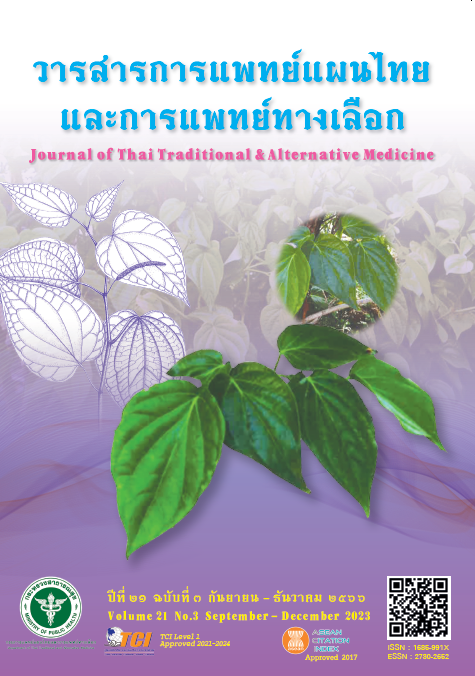
Callus Induction and Rosmarinic Acid Production of Helicteres isora L.
Article Sidebar
Main Article Content
Abstract
Introduction and objective: Helicteres isora L. is a medicinal plant (known in Thai as po bit) that exhibits numerous pharmacological properties such as antioxidant, anticancer, antibacterial and hypolipidemic activities. The cultivation of H. isora has inconsistent amounts of active substances due to many factors. Therefore, the objective of this study was to develop a suitable medium to induce rosmarinic acid (RA) substance from H. isora callus using a plant tissue culture system.
Methods: Firstly, the sterile lateral bud of H. isora was used and cultured on Marashige and Skoog (MS) medium which contains plant growth regulator, thidiazuron (TDZ) and naphthaleneacetic acid (NAA) for 45 days. The RA was determined in callus using High Performance Liquid Chromatography (HPLC) technique.
Results: The treatment of lateral bud with MS medium containing 0.4 mg/L TDZ and 0.3 mg/L NAA for 45 days could induce H. isora callus at 2.9±0.58 cm in diameter. The RA concentration was 0.3939% in dry weight and showed approximately 4.5 times higher than those of the natural sources.
Discussion: Callus culture can increase the efficiency and effectiveness of the desired active compounds in the herbal plant. In addition, it can reduce various factors that are caused by extracting substances directly from plants, such as reduced time, cost, including the contamination of chemicals, heavy metals, and various microorganisms. Therefore, the substances obtained from this process are of high quality and suitable for further use in both the medical and the herbal plant extract industry.
Conclusion and recommendation: This suitable medium is for callus culture of RA production. However, this study was based on the basic callus culture technique only. Increasing the efficiency of RA production can be done by adding other stimulants.
Article Details

This work is licensed under a Creative Commons Attribution-NonCommercial-NoDerivatives 4.0 International License.
References
The plant list. Malvaceae [Internet]. 2013. [cited 2023 Aug 16]; Available from: http://www.theplantlist.org/tpl1.1/record/kew-2843218
Seepen S, Phengklai C. Thai plant in Suanluang RAMA IX (Vol.2). Bangkok: Amarin Printing and Publishing Public Company Limited; 1999. 152 p. (in Thai)
Subcharoen P, Reuanglangsi N, Deewiset K. Thai herbs in central national park. 2nd ed. Thai traditional medicine development foundation; 2006. 164 p. (in Thai)
Varghese E, Pappachen KL, Narayanan SS. Isolation and evaluation of antimicrobial properties of isolated phytoconstituents of fruits of Helicteres isora Linn. Research Journal of Pharmaceutical, Biological and Chemical Sciences. 2012;3(3):959-64.
Tambekar DH, Khante BS, Panzade BK, Dahikar SB, Banginwar YS. Evaluation of phytochemical and antibacterial potential of Helicteres isora L. fruits against enteric bacterial pathogens. African Journal of Traditional Complementary and Alternative Medicines. 2008;5(3):290-3.
Venkatesh S, Sailaxmi K, Reddy BM, Mullangi R. Antimicrobial activity of Helicteres isora root. Indian Journal of Pharmaceutical Sciences. 2007;69(5):687-9.
Dayal R, Singh A, Ojha RP, Mishra KP. Possible therapeutic potential of Helicteres isora (L.) and it's mechanism of action in diseases. Journal of Medicinal Plants Studies. 2015;3(2):95-100.
Kamiya K, Saiki Y, Hama T, Fujimoto Y, Endang H, Umar M, Satake T. Flavonoid glucoronides from Helicteres isora. Phytochemistry. 2001;57:297-301.
Vennila S, Bupesh G, Saravanamurali K, Kumar VS, Raja RS, Saran N, Magesh S. In silico docking study of compounds elucidated from Helicteres isora fruits with ampkinase-insulin receptor. Bioinformation. 2014;10(5):263-6.
Satake T, Kamiya K, Saiki Y, Hama T, Fujimoto Y, Kitanaka S, Kimura Y, Uzawa J, Endang H, Umar M. Studies on the constituents of fruits of Helicteres isora L. Chemical and Pharmaceutical Bulletin. 1999;47(10):1444-7.
Chandirasegaran G, Elanchezhiyan C, Ghosh K, Sethupathy S. Determination of antidiabetic compounds from Helicteres isora fruits by oral glucose tolerance test. Journal of Applied Pharmaceutical Science. 2016;6(2):172-4.
Shekarchi M, Hajimehdipoor H, Saeidnia S, Gohari A.R, Hamedani M.P. Comparative study of rosmarinic acid content in some plants of Labiatae family. Pharmacogn Mag. 2012;8(29):37-41.
Swarup V, Ghosh J, Ghosh S, Saxena A, Basu A. Antiviral and anti-inflammatory effects of rosmarinic acid in an experimental murine model of Japanese encephalitis. Antimicrob Agents Chemother. 2007;51:3367-70.
Hooker CW, Lott WB, Harrich D. Inhibitors of human immunodeficiency virus type 1 reverse transcriptase target distinct phases of early reverse transcription. J Virol. 2001;75:3095-104.
Huang SS, Zheng RL. Rosmarinic acid inhibits angiogenesis and its mechanism of action in vitro. Cancer Lett. 2006;239:271-80.
Lu Y, Foo LY. Polyphenolics of Salvia- A review. Phytochemistry. 2002;75:197-202.
Murashige T, Skooge T. A revised medium for rapid growth bioassays with tobacco tissue culture. Physiol Plantarum. 1962;15:473-93.
Sanguansermri M, Phimsen N, Wongsawad P, Buddharaksa P. Effect of NAA and TDZ combinations on callus induction of drumstick (Moringa oleifera Lam.). Naresuan Phayao J. 2014;7:242-51. (in Thai).
Wongwicha W, Tanaka H, Shoyama Y, Tuvshintogtokh I, Putalun W. Production of glycyrrhizin in licorice callus cultures. Z Naturforsch C. 2008;63:413-7.
Marsud S, Thongchin T, somkid K, Poolsab P, Paparvadee S, Kotchaporn C, Phrugmanon, T, Pranakhon R, Pinta W, Banyati P, Chaisomboonpan S. The cannabinoid contents in different growth stages of thai cannabis sativa L. leaves. Bull Dept Med Sci. 2021;63(3):524-40. (in Thai)
Kumar V, Desai D, Shriram V. Hairy root induction in Helicteres isora L. and production of diosgenin in hairy roots. Nat. Prod. Bioprospect. 2014;4:107–12.
Kikowska M, Budzianowski J, Krawczyk A, Thiem B. Accumulation of rosmarinic, chlorogenic and caffeic acids in vitro cultures of Eryngium planum L. Acta Physiol Plant. 2012;34:2425-33.
Ekiert H, Kwiecien I, Szopa A. Rosmarinic acid production in plant in vitro cultures. Pol J Cosmetol. 2013;16(1):49-58.
Radapong S, Sahad T, Harnkit N, Suppajariyawat P, Akkpaiboon O.P, Meechalad W, Sincharoenpokai P, Niumsakul S, Buaboa S, Ontong S, Kenneth J.R, Chaisomboonpan S. Anti-SARS-CoV-2 activity screening of the selected Thai medicinal plants and potential host-target molecules. Bull Dept Med Sci. 2022;64(2):93-105. (in Thai)
