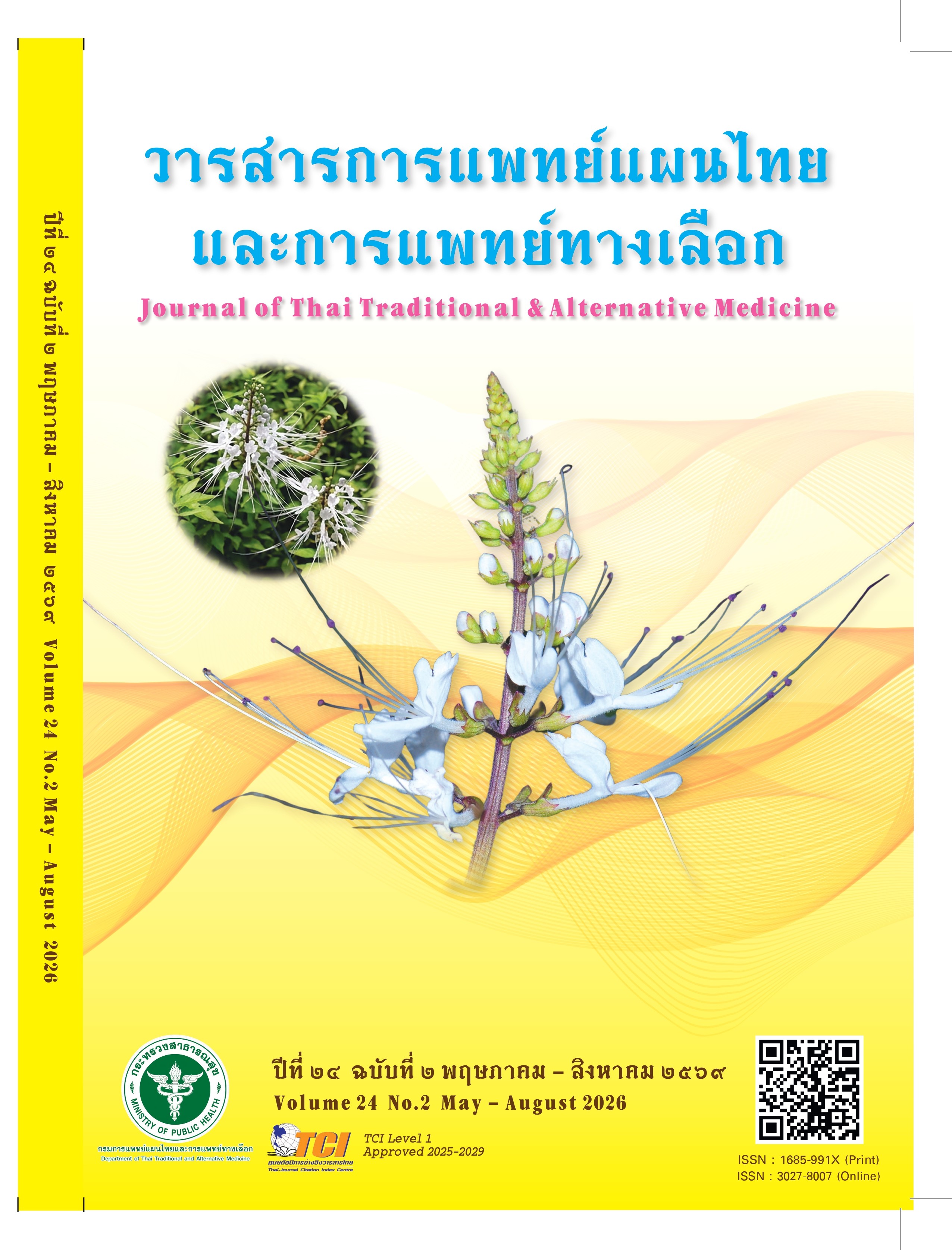
Development and Validation of Analytical Method for Quantitative Analysis of Rosmarinic Acid from Orthosiphon aristatus (Blume) Miq. Leaves and Its Finished Products by Ultra-High Performance Liquid Chromatography
Article Sidebar
Main Article Content
Abstract
Introduction and Objectives: Orthosiphon aristatus (Blume) Miq., commonly known as Java tea, is currently listed in the Thai National List of Essential Medicines in the form of herbal tea and is also commercially available as capsule. However, the current Thai Herbal Pharmacopoeia (THP) lacks an official content specification for the quantitative determination of active marker in both the raw material and its finished products. This study aimed to develop and validate an analytical method for rosmarinic acid content in this medicinal plant and its finished products, namely, capsule and tea.
Methods: This research was divided into three parts: 1) development of an extraction method for rosmarinic acid from O. aristatus using reflux extraction with 50% v/v ethanol; 2) validation of the analytical method using Ultra-High Performance Liquid Chromatography (UHPLC) in accordance with ICH guideline;3) determination of rosmarinic acid content in raw material and its finished products.
Results: The optimal extraction condition was determined to be reflux extraction with 50% v/v ethanol for 30 minutes. The optimized chromatographic system utilized a C18 column (4.6 x 150 mm, 5 µm) as the stationary phase. The mobile phase consisted of an isocratic mixture of acetonitrile and 0.1% formic acid in water (30:70), with a flow rate of 0.5 ml/min and UV detection at 330 nm. Under these conditions, the peak for rosmarinic acid appeared at a retention time of 9.6–9.7 minutes. The method demonstrated high specificity and excellent linearity within the concentration range of 10–140 µg/ml, with a correlation coefficient (r) ≥ 0.9999. Precision studies showed %RSD values between 0.6–1.5, while accuracy was confirmed with % recovery ranging from 96–101. Furthermore, the method exhibited robustness against variations in mobile phase proportions, flow rate, and column temperature. The analysis of 14 samples of Java Tea revealed a rosmarinic acid content ranging from 0.35% to 2.30% w/w and the mean was 0.60+0.16 %w/w. The rosmarinic acid contents of the capsule and the tea ranged from 0.37 % to 0.44 %w/w and from 0.22 % to 0.61 %w/w, respectively.
Discussion: The developed analytical method offers significant advantages over previously reported methods due to its simplicity and reduced time required for both sample and mobile phase preparation. It is applicable for the quantification of rosmarinic acid in both raw material and its commercial products.
Conclusion: This validated method serves as a valuable tool for not only determining the rosmarinic acid content but also standardizing the rosmarinic acid content in the O. aristatus monograph including its commercial products for future publication of the Thai Herbal Pharmacopoeia.
Keywords: Rosmarinic acid, Orthosiphon aristatus (Blume) Miq., Ultra-High Performance Liquid Chromatography
Article Details

This work is licensed under a Creative Commons Attribution-NonCommercial-NoDerivatives 4.0 International License.
References
Thai Pharmacopoeia Committee. Thai herbal pharmacopoeia. Nonthaburi: Department of Medical Sciences, Ministry of Public Health; 2021. p.785. Available from: https://bdn.dmsc.moph.go.th/th/detailAll/1080/ebook/136
National Drug System Development Committee. National List of Essential Medicines B.E. 2566 (2023). Royal Thai Government Gazette. 2023 Jun 2;140 (Special Pt 130 Ng):16. Available from: https://herbal.fda.moph.go.th/media.php?id=511902077832798208&name=001–66.pdf (in Thai).
Doan DD, Nguyen NH, Doan HK, Nguyen TL, Phan TS, Nguyen VD, Magnus G, Rolf J, Gerd L, Nils ES. Studies on the individual and combined diuretic effects of four Vietnamese traditional herbal remedies (Zea mays, Imperata cylindrica, Plantago major and Orthosiphon stamineus). J Ethnopharmacol. 1992;36(3):225–31. doi:10.1016/0378–8741(92)90048–V. PMID: 1434681. Available from: https://pubmed.ncbi.nlm.nih.gov/1434681/
Tabana YM, Al–Suede FS, Ahamed MB, Dahham SS, Saad SD, Loiy EAH, Saba K, Mohamad T, Doblin S, Aman S, Amin MSAM. Cat's whiskers (Orthosiphon stamineus) tea modulates arthritis pathogenesis via the angiogenesis and inflammatory cascade. BMC Complement Altern Med. 2016;16(1):480. doi:10.1186/s12906–016–1467–4. PMID: 27881135. Available from: https://pubmed.ncbi.nlm.nih.gov/27881135/
Arafat OM, Tham SY, Sadikun A, Zhari I, Haughton PJ, Asmawi MZ. Studies on diuretic and hypouricemic effects of Orthosiphon stamineus methanol extracts in rats. J Ethnopharmacol. 2008;118(3):354–60. doi:10.1016/j.jep.2008.04.015. PMID: 18602231. Available from: https://pubmed.ncbi.nlm.nih.gov/18602231/
Yam MF, Ang LF, Basir R, Salman IM, Ameer OZ, Asmawi MZ. Evaluation of the anti–pyretic potential of Orthosiphon stamineus Benth standardized extract. Inflammopharmacology. 2009;17(1):50–54. doi:10.1007/s10787–008–8038–3. PMID: 19127348. Available from: https://pubmed.ncbi.nlm.nih.gov/19127348/
Wang Q, Wang J, Li N, Liu J, Zhang J, Zhang P, Chen H. A systematic review of Orthosiphon stamineus Benth. in the treatment of diabetes and its complications. Molecules. 2022;27(2):444. doi:10.3390/molecules27020444. PMID: 35056765. Available from: https://pubmed.ncbi.nlm.nih.gov/35056765/
Lokman EF, Saparuddin F, Muhammad H, Othman MH, Zulkipli A. Orthosiphon stamineus as a potential antidiabetic drug in maternal hyperglycemia in streptozotocin–induced diabetic rats. Integr Med Res. 2019;8(3):173–9. doi:10.1016/j.imr.2019.05.006. PMID: 31334030. Available from: https://pubmed.ncbi.nlm.nih.gov/31334030/
Kaviya S, Prakash M, Gayathiri S, Umashankari E. A review on phytochemistry and therapeutic effect of cat's whisker plant (Orthosiphon stamineus). World J Pharm Res [Internet]. 2025;14(16):1189–206. [cited 2025 Aug 3]. Available from: https://wjpr.s3.ap–south–1.amazonaws.com/article_issue/263fbf924016d0222b8e98d115b29f99.pdf
Ashraf K, Halim H, Lim SM, Kalavathy R, Sadia S. In vitro antioxidant, antimicrobial and antiproliferative studies of four different extracts of Orthosiphon stamineus, Gynura procumbens and Ficus deltoidea. Saudi J Biol Sci. 2020;27(1):417–32. doi:10.1016/j.sjbs.2019.11.003. PMID: 31889866. Available from: https://pubmed.ncbi.nlm.nih.gov/31889866/
Alshawsh MA, Abdulla MA, Ismail S, Amin ZA, Qader SW, Hadi AHA, Harmal NS. Free radical scavenging, antimicrobial and immunomodulatory activities of Orthosiphon stamineus. Molecules. 2012;17(5):5385–95. doi:10.3390/molecules17055385. PMID: 22569417. Available from: https://pubmed.ncbi.nlm.nih.gov/22569417/
Hsu CL, Hong BH, Yu YS, Yen GC. Antioxidant and anti–inflammatory effects of Orthosiphon aristatus and its bioactive compounds. J Agric Food Chem. 2010;58(4):2150–6. doi:10.1021/jf903557c. PMID: 20095565. Available from: https://pubmed.ncbi.nlm.nih.gov/20095565/
Suhaimi SH, Hasham R, Hafiz Idris MK, Ismail HF. Optimization of ultrasound–assisted extraction conditions followed by solid phase extraction fractionation from Orthosiphon stamineus Benth. (Lamiaceae) leaves for antiproliferative effect on prostate cancer cells. Molecules [Internet]. 2019;24(22):4183. Available from: https://www.mdpi.com/1420–3049/24/22/4183
Liang YZ, Xie P, Chan K. Quality control of herbal medicines. J Chromatogr B Analyt Technol Biomed Life Sci [Internet]. 2004;812(1–2):53–70. Available from: https://www.sciencedirect.com/science/article/abs/pii/S1570023204006762
European Directorate for the Quality of Medicines & Health Care. European Pharmacopoeia. 11th ed. Strasbourg: Council of Europe; 2022. p. 1572–74.
International Council for Harmonisation of Technical Requirements for Pharmaceuticals for Human Use. ICH harmonised guideline: validation of analytical procedures Q2(R2) [Internet]. Geneva: International Council for Harmonisation of Technical Requirements for Pharmaceuticals for Human Use; 2023 [cited 2026 Jan 17]. Available from: https://database.ich.org/sites/default/files/ICH_Q2–R2_Guideline_2023_1130.pdf
The United States Pharmacopeial Convention. <1092> The dissolution procedure: development and validation. In: United States Pharmacopeia 47–National Formulary 42 (USP 47–NF 42). Rockville (MD): The United States Pharmacopeial Convention; 2024. p. 8350–8363.
Carlson M, Thompson RD. Analyte loss due to membrane filter adsorption as determined by high-performance liquid chromatography. J Chromatogr Sci. 2000;38(2):77–83. doi: 10.1093/chromsci/38.2.77 PMID: 10677837
National Center for Biotechnology Information. PubChem compound summary for CID 5281792, rosmarinic acid [Internet]. Bethesda (MD): National Library of Medicine (US); 2004 [cited 2026 Jan 17]. Available from: https://pubchem.ncbi.nlm.nih.gov/compound/Rosmarinic–Acid
Kamphan C, Poowanna R, Pongnaratorn P, Chan–ae P, Ohnon W, Pakdee N. The comparison of rosmarinic acid in Orthosiphon aristatus extract by high performance liquid chromatography. Huachiew Chalermprakiet Sci Technol J. 2022;8(2):81–91. (in Thai).
