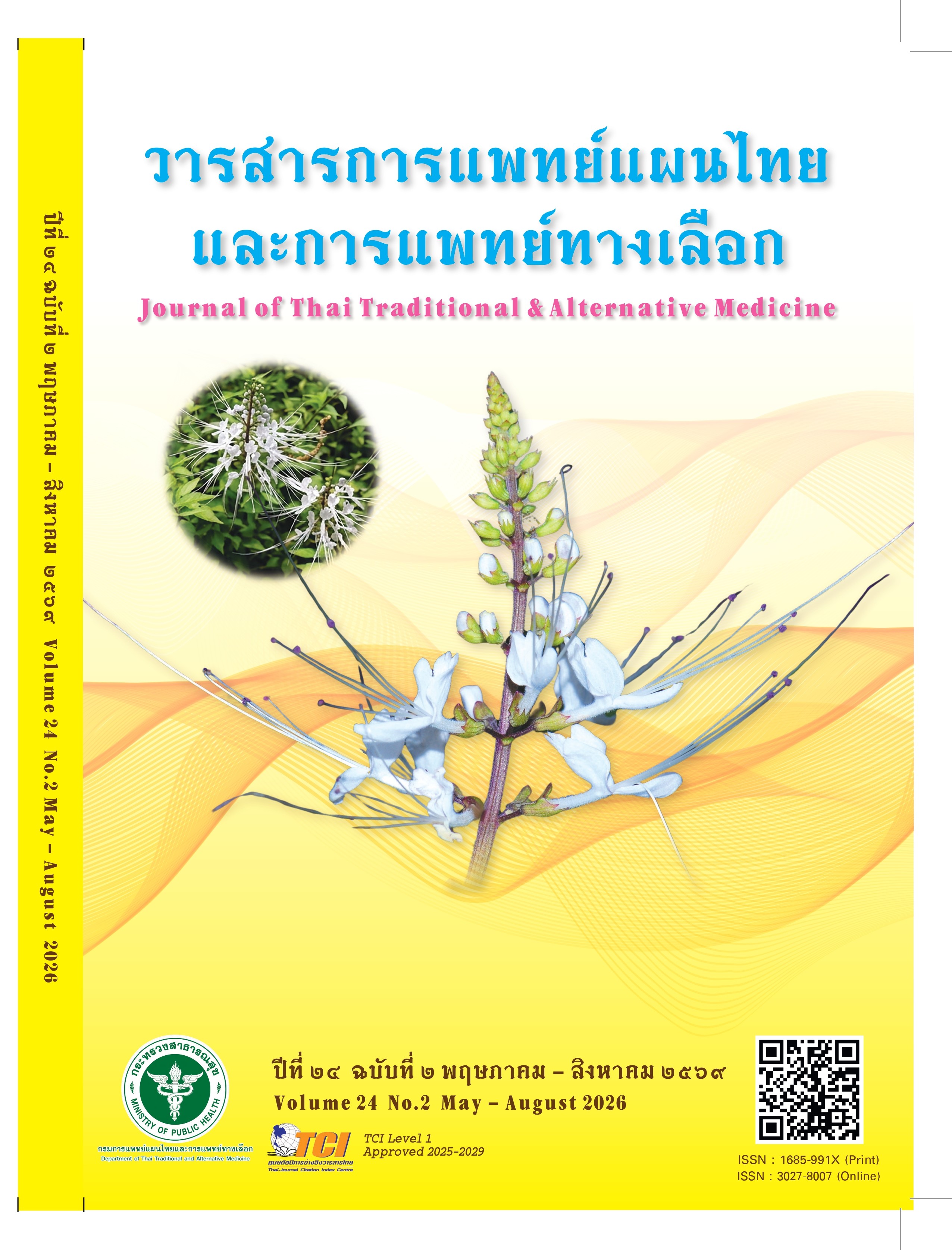
Total Phenolic and Flavonoid Content and Antioxidant Activities of “SAN–BAI–TANG” Formula and Its Herbal Components
Article Sidebar
Main Article Content
Abstract
Introduction and Objectives: "San–Bai–Tang" is a traditional Chinese medicine (TCM) polyherbal formulation historically administered orally to harmonize Qi and Blood, tonify the spleen, and improve skin complexion from within. It consists of four medicinal herbs in equal ratios: Baizhu (Atractylodes macrocephala Koidz.), Baishao (Paeonia lactiflora Pall.), Fuling (Poria cocos (Schw.) Wolf), and Gancao (Glycyrrhiza uralensis Fisch.). This study aimed to evaluate the phytochemical composition and antioxidant capacities of extracts of San–Bai–Tang and its individual herbal components, using solvents with different polarities to assess their potential use as active ingredients in herbal cosmeceuticals. Evaluations included total phenolic content (TPC), total flavonoid content (TFC), and antioxidant capacities via DPPH radical scavenging assay and ferric–reducing antioxidant power (FRAP) assay.
Methods: Individual herbs and the San–Bai–Tang formula were extracted using two extraction systems, i.e., water decoction and agitated maceration in 95% ethanol. The resulting extracts were analyzed for total phenolic content (TPC) and total flavonoid content (TFC). Antioxidant activity was evaluated using 2,2–Diphenyl–1–picrylhydrazyl (DPPH) radical scavenging and ferric reducing antioxidant power (FRAP) assays.
Results: The 95% ethanol extract of the San–Bai–Tang formula contained higher TPC and TFC content (52.60 ± 3.48 mg GAE/g and 47.16 ± 1.77 mg QE/g, respectively) compared to its water extract (28.11 ± 1.31 mg GAE/g and 20.41 ± 1.06 mg QE/g, respectively). In contrast, water extracts of both San–Bai–Tang formula and individual herbs exhibited significantly higher antioxidant capacities in both DPPH and FRAP assays than their corresponding 95% ethanol extracts. For the formula, the water extract showed DPPH and FRAP values of 297.18 ± 1.03 and 154.33 ± 4.68 mg TE/g extract, whereas the ethanol extract showed 217.40 ± 2.47 and 127.05 ± 1.45 mg TE/g extract, respectively. Notably, water extract of Fuling possessed low TPC (8.12 ± 0.65 mg GAE/g) and TFC (2.44 ± 0.40 mg QE/g), yet demonstrated high DPPH (305.33 ± 0.85 mg TE/g) and FRAP (215.35 ± 4.84 mg TE/g) activities, while water extract of Baizhu demonstrated the highest overall antioxidant capacities. These findings highlight the significant contribution of non–phenolic/non–flavonoid water–soluble bioactive compounds, such as β–glucan polysaccharides, to the antioxidant potential of the decoction.
Discussion: Although the 95% ethanol extracts of the San–Bai–Tang formula and its individual herbal components contained approximately two–fold higher total phenolic content (TPC) and total flavonoid content (TFC) than their corresponding water extract, antioxidant evaluations via both DPPH and FRAP assays revealed that the water extracts exhibited significantly superior activities. This reflects that antioxidant capacity does not rely solely on phenolic or flavonoid compounds but is strongly driven by other water–soluble non–phenolic bioactives—such as polysaccharides in Fuling and Baizhu, monoterpene glycosides in Baishao, and triterpene saponins in Gancao—which readily dissolve in water and efficiently donate electrons or hydrogen atoms to neutralize free radicals. The polyherbal combination within the formula thus fosters synergistic effects among these diverse antioxidant constituents. Consequently, these findings support the potential of San–Bai–Tang remedy as an antioxidant active ingredient for the formulation of herbal cosmeceuticals, suggesting that water–containing solvent systems are more appropriate for extraction than high–concentration ethanol alone.
Conclusion: The San–Bai–Tang formula demonstrates strong potential as a natural source of antioxidants. Although 95% ethanol yields higher total phenolic and flavonoid content, hot water extraction exhibits significantly superior antioxidant capacities, driven primarily by water–soluble non–phenolic bioactives. These findings provide a scientific rationale for selecting water–containing solvent systems when formulating San–Bai–Tang into active ingredients for herbal cosmeceuticals.
Article Details

This work is licensed under a Creative Commons Attribution-NonCommercial-NoDerivatives 4.0 International License.
References
Ashawat MS, Banchhor M, Saraf S, Saraf S. Herbal cosmetics: trends in skin care formulation. Pharmacogn Rev. 2009;3(5):82–89.
Hoang HT, Moon JY, Lee YC. Natural antioxidants from plant extracts in skincare cosmetics: recent applications, challenges and perspectives. Cosmetics. 2021;8(4):106.
Ribeiro AS, Estanqueiro M, Oliveira MB, Lobo JS. Main benefits and applicability of plant extracts in skin care products. Cosmetics. 2015;2(2):48–65.
Cosmetic Act B.E. 2558 (2015). Published in Government Gazette, Vol. 132, Part 86A. (2015 Sep 8). (in Thai)
Herbal Product Act B.E. 2562 (2019). Published in Government Gazette, Vol. 136, Part 56A. (2019 Apr 30). (in Thai)
Wang KH, Lin RD, Hsu FL, Huang YH, Chang HC, Huang CY, Lee MH. Cosmetic applications of selected traditional Chinese herbal medicines. J Ethnopharmacol. 2006;106(3):353–59.
Li C. Yixue Rumen (Introduction to Medicine). Beijing: People's Medical Publishing House; 2006 (in Chinese).
Luo W, Zhang K, Wang Y, Ye M, Zhang Y, Xu W, Chen L, Li H. The rhizome of Atractylodes macrocephala Koidz.: A comprehensive review on the traditional uses, phytochemistry and pharmacology. Chem Biodivers. 2025;22(1):e202401879.
Tan YQ, Chen HW, Li J, Wu Q. Paeonia lactiflora Pall.: A review of its phytochemistry, pharmacology, and clinical applications. Front Pharmacol. 2020;11:561587.
Ríos JL. Chemical constituents and pharmacological properties of Poria cocos. Planta Med. 2011;77(7):681–91.
Chinese Pharmacopoeia Commission. Pharmacopoeia of the People's Republic of China 2020. Beijing: China Medical Science Press; 2020 (in Chinese).
Yang R, Wang LQ, Yuan BC, Liu Y. The traditional uses, phytochemistry, and pharmacology of Glycyrrhiza uralensis Fisch. J Ethnopharmacol. 2017;209:301–16.
Ye Y, Chou GX, Mu DD, Wang H, Chu JH, Leung AK, Fong W, Yu ZL. Screening of Chinese herbal medicines for anti–tyrosinase activity in a cell free system and B16 cells. J Ethnopharmacol. 2010;129(3):387–90.
Xiao Y, Shan X, Wang H, Hong B, Ge Z, Ma J, LiY, Zhao Y, Ma G, Zhang C. Spectrum–effect relationship between HPLC fingerprint and antioxidant of "San–Bai Decoction" extracts. J Chromatogr B Analyt Technol Biomed Life Sci. 2022;1208:123380.
Cieniak C, Walshe–Roussel B, Liu R, Muhammad A, Saleem A, Haddad PS, Cuerrier A, Foster Brian C, Arnason John T. Phytochemical comparison of the water and ethanol leaf extracts of the cree medicinal plant, Sarracenia purpurea L. (Sarraceniaceae). J Pharm Pharm Sci. 2015;18(4):484–93.
Sultana B, Anwar F, Ashraf M. Effect of extraction solvent/technique on the antioxidant activity of selected medicinal plant extracts. Molecules. 2009;14(6):2167–80.
Atun S, Pertiwi KR, Qolbiah M, Safa S. Phytochemical analysis both of water and ethanol extract from some herbs combinations, nanoemulsion formulation, and antioxidant effects. Open Access Maced J Med Sci. 2022;10(A):95–100.
Lee CI, Lee CL, Hwang JF, Lee YH, Wang JJ. Monascus–fermented red mold rice exhibits cytotoxic effect and induces apoptosis on human breast cancer cells. Appl Microbiol Biotechnol. 2013;97(3):1269–78.
Sanjukta S, Rai AK, Muhammed A, Jeyaram K, Talukdar NC. Enhancement of antioxidant properties of two soybean varieties of Sikkim Himalayan region by proteolytic Bacillus subtilis fermentation. J Funct Foods. 2015;14:650–58.
Benzie IF, Strain JJ. The ferric reducing ability of plasma (FRAP) as a measure of “antioxidant power”: the FRAP assay. Anal Biochem. 1996;239(1):70–6.
Brand–Williams W, Cuvelier ME, Berset C. Use of a free radical method to evaluate antioxidant activity. LWT. 1995;28(1):25–30.
Qu L, Xu J, Cheng Z, Zhang X, Zhou B, Wang C, et al. Structural characterization and antioxidant activity of polysaccharides from Atractylodes macrocephala Koidz. Int J Biol Macromol. 2020;159:1016–24.
Dai J, Mumper RJ. Plant phenolics: extraction, analysis and their antioxidant and anticancer properties. Molecules. 2010;15(10):7313–52.
Wong SP, Leong LP, Koh JH. Antioxidant activities of aqueous extracts of selected plants. Food Chem. 2006;99(4):775–83.
Zhou X, Seto SW, Chang D, Kiat H, Razmovski–Naumovski V, Chan K, Bensoussan A. Synergistic effects of Chinese herbal medicine: a comprehensive review of methodology and current research. Front Pharmacol. 2016;7:201.
