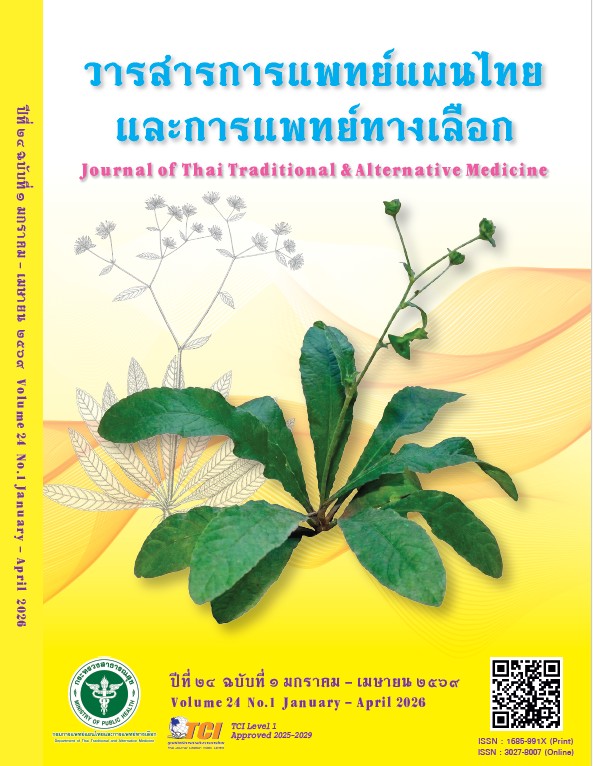
Efficacy of Calendula gel on the Healing of Chronic Wounds: An Open–Label Randomized Controlled Trial
Article Sidebar
Main Article Content
Abstract
Introduction and objective: The management of chronic wounds remains a clinical challenge in modern healthcare due to their delayed healing process and increased risk of recurrent infections, which demand substantial healthcare resources. Recently, integration of herbal remedies with conventional medicine has gained attention, especially herbs with anti–inflammatory and wound healing properties. Calendula officinalis L. (pot marigold) is a medicinal plant with strong therapeutic potential, containing bioactive compounds such as flavonoids, lutein, saponins, and triterpenoids that exhibit antioxidant, anti–inflammatory, and tissue–regenerating effects. This study aimed to evaluate the efficacy of Calendula gel in combination with standard care for chronic wound healing using the Pressure Ulcer Scale for Healing (PUSH) score as the primary outcome, and to assess the safety of the herbal formulation.
Methods: This open–label randomized controlled trial was conducted at Tao Ngoi Hospital and its affiliated network in Sakon Nakhon Province, Thailand. A total of 46 patients with chronic wounds were divided into two groups using block randomization with a block size of 4. Both groups underwent daily wound cleansing following standard protocols. Afterwards, the intervention group (n = 23) received topical application of 4% w/v Calendula gel, prepared from German-origin mother tincture, once daily for seven days, while the control group (n = 23) received placebo gel. Daily assessments of wound status and pain intensity were conducted over a 7-day period using the PUSH score and Numerical Rating Scale (NRS), and any adverse events were monitored and documented. Data were analyzed using descriptive statistics, including mean, standard deviation, and percentage. For clinical outcomes, a linear mixed-effects model was employed to analyze the daily trends of PUSH scores and compare percentage changes of PUSH scores between groups. Pain scores were analyzed using a paired t-test for intra-group comparisons and an independent t-test for inter-group comparisons.
Results: Throughout the 7-day follow-up period, both the experimental and control groups showed a continuous reduction in PUSH scores, reflecting progressive wound healing over time. However, the group receiving calendula gel demonstrated a faster and greater reduction in scores compared to the control group, with noticeable differences emerging around days 4–5 and becoming more pronounced during days 5–7. When considering changes from baseline, the experimental group showed a statistically significant reduction from day 5, whereas the control group showed significant improvement only on days 6 and 7. Furthermore, comparisons of percentage change between groups revealed statistically significant differences on days 5 and 6, supporting that calendula gel combined with standard treatment enhances wound healing more effectively than standard wound care plus placebo gel. The experimental group also demonstrated a more rapid and sustained wound recovery trend, with no reported adverse events or product-related side effects throughout the follow-up period. Meanwhile, NRS scores for pain were not significantly different between groups throughout the follow-up period (p > 0.05). These findings suggest that calendula gel may play a role in accelerating tissue repair and reducing healing time when used in conjunction with standard care.
Discussion: The use of Calendula gel alongside standard care significantly promoted chronic wound healing and may be particularly beneficial in settings with limited healthcare resources. This finding aligns with the principles of integrative medicine, which blends evidence–based modern medicine with traditional therapies to enhance clinical outcomes. Calendula–based products are also low–cost and easily accessible, making them well-suited for use in general practice. Our findings are consistent with previous clinical trials conducted in Europe and Latin America, which reported positive outcomes of topical Calendula officinalis in wound healing. Additionally, the absence of any adverse reactions in this study supports the safety profile of the gel, making it a viable option for vulnerable populations such as the elderly, diabetic patients, and those with compromised immunity.
Conclusions and Recommendations: Calendula gel was found to be safe and effective when used as an adjunct to standard wound care in patients with chronic wounds. The results support the development of reliable herbal–based interventions for clinical use. Further research should involve larger sample sizes, various types of chronic wounds (e.g., diabetic ulcers, pressure ulcers), and long-term follow-up to confirm the consistency of these outcomes in diverse healthcare contexts. Such evidence could serve as a foundation for incorporating Calendula gel into national public health policy as an alternative or adjunctive therapy in wound care.
Key words: Calendula gel, chronic wounds, PUSH score, wound healing, randomized controlled trial
Article Details

This work is licensed under a Creative Commons Attribution-NonCommercial-NoDerivatives 4.0 International License.
References
Buzzi M, de Freitas F. Therapeutic effectiveness of a Calendula officinalis extract in venous leg ulcer healing. J Wound Care. 2016;25(12):732–9. doi:10.12968/jowc.2016.25.12.732.
Duran V, Matic M, Jovanovc M, Mimica N, Gajinov Z, Poljacki M, Duran I. Results of the clinical examination of an ointment with marigold (Calendula officinalis) extract in the treatment of venous leg ulcers. Int J Tissue React. 2005;27:101–6.
Lièvre M, Marichy J, Baux S, de Saint-Aubert B, Bled N. Controlled study of three ointments for the local management of second- and third-degree burns. Clin Trials Meta-Anal. 1992;28:9–12. Available from: https://eurekamag.com/research/008/387/008387217.php
Givol O, Kornhaber R, Visentin D, Cleary M, Haik J, Harats M. A systematic review of Calendula officinalis extract for wound healing. Wound Repair Regen. 2019;27(5):548–61. doi:10.1111/wrr.12737.
Fırat R, Durna H. Nutrition and wound healing: an overview of evidence from the literature. Front Nutr. 2021;8:791899. doi:10.3389/fnut.2021.791899.
Jenwiteesuk K. Wound healing process and treatment principles. Proceedings of the 9th Annual Academic Conference; 2013. Available from: https://li01.tcithaijo.org/index.php/SRIMEDJ/article/view/14743 (in Thai).
Lazarus GS, Cooper DM, Knighton DR, Margolis DJ, Pecoraro RE, Rodeheaver G, Robson MC. Wound healing and repair. In: StatPearls [Internet]. Treasure Island (FL): StatPearls Publishing; 2023 [cited 2025 Aug 3]. Available from: https://www.ncbi.nlm.nih.gov/books/NBK470443/
National Pressure Ulcer Advisory Panel. Pressure Ulcer Status Tool (PUSH Tool 3.0) [Internet]. 1998. Available from: https://www.sralab.org/sites/default/files/2017-06/push3.pdf
Sen CK, Gordillo GM, Roy S, Kirsner R, Lambert L, Hunt TK, Gottrup F, Gurtner GC, Longaker MT. Human skin wounds: a major and snowballing threat to public health and the economy. Wound Repair Regen. 2009;17(6):763–71. doi:10.1111/j.1524-475X.2009.00543.x.
Weller CD, Team VD. First-line interactive wound dressings: review of properties, uses and evidence. Front Pharmacol. 2020;11:155. doi:10.3389/fphar.2020.00155.
Sidhu GS, Mani H, Gaddipati JP, et al. Curcumin enhances wound healing in streptozotocin-induced diabetic rats and genetically diabetic mice. Wound Repair Regen. 1999;7(5):362–74. doi:10.1046/j.1524-475x.1999.00362.x.
Shukla A, Rasik AM, Dhawan BN. Asiaticoside-induced elevation of antioxidant levels in healing wounds. Phytother Res. 1999;13(1):50–4. doi:10.1002/(SICI)1099-1573(199902)13:1<50:AID-PTR379>3.0.CO;2-0.
Molan PC. The evidence supporting the use of honey as a wound dressing. Int J Low Extrem Wounds. 2006;5(1):40–54. doi:10.1177/1534734605286014.
Hekmatpou D, Mehrabi F, Rahzani K, Aghamohammadi-Kalkhoran M. The effect of aloe vera clinical trials on prevention and healing of skin wound: a systematic review. Iran J Med Sci. 2019;44(1):1–9. PMCID: PMC6330525.
Department of National Parks, Wildlife and Plant Conservation (TH). Calendula officinalis [Internet]. Bangkok: Department of National Parks, Wildlife and Plant Conservation; [cited 2026 Apr 18]. Available from: https://www.dnp.go.th/botany/mplant/words.html? keyword= Calendula%20officinalis
Royal Botanic Gardens, Kew. Calendula officinalis L. Plants of the World Online. Available from: https://powo.science.kew.org/taxon/urn:lsid:ipni.org:names:185457-1
Theerachaisakul M. Five Thai herbs commonly used in homeopathy. Bangkok: Sukhumvit Media Marketing Co., Ltd.; 2009. (in Thai)
Preethi KC, Kuttan R. Wound healing activity of flower extract of Calendula officinalis. J Basic Clin Physiol Pharmacol. 2009;20(1):73–9.
Ullah MA, Hassan A, Hamza A. Calendula (Calendula officinalis) marigold as medicinal plant. Orthop Case Rep. 2024;2(6). doi:10.31579/2835-8465/009.
Wanwaitayajit S, Vanikiat P. The effectiveness of Calendula gel on wound healing in patients with acute wounds at Tao Ngoi Hospital and its network in Sakon Nakhon Province [Master’s thesis]. Bangkok: Dhurakij Pundit University; 2023. (in Thai).
Della Loggia R, Tubaro A, Sosa S, Becker H, Saar S, Isaac O. The role of triterpenoids in the topical anti-inflammatory activity of Calendula officinalis flowers. Planta Med. 1994;60(6):516–20. doi:10.1055/s-2006-959562.
National Institute for Emergency Medicine. Guidelines for triage and prioritization of emergency patients at the emergency room according to NIEM criteria. Bangkok: National Institute for Emergency Medicine; 2015. Available from: https://www.niems.go.th/1/Ebook/Detail/485?group=21
Downie WW, Leatham PA, Rhind VM, Wright V, Branco JA, Anderson JA. Studies with pain rating scales. Ann Rheum Dis. 1978;37(4):378–81.
Hawker GA, Mian S, Kendzerska T, French M. Measures of adult pain: Visual Analog Scale Pain (VAS Pain), Numeric Rating Scale for Pain (NRS Pain), McGill Pain Questionnaire (MPQ), Short-Form McGill Pain Questionnaire (SF-MPQ), Chronic Pain Grade Scale (CPGS), Short Form-36 Bodily Pain Scale (SF-36 BPS), and Measure of Intermittent and Constant Osteoarthritis Pain (ICOAP). Arthritis Care Res. 2011;63(Suppl 11):S240–52.
Gould LJ. Chronic wound repair and healing in older adults. Adv Skin Wound Care. 2015;28(6):268–74.
Massaro LA, et al. Older adults more likely to develop chronic wounds. J Am Geriatr Soc. 2021;69(7):1855–62.
