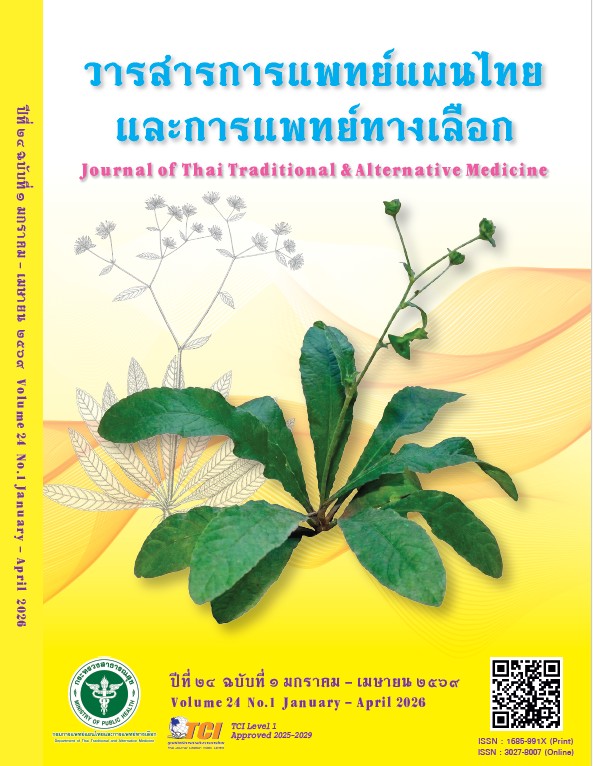
Chemical and Physicochemical Properties of Elephantopus scaber L. Leaves
Article Sidebar
Main Article Content
Abstract
Introduction and Objective: Elephantopus scaber L., a member of the Asteraceae family, is a medicinal herb traditionally utilized by local communities and high–altitude ethnic groups in Thailand. According to indigenous wisdom, the roots and whole plants are typically sun–dried and prepared as decoctions or medicinal tinctures (steeped in alcohol). Its primary therapeutic properties include enhancing physical vigor, acting as an aphrodisiac, relieving muscular pain, serving as a diuretic, and treating various male–specific ailments. Additionally, the leaves are also employed for wound healing and relieving fever and cough. Despite its extensive traditional use, E. scaber lacks established quality control specifications in the Thai Herbal Pharmacopoeia. Consequently, this study aims to investigate the physicochemical properties of E.scaber L. leaves to provide information for the development of standard specification monograph and quality control of this herbal material.
Methods: Twelve samples of Elephantopus scaber L. were obtained from natural sources in Thailand and compared with the authentic sample received from the Herbarium Laboratory. Samples of Elephantopus scaber scaber L. were preliminarily examined for chemical properties using color reaction. Chemical identification was performed using the thin layer chromatography (TLC) method and their physicochemical properties were also determined.
Results: Of all 12 samples, based on the color reactions of the preliminary chemical examination, 12 were positive when tested for flavonoids and phenolic compounds; and based on the TLC method, they were positive for flavonoids and chlorogenic acid. As for their physicochemical property studies including gravimetric method, their mean amounts ± SD for the moisture content, total ash, acid–insoluble ash, water–soluble extractive and 95% ethanol–soluble extractive were 9.33 ± 0.75 %, 6.42 ± 1.20 %, 2.70 ± 0.92 %, 15.55 ± 3.60 % and 7.05 ± 1.59 % w/w, respectively.
Discussion: All 12 samples of Elephantopus scaber L. were found to contain substances with hRf values and colors identical to the chlorogenic acid standard, with an hRf value of approximately 30 – 31. However, variations in band intensity suggest differing concentrations of chlorogenic acid across the samples. These differences may be attributed to variations in cultivars, the age of the herbal plant, harvest time, soil conditions, mineral content, topography, or climatic conditions. Based on the results of the physicochemical analysis, the quality standards for dried Elephantopus scaber L. leaves should be defined as follows: moisture content, total ash, and acid–insoluble ash should be no more than 10%, 7%, and 3% w/w, respectively. Furthermore, the contents of water–soluble extractive and 95% ethanol–soluble extractive should be not less than 14% and 7% w/w, respectively.
Conclusion and Recommendation: The findings of this study will contribute to the establishment of a standard specification monograph for Elephantopus scaber L. leaf in the Thai Herbal Pharmacopoeia (THP), as reference for its quality control. If future research identifies specific compounds with significant pharmacological activity suitable for drug development, quantitative research should be conducted to analyze those markers within a standardized extract. This is essential for toxicological studies, clinical trials, and future commercial utilizations, including the development of a new monograph for Elephantopus scaber L. standardized extracts in THP.
Key words: Elephantopus scaber L., physicochemical properties, proposed specifications, quality control
Article Details

This work is licensed under a Creative Commons Attribution-NonCommercial-NoDerivatives 4.0 International License.
References
Boonyaprapat N, Chokchaicharoenporn O. Medicinal plants indigenous to Thailand. Vol. 1. Bangkok: Prachachon; 1998. p. 32–4. (inThai)
Thai Health Promotion Foundation. Understanding "Do Mai Ru Lom" (Elephant's Foot) [Internet]. Bangkok: Thai Health Promotion Foundation; 2022 Dec 26 [cited 2026 Mar 19]. Available from: https://www.thaihealth.or.th/
Highland Research and Development Institute (Public Organization). Elephantopus scaber: Herbs and the Elderly [Internet]. Chiang Mai: The Institute; [cited 2026 Mar 19]. Available from: https://www.hrdi.or.th/Articles/Detail/131
Highland Research and Development Institute (Public Organization). Final report of the research and development project on medicinal plants and folk medicine in highland areas. Chiang Mai: Highland Research and Development Institute (Public Organization); 2016.
Das M, Bandyopadhyay A. Promising phytomedicines from Elephantopus scaber L: a review. Res J of Pharm Biol Chem Sci. 2015;6(3):1508–18.
Deetae W. Effects of crude extracts of Elephantopus scaber L. and Diospyros rhodocalyx Kurz. on sexual performance in male rats [master’s thesis]. Chiang Mai: Chiang Mai University; 2023.
Pinmongkholgul S, Smitasiri Y, Wongreun S. The effects of Elephantopus scaber Linn. on blood pressure, intracavernous pressure and sperm density in male albino rat (Rattus norvegicus). KKU Sci J. 2005;33(2):104–12. (in Thai)
Rerk–am U, Kongsombat B, Tangsatirapakdee S, Banchonglikitkul C. Determination of some phenolic compounds in ethanolic extract of Elephantopus scaber Linn. leaves. Thai J Pharm Sci. 2012;36:14–6. (in Thai)
Osman ME, Ahmed EM, Eltohami MS. Preliminary phytochemical evaluation and seed proximate analysis of Surib (Sesbania leptocarpa DC.). Sudan J Med Sci. 2013;8(1):29–34.
Department of Medical Sciences. Thai Herbal Pharmacopoeia. Volume 2. Bangkok: Prachachon; 2007.
Ahuja J, Suresh J, Deep A, Madhuri, Pratyusha, Ravi. Phytochemical screening of aerial parts of Artemisia parviflora Roxb.: a medicinal plant. Pharm Lett. 2011;3(6):116–24.
Deachathai S, Mahabusarakam W, Phongpaichit S, Taylor WC. Phenolic compounds from the fruit of Garcinia dulcis. Phytochemistry. 2005;66(19):2368–75. (in Thai)
Dechatiwongse T, Techadamrongsin Y, Jirawattanapong W. Chemical specification of Thai herbal drugs, Volume 1. Nonthaburi: Department of Medical Sciences, Ministry of Public Health; 1993. p. 171–6. (in Thai)
Department of Medical Sciences, Ministry of Public Health. Thai herbal pharmacopoeia 2018. Bangkok: Keawjawjom Printing & Publishing, Suan Sunandha Rajabhat University; 2018. 782 p.
(in Thai)
Plant Research and Development Division. Inspection methods to control quality and standardization. In: Department of Medical Sciences. Herbal guide to basic public health. Bangkok: Text and Journal Corporation; 1988. p. 17–9. (in Thai)
Evans WC. Trease and Evans’ pharmacognosy. 13th ed. London: ELBS; 1989. p. 39–57, 127–9.
Department of Medical Sciences, Ministry of Public Health. Thai herbal pharmacopoeia. Volume 1. Bangkok: Prachachon; 1995.
Department of Medical Sciences, Ministry of Public Health. Thai herbal pharmacopoeia. Volume 2. Bangkok: Prachachon; 2000.
Dechatiwongse Na Ayudhya T, Jirawattanapong W. Standardization and quality control of herbs. Nonthaburi: Medicinal Plant Research Institute, Department of Medical Sciences; 2001. p. 1–25. (in Thai)
Drug Control Division, Food and Drug Administration. Guidelines for quality control of medicinal products from herbs. Bangkok: Agricultural Cooperative Assembly Printing Company of Thailand; 2005.
