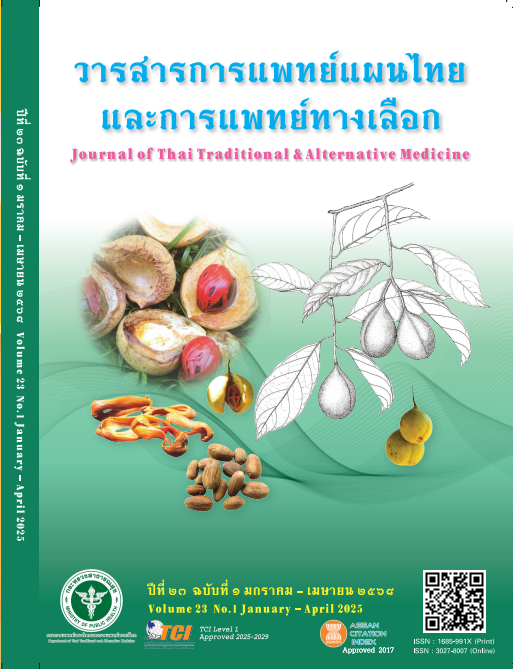
Bioactive Compounds of Indigofera tinctorial L. Extract and Lotion Formulation
Article Sidebar
Main Article Content
Abstract
Introduction & Objectives: Indigofera tinctorial L. (indigo) isabroadshrub withalternatepinnateleaves
and elliptic leaflets that have compounds with antioxidant, antibacterial and anti-inflammatory activities, which
inhibit thedevelopmentof lungcancer,andprotectagainstultraviolet radiation. Indigohasbeenusedtodyefabric,
and there has been research on indigo extracts being used to develop cosmetic products. This research aimed to
study the biological properties of indigo extract, formulate lotions and test their physical and chemical stability.
Methodology: Theantioxidantactivityof indigoextract was studiedusinga DPPH assay,anditsphenolic
content was determined using theFolin-ciocalteu colorimetry method and flavonoid content using the aluminum
chloridecolorimetry method.Freshindigofrom theshoot tips,youngleaves, matureleaves,andall threeparts ina
ratioof1:1:1 wasextracted with methanol solvent. Theextract thatexhibitedthebestantioxidantactivity,phenolic
content,and flavonoidcontent wasselectedtodeveloplotion,andthebest lotion wastestedforantioxidantactivity,
phenolic content, and flavonoid content by using one-way ANOVA for the effects of such substances.
Results: The indigo extracts from shoot tips had the best antioxidant activity at IC50 of 0.12 ± 0.01 mg/
mL, from young leaves had the highest phenolic content (114.93 ± 11.44 mg GAE/g extract), and from all three
partshadthehighest flavonoidcontent (763.00±42.26 mg QE/gextract). As for the lotion formulation, the third
formula with0.12 %w/w all-part indigoextracthadgoodphysical andchemical stabilitycharacteristics; whilethe
formula usingshoot-tip extract hadthebest antioxidant activity at IC50 of 42.23±0.02 mg/mL.
Discussion: Thisstudyfoundthat thetotalphenolicand flavonoidcontentsdidnotpositivelycorrelate with
antioxidant activity. This could be a guideline for selecting the plant parts for testing to match the application’s
benefits.Forexample, toproduceaproduct for reducinginflammationand wrinkles, theplantpart withthehighestantioxidant activity maybe used.
Conclusions and Recommendations: The extract from shoot tip had the highest antioxidant content.
The lotion formula with an extract from shoot tips had the highest antioxidant activity.Formulating a lotion with
indigoextract as a cosmeticproduct was anadditionaluseof indigoother thanfor fabricdyeing. Other important
substances from indigoextractandtoxicitytestinginanimal models shouldbefurther studied. It mayalsobe made intoa medicinal product for reducinginflammation. That was anadditional choice for consumers to useproducts
withnatural herbal ingredients, leading to the development of commercial herbal products
Article Details

This work is licensed under a Creative Commons Attribution-NonCommercial-NoDerivatives 4.0 International License.
References
Tem Smitinand. Thai Plant Names. Forest Botany Division, Forest Academic Office, Royal Forest Department. 2nd ed. (revised edition). Bangkok: Prachachon Company Limited; 2001.
Renukadevi KP, Sultana SS. Determination of Antibacterial, Antioxidant and Cytotoxicity Effect of Indigofera tinctoria on Lung Cell Line NCI-h69. International Journal of Pharmacology. 2011;7(3):356-62.
Sharma R, Agarwal A. Physicochemical and Antioxidant Assays of Methanol and Hydromethanol Extract of Ariel Parts of Indigofera tinctoria Linn. International Journal of Cancer Research. 2015;4(3):71-80.
Joy PP, Thomas J, Mathew S, Skaria BP. Medical Plants. Medical Plant Research Station. 1998:73-4.
Stepp JR. The role of weeds as source of pharmaceuticals. Journal of ethnopharmacology. 2004;92:163-6.
Poonkasem Y, Damrianant S, Sakkayawong N. Antioxidant Activities and Cytotoxicity Screening of the Extracts from Indigo (Indigofera tinctoria). Thai Journal of Science and Technology. 2021;10(5):571-86. (in Thai)
Saithong A. The pattern creation and the dyeing process of Indigo fabric of Phu
Tai people in Thailand, Laos and Vietnam. Final report (Thai), Sakon Nakhon: Sakon Nakhon Rajabhat University; 2017.
Poonkasem Y. Preparation of cosmetic product prototype from Indigofera tinctoria L. extracts and powdered indigo. Master of Science (Thai), Bangkok: Thammasat University; 2021.
Loipiman P, Phasakul T, Mongkoltai R. Comparison with antioxidants and total
Phenolic compound of peel fruit. Journal of Science. 2011;42(2):233-6. (in Thai)
Prommuak C, D-Eknamkul W, Shotipruk A. Extraction of flavonoids and carotenoids from Thai silk waste and antioxidant activity of extract. Separation and Purification Technology. 2008;62:444-8. (in Thai)
Buabang R, Thongbunjob K, Inchaithep S. Stroke Risk Assessment Using Color Chart in Patients with Diabetes Mellitus and Hypertension, Ngao District Hospital, Lampang Province. Journal of Boromarajonani College of Nursing, Surin. 2024;14(1):144-59.
Webster D. pH–principles and measurement.Encyclopaedia of Food Science, Food Technology and Nutrition. 2003:4501-07.
Jaitham A. Optimization of formulation for enhancing stability of silicone emulsion containing karanda fruit extract. Master of Science (Thai), Bangkok: Srinakharinwirot University; 2022.
Berna E, Rosmala D, Muhammad H. Antioxidant Cream of Solanum lycopersicum L. International Journal of Pharm Tech Research. 2013;5(1):233-8.
Ongaj C. Antioxidant properties of local vegetables in Phra Nakhon Si Ayutthaya Province. Journal of Agriculture. 2015;46(3):321-4. (in Thai)
Kim KS, Hwang WG, Jang HG, Heo BG, Suhaj M, Leontowicz H, Leontowicz M, Jastrzebski Z, Tashma Z, Gorinstein S. Assessment of Indigo (Polygonum tinctorium Ait.) water extracts’ bioactive compounds and their antioxidant and antiproliferative activities. Journal of Food Science and Technology. 2012;46(2):500-10.
Josuttis M, Carlen C, Crespo P, Nestby R, Toldam-Andersen TB, Dietrich H, Krüger E. A comparison of bioactive compounds of Strawberry fruit from Europe affected by genotype and latitude. Journal of Berry Research. 2012;2(2):73-95.
Prathanturaruk S. Encyclopedia of Herbs, Volume 1. Bangkok: Sirirukachart Herb Garden, Department of Pharmacognosy, Faculty of Pharmacy, Mahidol University. 2000.
Thantong S, Malaluk P, Limsuk N. Development of skin care products from
Tamarind. Final report (Thai), Phetchabun: Phetchabun Rajabhat University; 2011.
Pandey KB, Rizvi SI. Plant Polyphenols as dietary antioxidants in human health
and disease. International Journal oxidative medicine and cellular. 2009;2(5):270-78.
Moeykhang N. Finding the quantity Phenolic compounds and antioxidant activity
juice drink. Final report (Thai), Khon Kaen: Khon Kaen University; 2014.
Yartchimplee A, Khumphaiand P, Sakkayawong N, Sompark C. Antioxidant activities of the indigo extracts and prediction of tyrosinase inhibition by molecular docking. Thai Journal of Science and Technology. 2021;10(4):469-86.
