
ภาวะโซเดียมในเลือดต่ำเนื่องจากการสูญเสียโซเดียมจากร่างกายในโรคระบบประสาทส่วนกลาง
Article Sidebar
Main Article Content
บทคัดย่อ
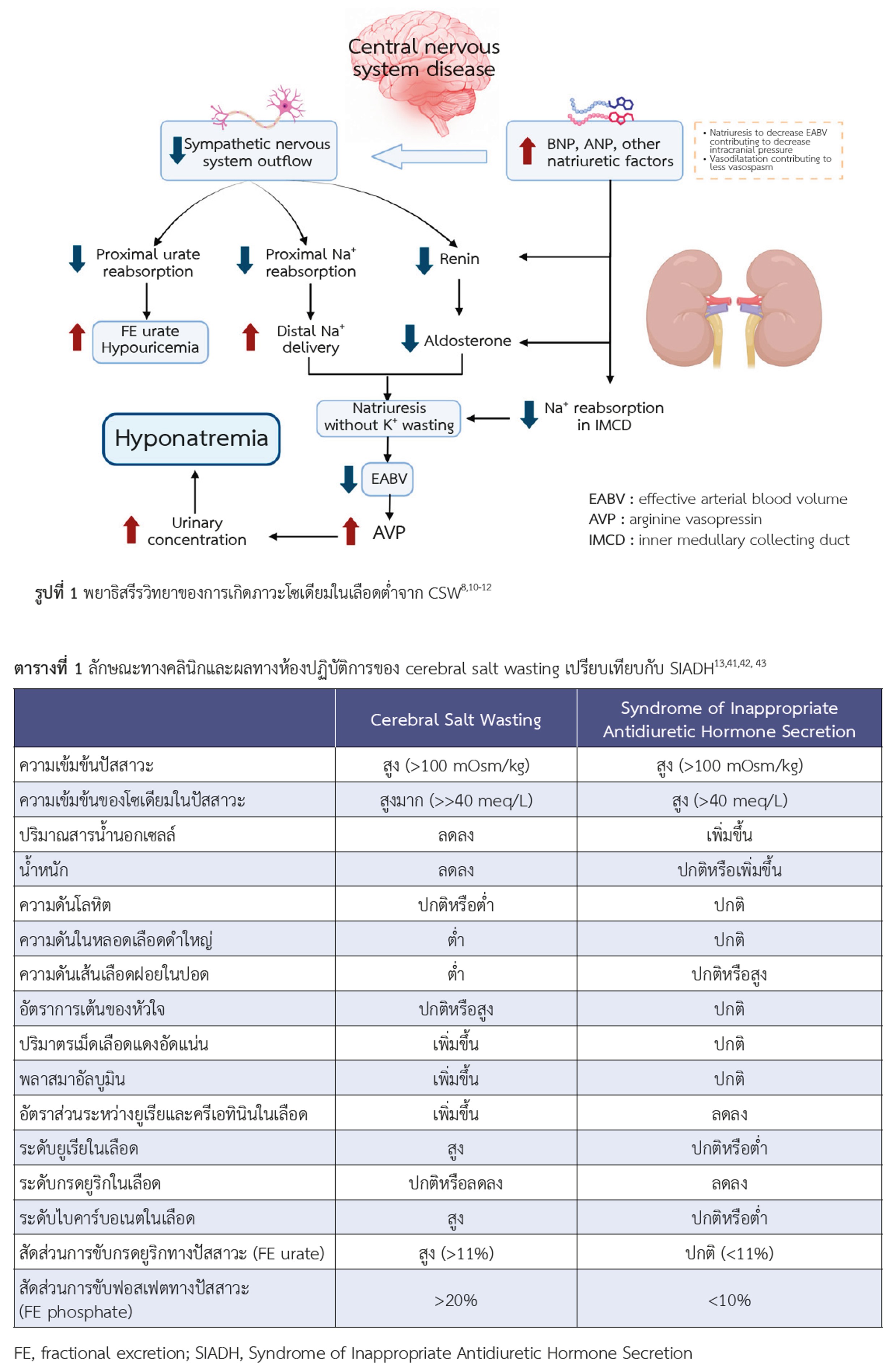
ภาวะโซเดียมในเลือดต่ำเป็นความผิดปกติที่พบได้บ่อยในผู้ป่วยที่มีโรคทางระบบประสาทส่วนกลาง สาเหตุสำคัญสองอย่างหลักของภาวะโซเดียมในเลือดต่ำคือ Syndrome of Inappropriate Antidiuretic Hormone (SIADH) และ Cerebral Salt Wasting (CSW) การวินิจฉัยแยกโรคระหว่าง CSW และ SIADH เป็นสิ่งสำคัญ เนื่องจากมีวิธีการรักษาที่แตกต่างกัน พยาธิสรีรวิทยาของ CSW เกิดจากการดูดกลับโซเดียมที่ลดลง เนื่องจากเซลล์สมองที่บาดเจ็บมีการหลั่ง Brain Natriuretic Peptide ร่วมกับระบบประสาทซิมพาเทติกที่ลดลง นำไปสู่การมีภาวะขาดน้ำของร่างกายและกระตุ้น Antidiuretic Hormone ทำให้เกิดภาวะโซเดียมในเลือดต่ำ การตรวจร่างกายและการตรวจทางห้องปฏิบัติการที่บ่งบอกภาวะขาดน้ำ เช่น ภาวะความดันโลหิตต่ำ ความยืดหยุ่นของผิวลดลง ปริมาตรเม็ดเลือดแดงอัดแน่นเพิ่มมากขึ้นซึ่งแตกต่างจาก SIADH ที่จะมีปริมาตรของเหลวนอกเซลล์ที่เพิ่มขึ้นเล็กน้อยหรือปกติ การรักษา CSW คือการให้สารน้ำและโซเดียมในปริมาณที่เพียงพอ รวมถึงการให้ยา fludrocortisone เพื่อป้องกันการสูญเสียน้ำและเกลือแร่ในร่างกาย การรักษาที่ถูกต้องเป็นสิ่งสำคัญในการฟื้นฟูสมดุลของเหลวและเกลือแร่ในร่างกายและลดความเสี่ยงต่อภาวะแทรกซ้อนที่อาจเกิดขึ้นได้ บทความนี้จึงทบทวนกลไกการเกิดโรค การวินิจฉัย และการรักษาในปัจจุบันของภาวะ CSW
Article Details

อนุญาตภายใต้เงื่อนไข Creative Commons Attribution-NonCommercial-NoDerivatives 4.0 International License.
บทความนี้ตีพิมพ์ภายไต้การอนุญาต CC BY-NC-ND 4.0 ซึ่งอนุญาตให้สามารถใช้บทความนี้พื่อวัตถุประสงค์ใดๆ ก็ตามที่ไม่ใช่เชิงพาณิชย์ โดยต้องมีการอ้างถึงที่มาของบทความอย่างครบถ้วน ใครก็ตามสามารถคัดลอกและแจกจ่ายทุกส่วนของบทความนี้โดยไม่ต้องขออนุญาตจากผู้ประพันธ์หรือสมาคมโรคไตแห่งประเทศไทย
เอกสารอ้างอิง
Hasan D, Wijdicks EF, Vermeulen M. Hyponatremia is associated with cerebral ischemia in patients with aneurysmal subarachnoid hemorrhage. Ann Neurol 1990;27(1):106-8. doi: 10.1002/ana.410270118.
Sherlock M, O’Sullivan E, Agha A, Behan LA, Rawluk D, Brennan P, et al. The incidence and pathophysiology of hyponatraemia after subarachnoid haemorrhage. Clin Endocrinol (Oxf) 2006;64(3):250-4. doi: 10.1111/j.1365-2265.2006.02432.x.
Wartenberg KE, Schmidt JM, Claassen J, Temes RE, Frontera JA, Ostapkovich N, et al. Impact of medical complications on outcome after subarachnoid hemorrhage. Crit Care Med 2006;34(3):617-23; quiz 24. doi: 10.1097/01.ccm.0000201903.46435.35.
Qureshi AI, Suri MF, Sung GY, Straw RN, Yahia AM, Saad M, et al. Prognostic significance of hypernatremia and hyponatremia among patients with aneurysmal subarachnoid hemorrhage. Neurosurgery 2002;50(4):749-55; discussion 55-6. doi: 10.1097/00006123-200204000-00012.
Gutierrez OM, Lin HY. Refractory hyponatremia. Kidney Int 2007;71(1):79-82. doi: 10.1038/sj.ki.5001845.
Singh S, Bohn D, Carlotti AP, Cusimano M, Rutka JT, Halperin ML. Cerebral salt wasting: truths, fallacies, theories, and challenges. Crit Care Med 2002;30(11):2575-9. doi: 10.1097/00003246-200211000-00028.
Carlotti AP, Bohn D, Rutka JT, Singh S, Berry WA, Sharman A, et al. A method to estimate urinary electrolyte excretion in patients at risk for developing cerebral salt wasting. J Neurosurg 2001;95(3):420-4. doi: 10.3171/jns.2001.95.3.0420.
Palmer BF. Hyponatremia in patients with central nervous system disease: SIADH versus CSW. Trends Endocrinol Metab 2003;14(4):182-7. doi: 10.1016/s1043-2760(03)00048-1.
Palmer BF. Hyponatraemia in a neurosurgical patient: syndrome of inappropriate antidiuretic hormone secretion versus cerebral salt wasting. Nephrol Dial Transplant 2000;15(2):262-8. doi: 10.1093/ndt/15.2.262.
Maesaka JK, Imbriano LJ. Cerebral Salt Wasting Is a Real Cause of Hyponatremia: PRO. Kidney360 2023;4(4):e437-e40. doi: 10.34067/KID.0001422022.
Palmer BF, Clegg DJ. Cerebral Salt Wasting Is a Real Cause of Hyponatremia: COMMENTARY. Kidney360 2023;4(4):e445-e7. doi: 10.34067/KID.0001452022.
Sterns RH, Rondon-Berrios H. Cerebral Salt Wasting Is a Real Cause of Hyponatremia: CON. Kidney360 2023;4(4):e441-e4. doi: 10.34067/KID.0001412022.
Al-Mufti H, Arieff AI. Hyponatremia due to cerebral salt-wasting syndrome. Combined cerebral and distal tubular lesion. Am J Med 1984;77(4):740-6. doi: 10.1016/0002-9343(84)90377-2.
Berendes E, Walter M, Cullen P, Prien T, Van Aken H, Horsthemke J, et al. Secretion of brain natriuretic peptide in patients with aneurysmal subarachnoid haemorrhage. Lancet 1997;349(9047):245-9. doi: 10.1016/s0140-6736(96)08093-2.
Berger TM, Kistler W, Berendes E, Raufhake C, Walter M. Hyponatremia in a pediatric stroke patient: syndrome of inappropriate antidiuretic hormone secretion or cerebral salt wasting? Crit Care Med 2002;30(4):792-5. doi: 10.1097/00003246-200204000-00012.
Yee AH, Burns JD, Wijdicks EF. Cerebral salt wasting: pathophysiology, diagnosis, and treatment. Neurosurg Clin N Am 2010;21(2):339-52. doi: 10.1016/j.nec.2009.10.011.
Levin ER, Gardner DG, Samson WK. Natriuretic peptides. N Engl J Med 1998;339(5):321-8. doi: 10.1056/NEJM199807303390507.
Steele MK, Gardner DG, Xie PL, Schultz HD. Interactions between ANP and ANG II in regulating blood pressure and sympathetic outflow. Am J Physiol 1991;260(6 Pt 2):R1145-51. doi: 10.1152/ajpregu.1991.260.6.R1145.
Maesaka JK, Imbriano LJ, Grant C, Miyawaki N. High prevalence of renal salt wasting induced by haptoglobin-related protein without signal peptide is linked to new syndrome of salt wasting in Alzheimer disease. Kidney Res Clin Pract 2024;43(1):33-46. doi: 10.23876/j.krcp.23.092.
Lenhard T, Kulkens S, Schwab S. Cerebral salt-wasting syndrome in a patient with neuroleptic malignant syndrome. Arch Neurol 2007;64(1):122-5. doi: 10.1001/archneur.64.1.122.
Sivakumar V, Rajshekhar V, Chandy MJ. Management of neurosurgical patients with hyponatremia and natriuresis. Neurosurgery 1994;34(2):269-74; discussion 74. doi: 10.1227/00006123-199402000-00010.
Levine JP, Stelnicki E, Weiner HL, Bradley JP, McCarthy JG. Hyponatremia in the postoperative craniofacial pediatric patient population: a connection to cerebral salt wasting syndrome and management of the disorder. Plast Reconstr Surg 2001;108(6):1501-8. doi: 10.1097/00006534-200111000-00009.
Wijdicks EF, Vermeulen M, ten Haaf JA, Hijdra A, Bakker WH, van Gijn J. Volume depletion and natriuresis in patients with a ruptured intracranial aneurysm. Ann Neurol 1985;18(2):211-6. doi: 10.1002/ana.410180208.
Nelson PB, Seif SM, Maroon JC, Robinson AG. Hyponatremia in intracranial disease: perhaps not the syndrome of inappropriate secretion of antidiuretic hormone (SIADH). J Neurosurg 1981;55(6):938-41. doi: 10.3171/jns.1981.55.6.0938.
Hannon MJ, Behan LA, O’Brien MM, Tormey W, Ball SG, Javadpour M, et al. Hyponatremia following mild/moderate subarachnoid hemorrhage is due to SIAD and glucocorticoid deficiency and not cerebral salt wasting. J Clin Endocrinol Metab 2014;99(1):291-8. doi: 10.1210/jc.2013-3032.
Oster JR, Perez GO, Larios O, Emery WE, Bourgoignie JJ. Cerebral salt wasting in a man with carcinomatous meningitis. Arch Intern Med 1983;143(11):2187-8.
Erduran E, Mocan H, Aslan Y. Another cause of hyponatraemia in patients with bacterial meningitis: cerebral salt wasting. Acta Paediatr 1997;86(10):1150-1. doi: 10.1111/j.1651-2227.1997.tb14830.x.
Ti LK, Kang SC, Cheong KF. Acute hyponatraemia secondary to cerebral salt wasting syndrome in a patient with tuberculous meningitis. Anaesth Intensive Care 1998;26(4):420-3. doi: 10.1177/0310057X9802600413.
Sengupta K, Ali U, Andankar P. Cerebral salt wasting. Indian Pediatr 2002;39(5):488-91.
Filippella M, Cappabianca P, Cavallo LM, Faggiano A, Lombardi G, de DE, et al. Very delayed hyponatremia after surgery and radiotherapy for a pituitary macroadenoma. J Endocrinol Invest 2002;25(2):163-8. doi: 10.1007/BF03343981.
Maesaka JK, Imbriano LJ, Miyawaki N. High Prevalence of Renal Salt Wasting Without Cerebral Disease as Cause of Hyponatremia in General Medical Wards. Am J Med Sci 2018;356(1):15-22. doi: 10.1016/j.amjms.2018.03.020.
Maesaka JK, Imbriano LJ, Pinkhasov A, Muralidharan R, Song X, Russo LM, et al. Identification of a Novel Natriuretic Protein in Patients With Cerebral-Renal Salt Wasting-Implications for Enhanced Diagnosis. Am J Med Sci 2021;361(2):261-8. doi: 10.1016/j.amjms.2020.07.015.
Spatenkova V, Bradac O, de Lacy P, Skrabalek P. Polyuria in relation to dysnatraemias in neurocritical care. Br J Neurosurg 2015;29(5):650-4. doi: 10.3109/02688697.2015.1054347.
Bettinelli A, Longoni L, Tammaro F, Fare PB, Garzoni L, Bianchetti MG. Renal salt-wasting syndrome in children with intracranial disorders. Pediatr Nephrol 2012;27(5):733-9. doi: 10.1007/s00467-011-2093-5.
Wijdicks EF, Vermeulen M, Murray GD, Hijdra A, van Gijn J. The effects of treating hypertension following aneurysmal subarachnoid hemorrhage. Clin Neurol Neurosurg 1990;92(2):111-7. doi: 10.1016/0303-8467(90)90085-j.
Naval NS, Stevens RD, Mirski MA, Bhardwaj A. Controversies in the management of aneurysmal subarachnoid hemorrhage. Crit Care Med 2006;34(2):511-24. doi: 10.1097/01.ccm.0000198331.45998.85.
Taplin CE, Cowell CT, Silink M, Ambler GR. Fludrocortisone therapy in cerebral salt wasting. Pediatrics 2006;118(6):e1904-8. doi: 10.1542/peds.2006-0702.
Verbalis JG. Hyponatremia with intracranial disease: not often cerebral salt wasting. J Clin Endocrinol Metab 2014;99(1):59-62. doi: 10.1210/jc.2013-4289.
Hannon MJ, Behan LA, O’Brien MM, Tormey W, Javadpour M, Sherlock M, et al. Chronic hypopituitarism is uncommon in survivors of aneurysmal subarachnoid haemorrhage. Clin Endocrinol (Oxf) 2015;82(1):115-21. doi: 10.1111/cen.12533.
Maesaka JK, Venkatesan J, Piccione JM, Decker R, Dreisbach AW, Wetherington JD. Abnormal urate transport in patients with intracranial disease. Am J Kidney Dis 1992;19(1):10-5. doi: 10.1016/s0272-6386(12)70196-8.
Maesaka JK, Imbriano LJ, Miyawaki N. Evolution and evolving resolution of controversy over existence and prevalence of cerebral/renal salt wasting. Curr Opin Nephrol Hypertens 2020;29(2):213-20. doi: 10.1097/MNH.0000000000000592.
Maesaka JK, Imbriano LJ, Ali NM, Ilamathi E. Is it cerebral or renal salt wasting? Kidney Int 2009;76(9):934-8. doi: 10.1038/ki.2009.263.
Diringer MN, Wu KC, Verbalis JG, Hanley DF. Hypervolemic therapy prevents volume contraction but not hyponatremia following subarachnoid hemorrhage. Ann Neurol 1992;31(5):543-50. doi: 10.1002/ana.410310513.
Tobin G, Chacko AG, Simon R. Evaluation of NT-ProBNP as a marker of the volume status of neurosurgical patients developing hyponatremia and natriuresis: A pilot study. Neurol India 2018;66(5):1383-8. doi: 10.4103/0028-3886.241401.
Bunnag S, Pattanasombatsakul K. N-terminal-pro-brain natriuretic peptide for the differential diagnosis of hypovolemia vs. euvolemia in hyponatremic patients. J Med Assoc Thai 2012;95 Suppl 3(Suppl 3):S69-74.
Albanese A, Hindmarsh P, Stanhope R. Management of hyponatraemia in patients with acute cerebral insults. Arch Dis Child 2001;85(3):246-51. doi: 10.1136/adc.85.3.246.
Misra UK, Kalita J, Kumar M, Tripathi A. A study of atrial and brain natriuretic peptides in tuberculous meningitis and acute encephalitis. Int J Tuberc Lung Dis 2018;22(4):452-7. doi: 10.5588/ijtld.17.0479.
Misra UK, Kalita J, Kumar M. Safety and Efficacy of Fludrocortisone in the Treatment of Cerebral Salt Wasting in Patients With Tuberculous Meningitis: A Randomized Clinical Trial. JAMA Neurol 2018;75(11):1383-91. doi: 10.1001/jamaneurol.2018.2178.
Ishikawa SE, Saito T, Kaneko K, Okada K, Kuzuya T. Hyponatremia responsive to fludrocortisone acetate in elderly patients after head injury. Ann Intern Med 1987;106(2):187-91. doi: 10.7326/0003-4819-106-2-187.
Hasan D, Lindsay KW, Wijdicks EF, Murray GD, Brouwers PJ, Bakker WH, et al. Effect of fludrocortisone acetate in patients with subarachnoid hemorrhage. Stroke 1989;20(9):1156-61. doi: 10.1161/01.str.20.9.1156.
