
Ketamine-Induced Uropathy: A Case Report and Literature Review
Article Sidebar
Main Article Content
Abstract
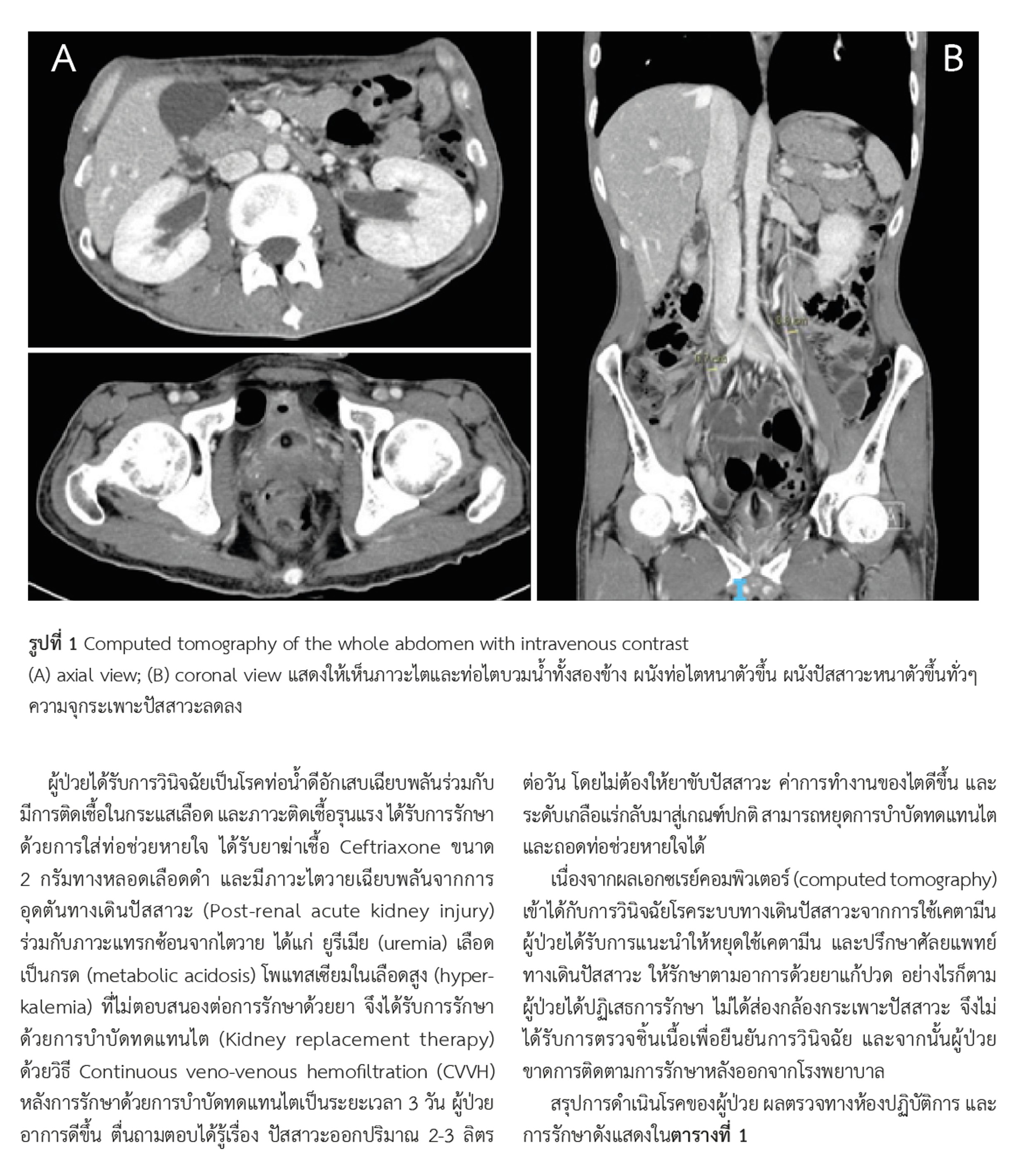
Ketamine-induced uropathy caused by long-term use of ketamine leads to lower urinary tract symptoms, hydronephrosis, and recurrent urinary tract infection. The principles of treatment involve cessation of ketamine abuse, symptomatic treatments including pain control, and surgical intervention in severe cases. We report the case of a 42-year-old previously healthy male who presented with altered consciousness for 2 hours. He had frequently abused ketamine for recreational purposes over a period of two years. His laboratory results revealed acute kidney injury, uremia, metabolic acidosis, and hyperkalemia. Computed tomography revealed bilateral moderate hydronephrosis and hydroureter without any identifiable cause of obstruction, along with diffused bladder wall thickening and reduced bladder capacity, findings compatible with ketamine-induced uropathy. Continuous kidney replacement therapy was performed until his serum creatinine and electrolyte levels were normalized. He was strongly advised to discontinue ketamine use. In addition, symptomatic treatment, mainly pain controllers, was provided.
Article Details

This work is licensed under a Creative Commons Attribution-NonCommercial-NoDerivatives 4.0 International License.
This article is published under CC BY-NC-ND 4.0 license, which allows for non-commercial reuse of the published paper as long as the published paper is fully attributed. Anyone can share (copy and redistribute) the material in any medium or format without having to ask permission from the author or the Nephrology Society of Thailand.
References
Tsai YC, Kuo H-C. Ketamine cystitis: its urological impact and management. Urological Science 2015;26(3):153-7.
Anderson DJ, Zhou J, Cao D, McDonald M, Guenther M, Hasoon J, et al. Ketamine-Induced Cystitis: A Comprehensive Review of the Urologic Effects of This Psychoactive Drug. Health Psychol Res 2022;10(3):38247. doi: 10.52965/001c.38247.
Jhang JF, Birder LA, Kuo HC. Pathophysiology, clinical presentation, and management of ketamine-induced cystitis. Tzu Chi Med J 2023;35(3):205-12. doi: 10.4103/tcmj.tcmj_94_23.
Hoffman RJ. Ketamine poisoning 2024 [Available from: https://www.uptodate.com/contents/ketamine-poisoning.
กองควบคุมวัตถุเสพติด. ยาเค (Ketamine) 2023 [Available from:https://narcotic.fda.moph.go.th/information-about-drugs/ketamine.
กองควบคุมวัตถุเสพติด. วัตถุออกฤทธิ์ [Available from: https://narcotic.fda.moph.go.th/detail-psycho-new1/category/detail-psychrotrophic1.
พลชัย อ. ผ่าสารเสพติด เคนมผง ยาเสพติดสูตรนรก ไม่ตายก็วิกลจริต 2021 [Available from: https://www.sci.psu.ac.th/news/2021/01/analyze-k-nom-pong-drug/.
Chang M, Juruena MF, Young AH. Ketamine cystitis following ketamine therapy for treatment-resistant depression - case report. BMC Psychiatry 2024;24(1):9. doi: 10.1186/s12888-023-05468-3.
Selby NM, Anderson J, Bungay P, Chesterton LJ, Kolhe NV. Obstructive nephropathy and kidney injury associated with ketamine abuse. NDT Plus 2008;1(5):310-2. doi: 10.1093/ndtplus/sfn054.
Chu PS, Ma WK, Wong SC, Chu RW, Cheng CH, Wong S, et al. The destruction of the lower urinary tract by ketamine abuse: a new syndrome? BJU Int 2008;102(11):1616-22. doi: 10.1111/j.1464-410X.2008.07920.x.
Zhou J, Scott C, Miab ZR, Lehmann C. Current approaches for the treatment of ketamine-induced cystitis. Neurourol Urodyn 2023;42(3):680-9. doi: 10.1002/nau.25148.
Jhang JF, Hsu YH, Jiang YH, Kuo HC. Elevated serum IgE may be associated with development of ketamine cystitis. J Urol 2014;192(4):1249-56. doi: 10.1016/j.juro.2014.05.084.
Winstock AR, Mitcheson L, Gillatt DA, Cottrell AM. The prevalence and natural history of urinary symptoms among recreational ketamine users. BJU Int 2012;110(11):1762-6. doi: 10.1111/j.1464-410X.2012.11028.x.
