
Development of a Surveillance Guideline for Patients with Unstable Conditions and Deteriorating Symptoms in the 6th Floor Special Ward of a Regional Hospital in Southern Thailand
Keywords:
Guideline Development, Surveillance Guideline, Unstable Conditions and Deterioration, Special WardAbstract
This action research aimed to: (1) develop a surveillance guideline for patients with unstable conditions and deterioration, and (2) study the outcomes of implementing the developed surveillance guideline in a special ward on the 6th floor of a regional hospital in southern Thailand. The participants included 24 healthcare personnel—registered nurses, nurse aides, and patient assistants—and 97 patients admitted to the special ward. Research instruments consisted of the surveillance guideline for patients with unstable conditions and deterioration, an evaluation form for compliance with the guideline, and a staff satisfaction questionnaire. Content validity was verified by three experts, yielding a content validity index (CVI) of 1.00. The reliability of the instruments was confirmed with a Cronbach’s alpha coefficient of .96, and inter-rater agreement was .90. Quantitative data were analyzed using frequency, percentage, mean, standard deviation, and the one-sample Wilcoxon signed-rank test, while qualitative data were analyzed using content analysis. The results reveal as follows.
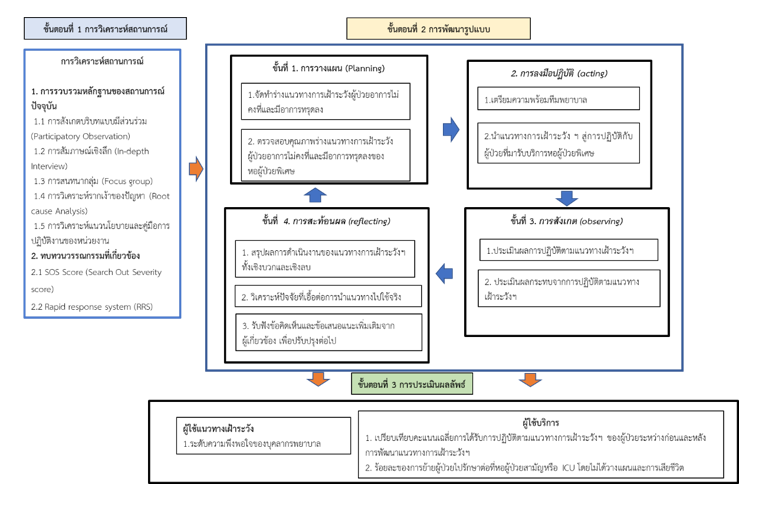
1. The developed surveillance guideline consisted of three components: identification of at-risk patients, effective communication, and appropriate response upon receiving information about at-risk patients.
2. The median compliance score with the guideline was significantly higher than the 90% standard criterion (p-value < .001).
3. The unplanned patient transfer rate decreased from 8.86% to 3.86%, representing a 56.43% reduction.
4. Staff satisfaction with the surveillance guideline was at a high level (M = 4.47, SD = 0.66).
Based on these findings, it is recommended that the surveillance guideline for patients with unstable conditions and deterioration should be applied in special wards and other units with similar contexts. Hospital administrators should promote and continuously monitor the implementation to enhance the long-term effectiveness of patient care.
References
Andersen, L. W., Kim, W. Y., Chase, M., Berg, K. M., Mortensen, S. J., Moskowitz, A., et al. (2016). The prevalence and significance of abnormal vital signs prior to in-hospital cardiac arrest. Resuscitation, 98, 112–117. doi.org/10.1016/j.resuscitation.2015.08.016
Barrett, J., Hawdon, G., Wade, J., & Reeves, J. (2018). Measuring the success of Medical Emergency Teams: Potentially preventable deaths versus total cardiac arrest deaths. A single-center observational study. Internal Medicine Journal, 48(3), 264–269. doi.org/10.1111/imj.13676
Bucknall, T. K., Guinane, J., McCormack, B., Jones, D., Buist, M., & Hutchinson, A. M. (2024). Listen to me, I really am sick! Patient and family narratives of clinical deterioration before and during rapid response system intervention. Journal of Clinical Nursing, 33(10), 4048-4060. doi.org/10.1111/jocn.17310
Burke, J. R., Downey, C., & Almoudaris, A. M. (2022). Failure to rescue deteriorating patients: A systematic review of root causes and improvement strategies. Journal of Patient Safety, 18(1), e140–e155. doi.org/10.1097/PTS.0000000000000720
Champunot, R., Tansuphaswasdikul, S., Kamsawang, N., Tuandoung, P., & Thimsri, D. (2016). Application of search out severity (SOS) score for identification of deteriorating patients in general wards. Buddhachinaraj Medical Journal, 33(3), 313–325.
Chung, J., & Jung, H. (2024). Indicators of clinical deterioration in adult general ward patients from nurses' perspectives: A mixed-methods systematic review. BMC nursing, 23(1), 861. doi.org/10.1186/s12912-024-02531-6
Cohen, J. (1988). Statistical Power Analysis for The Behavioral Siences (2nd ed.). Lawrence Erlbaum Associates.
Compton, R. M., Hubbard Murdoch, N., Press, M. M., Lowe, M. E., Ottley, K. M., Barlow, M., et al. (2023). Capacity of nurses working in long-term care: A systematic review qualitative synthesis. Journal of Clinical Nursing, 32(9-10), 1642–1661. doi.org/10.1111/jocn.16144
Duff, B., Massey, D., Gooch, R., & Wallis, M. (2018). The impact of a multimodal education strategy (the DeTER program) on nurses' recognition and response to deteriorating patients. Nurse Education in Practice, 31, 130–135. https://doi.org/10.1016/j.nepr.2018.05.011
Ede, J., Jeffs, E., Vollam, S., & Watkinson, P. (2020). A qualitative exploration of escalation of care in the acute ward setting. Nursing in critical care, 25(3), 171–178. doi.org/10.1111/nicc.12479
Gerry, S., Bonnici, T., Birks, J., Kirtley, S., Virdee, P. S., Watkinson, P. J., & Collins, G. S. (2020). Early warning scores for detecting deterioration in adult hospital patients: systematic review and critical appraisal of methodology. BMJ (Clinical research ed.), 369, m1501. doi.org/10.1136/bmj.m1501
Jantarat, P., Rattanaphan, P., Kunsete, P., & Thiengchanya. P. (2023). Development of early warning sign model in high-risk patient, Songkhla hospital. Journal of Health Science of Thailand, 32(1), 109–119. (in Thai)
Kaisingdeacha, W. (2022). The development of a surveillance guideline for deteriorating patients during waiting at the surgical outpatient department, Buddhachinaraj Phitsanulok hospital. Nursing, Health, and Public Health Journal, 1(1), 40-52. (in Thai)
Kemmis, S., McTaggart, R., & Nixon, R. (2014). The Action Research Planner: Doing Critical Participatory Action Research. New York: Springer
Large, C., & Aldridge, M. (2018). Non-technical skills required to recognize and escalate patient deterioration in acute hospital settings. Nursing management (Harrow, London, England: 1994), 25(2), 24–30. doi.org/10.7748/nm.2018.e1707
Lee, J. R., Kim, E. M., Kim, S. A., & Oh, E. G. (2020). A systematic review of early warning systems' effects on nurses' clinical performance and adverse events among deteriorating ward patients. Journal of Patient Safety, 16(3), e104–e113. doi.org/10.1097/PTS.0000000000000492
Leonard-Roberts, V., Currey, J., & Considine, J. (2020). Emergency nurses' perceptions of their role in responding to escalations of care for clinical deterioration. Australasian Emergency Care, 23(4), 233–239. doi.org/10.1016/j.auec.2020.03.002
Liu, Q., Zheng, X., Xu, L., Chen, Q., Zhou, F., & Peng, L. (2023). The effectiveness of education strategies for nurses to recognize and manage clinical deterioration: A systematic review. Nurse Education Today,126, 105838. doi.org/10.1016/j.nedt.2023.105838
Marie, J. O. S., & Rammel, T.B. (2024). The study of happiness levels of secondary school teachers in rural area. International Journal of Advance Research and Innovative Ideas in Education, 10(2), 145–150.
Massey, D., Chaboyer, W., & Aitken, L. M. (2017). Nurses' perceptions of accessing a medical emergency team: A qualitative study. Australian Critical Care, 30(3), 133–138. doi.org/10.1016/j.aucc.2016.07.001
Orique, S. B., Despins, L., Wakefield, B. J., Erdelez, S., & Vogelsmeier, A. (2019). Perception of clinical deterioration cues among medical-surgical nurses. Journal of Advanced Nursing, 75(11), 2627–2637. doi.org/10.1111/jan.14038
Osborne, S., Douglas, C., Reid, C., Jones, L., Gardner, G., & RBWH Patient Assessment Research Council (2015). The primacy of vital signs-acute care nurses' and midwives' use of physical assessment skills: a cross-sectional study. International Journal of Nursing Studies, 52(5), 951–962. doi.org/10.1016/j.ijnurstu.2015.01.01
Stotts, J. R., Lyndon, A., Chan, G. K., Bekmezian, A., & Rehm, R. S. (2020). Nursing surveillance for deterioration in pediatric patients: An integrative review. Journal of Pediatric Nursing, 50, 59–74. doi.org/10.1016/j.pedn.2019.10.008
Subbe, C. P., Duller, B., & Bellomo, R. (2017). Effect of an automated notification system for deteriorating ward patients on clinical outcomes. Critical Care, 21(1), 52. doi.org/10.1186/s13054-017-1635-z
Treacy, M., & Caroline Stayt, L. (2019). To identify the factors that influence the recognizing and responding to adult patient deterioration in acute hospitals. Journal of Advanced Nursing, 75(12), 3272–3285. doi.org/10.1111/jan.14138
Downloads
Published
Issue
Section
License
Copyright (c) 2025 Journal of Nursing and Education

This work is licensed under a Creative Commons Attribution-NonCommercial-NoDerivatives 4.0 International License.



