
Behavioral Intentions of Nursing Students in Simulation-Based Practice
Keywords:
Technology Acceptance, Behavioral Intention, Nursing Students, Simulation-Based LearningAbstract
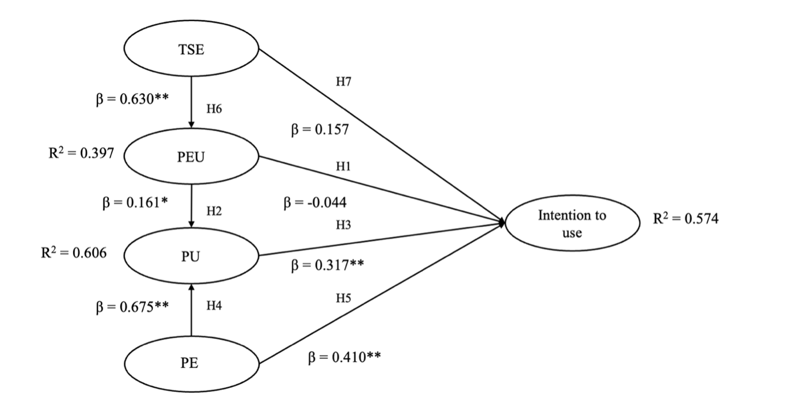
This cross-sectional quantitative study aimed to analyze the behavioral intentions of nursing students to engage in simulation-based practice. The study extended the Technology Acceptance Model (TAM) by incorporating perceived enjoyment and technological self-efficacy. The sample consisted of 208 nursing students. The research instrument was a questionnaire measuring nursing students’ behavioral intentions toward simulation-based practice, with a content validity index of 1.00. Data were analyzed using Partial Least Squares Structural Equation Modeling (PLS-SEM). The findings were as follows.
1. Perceived usefulness and perceived enjoyment had statistically significant effects on the intention to use simulation-based training (p-value < .05).
2. Technological self-efficacy significantly influenced perceived ease of use.
The study highlights the importance of designing simulation tools that are both engaging and effective in order to enhance student learning. Further research should be conducted across diverse educational contexts and theoretical frameworks.
References
Alinier, G., & Oriot, D. (2022). Simulation-based education: Deceiving learners with good intent. Advances in Simulation, 7(1), 8. doi.org/10.1186/s41077-022-00117-w
Balog, A., & Pribeanu, C. (2010). The role of perceived enjoyment in the students’ acceptance of an augmented reality teaching platform: A structural equation modelling approach. Studies in Informatics and Control, 19(3), 319-330. doi.org/10.24846/v19i3y201006
Barbosa, M. L., Atanasio, L. L. d. M., Medeiros, S. G. d., Saraiva, C. O. P. d. O., & Santos, V. E. P. (2021). Evolución de la enseñanza de enfermería en el uso de la tecnología educacional: Una revisión sistemática. Revista Brasileira de Enfermagem, 74, e20200422. doi.org/10.1590/0034-7167-2020-0422
Bowtell, L., Kist, A., Osbourne, D., & Parker, V. (2013). Interactive emulator system to aid clinical practice outcomes for nurses. International Journal of Online Engineering, 9, 32-37. doi.org/10.3991/ijoe.v9iS5.2771
Campos, N., Nogal, M., Caliz, C., & Juan, A. A. (2020). Simulation-based education involving online and on-campus models in different European universities. International Journal of Educational Technology in Higher Education, 17(1), 8. doi.org/10.1186/s41239-020-0181-y
Chien, T. C. (2012). Computer self-efficacy and factors influencing e-learning effectiveness. European Journal of Training and Development, 36(7), 670-686. doi.org/10.1108/030905912112 74135
Choi, H., & Tak, S. H. (2022). Nurses' behavioral intention in using virtual clinical simulation training: By structural equation modeling. Nurse Education in Practice, 65, 103492. doi.org/10.1016/j.nepr. 2022.103492
Chow, M. C. M., Hung, M. S. Y., Chu, J. W. K., & Lam, S. K. K. (2022). Factors affecting nursing students’ intention to use a 3D game to learn field triage skills: A structural equation modelling analysis. BMC Nursing, 21(1), 46. doi.org/10.1186/s12912-022-00826-0
Cohen, B. S., & Boni, R. (2018). Holistic nursing simulation: A concept analysis. Journal of Holistic Nursing, 36(1), 68-78. doi.org/10.1177/0898010116678325
Cohen, J. (2013). Statistical Power Analysis for the Behavioral Sciences. Taylor & Francis. Compeau, D. R., & Higgins, C. A. (1995). Computer self-efficacy: Development of a measure and initial test. MIS Quarterly, 19(2), 189-211. doi.org/10.2307/249688
Davis, F. D. (1986). A technology acceptance model for testing new end-user information systems: Theory and results. Sloan School of Management, 291.
Davis, F. D. (1989). Perceived usefulness, perceived ease of use, and user acceptance of information technology. MIS Quarterly, 13(3), 319-340.
Demoulin, N. T., & Djelassi, S. (2016). An integrated model of self-service technology (SST) usage in a retail context. International Journal of Retail & Distribution Management, 44(5), 540-559. doi.org/10.1108/IJRDM-05-2015-0084
Forehand, J. W., Benson, A. D., Chance, K. D., & Armstrong, B. (2021). Exploring factors of mobile device adoption in nursing education. Computers, Informatics, Nursing, 39(9), 477-483. doi.org/10.1097/cin.0000000000000751
Hair, J. F. (2014). A primer on partial least squares structural equation modeling (PLS-SEM). SAGE Publications.
Izza, S., Firman, A., Rahman, F. F., Gayatri, D., Yetti, K., Boro, M. F. V., et al. (2022). Nursing student reactions in conducting nursing practicum learning using virtual reality simulation. Universal Journal of Public Health, 10(6), 563-568. doi.org/10.13189/ujph.2022.100601
King, W. R., & He, J. (2006). A meta-analysis of the technology acceptance model. Information & Management, 43(6), 740-755. doi.org/10.1016/j.im.2006.05.003
Koukourikos, K., Tsaloglidou, A., Kourkouta, L., Papathanasiou, I. V., Iliadis, C., Fratzana, A., et al. (2021). Simulation in clinical nursing education. Acta Informatica Medica, 29(1), 15-20. doi.org/10.5455/aim.2021.29.15-20
Lateef, F. (2010). Simulation-based learning: Just like the real thing. Journal of Emergencies, Trauma, and Shock, 3(4), 348–352. https://doi.org/10.4103/0974-2700.70743
Marangunić, N., & Granić, A. (2015). Technology acceptance model: A literature review from 1986 to 2013. Universal Access in the Information Society, 14, 81-95. doi.org/10.1007/s10209-014-03580
Mishra, R., & Trivedi, D. (2023). Simulation-based learning in nursing curriculum-time to prepare quality nurses: A systematic review and meta-analysis. Heliyon, 9(5), e16835. doi.org/10.1016/j.heliyon. 2023.e16835
Mubuke, F., Ogenmungu, C., Masaba, A. K., & Andrew, W. (2017). The predictability of perceived enjoyment and its impact on the intention to use mobile learning systems. Asian Journal of Computer Science and Information Technology, 1(1), 7.
Narayan, R., Rodriguez, C., Araujo, J., Shaqlaih, A., & Moss, G. (2013). Constructivism/Constructivist Learning Theory. In Handbook of research on educational technology (pp. 169-184).
Park, Y., Son, H., & Kim, C. (2012). Investigating the determinants of construction professionals' acceptance of web-based training: An extension of the technology acceptance model. Automation in Construction, 22, 377-386. doi.org/10.1016/j.autcon.2011.09.001
Sarstedt, M., Ringle, C. M., & Hair, J. F. (2021). Partial Least Squares Structural Equation Modeling. In Handbook of Market Research (pp. 587-632). Springer. doi.org/10.1007/978-3-030-19576-4_24
Shanmugapriya, K., Seethalakshmi, A., Zayabalaradjane, Z., & Rani, N. R. V. (2023). Mobile technology acceptance among undergraduate nursing students instructed by blended learning at selected educational institutions in South India. Journal of Education and Health Promotion, 12(1), 45. doi.org/10.4103/jehp.jehp_91_23
Sun, H., & Zhang, P. (2008). An exploration of affect factors and their role in user technology acceptance: Mediation and causality. Journal of the American Society for Information Science and Technology, 59(8), 1252-1263. doi.org/10.1002/asi.20894
Venkatesh, V., & Davis, F. D. (1996). A model of the antecedents of perceived ease of use: Development and test. Decision Sciences, 27(3), 451-481. doi.org/10.1111/j.15405915.1996. tb01822.x
Venkatesh, V., & Davis, F. D. (2000). A theoretical extension of the technology acceptance model: Four longitudinal field studies. Management Science, 46(2), 186-204. doi.org/10.1287/mnsc.46.2.186. 11926
Wangpipatwong, S., Chutimaskul, W., & Papasratorn, B. (2008). Understanding citizen's continuance intention to use e‐government website: A composite view of technology acceptance model and computer self‐efficacy. Electronic Journal of e-Government, 6(1), 55-64. doi.org/10. 1037/0898010116678325
Williamson, K. M., & Muckle, J. (2018). Students' perception of technology use in nursing education. CIN: Computers, Informatics, Nursing, 36(2), 70-76. doi.org/10.1097/CIN.00000000000 00393.
World Health Organization. (2023). Patient Safety. Rerieved November 4, 2025 from https://www.who.int/news-room/fact-sheets/detail /patient-safety.
Downloads
Published
Issue
Section
License
Copyright (c) 2026 Journal of Nursing and Education

This work is licensed under a Creative Commons Attribution-NonCommercial-NoDerivatives 4.0 International License.



