
Effect of Discharge Planning Program for Patients with Stroke in duration of Transition from Hospital to Home on Preparedness, Anxiety and Satisfaction of Caregiver
Keywords:
Discharge Planning Program, Patients Stroke in duration of Transition from Hospital to Home, Preparedness of Care GiverAbstract
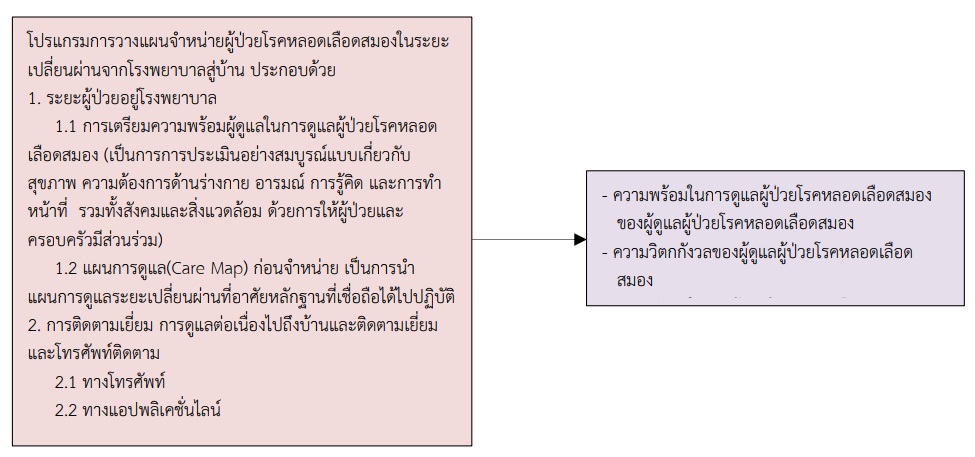
This quasi-experimental research aimed to compare preparedness, anxiety and satisfaction of caregivers before discharge of caregivers receiving discharge planning program for patients with stroke in duration of transition from hospital to home, Surat Thani hospital. Research instrument was discharge planning program for patients with stroke based on conceptual framework of transitional care model (Naylor, Brooten, Campbell, Maislin, McCauley, & Schwartz, 2004). Data were collected through preparedness of care for patients with stroke assessment scale. Data were analyzed using mean, standard deviation, and Wilcoxon Signed - Rank Test for comparing score of preparedness, and anxiety of caregivers before and after receiving discharge planning program for patients with stroke in duration of transition from hospital to home. Research results revealed that score of preparedness of care of caregivers after receiving discharge planning program for patients with stroke in duration of transition from hospital to home was significantly higher than that of before (p=.05). Score of anxiety of care of caregivers after receiving discharge planning program for patients with stroke in duration of transition from hospital to home was significantly lower than that of before (p=.05). and the satisfaction of care of caregivers after receiving discharge planning program for patients with stroke in duration of transition from hospital were high.
From research findings, guideline for promoting preparedness of care for patients with stroke receiving discharge plan is established to develop quality of nursing service and enhance quality of life of patients with stroke.
References
American Stroke Association. (2015). Heart Disease and Stroke Statistics-At-a-Glance. Retrieved November 23, 2021 from: https://www.heart.org/idc/groups/ucm_470704.pdf.
Andrew, N., Kilkenny, M., Naloy, T., Purvis, T. & Cadilhac, A. D. (2015). The Relation Between Caregiver Impacts and the Unmet Needs of Survivor Stroke. Patient Prefer Adherence, 9, 1065-1073. doi: 10.2147/PPA.S85147.
Chunhabirde, A., Supanuant, T., Oupara, R. & Thongsai, S. (2012). Stress and Needs of Caregivers Providing Care for Stroke Patients and Home. The Journal of Prapokklao Nursing College, 24(1), 1-9. (in Thai)
Division of Non Communication. (2021). Report 2019. Retrieved November 23, 2021 from: http://www.thaincd.com/2016/media.php?tid=30&gid=1-015.
Foust, J. B. (2007). Discharge Planning as Part of daily Nursing Practice. Applied Nursing Research, 20(1),72-77.
Hafsteinsdottir, T. B., Vergunst, M., Lindeman, E. & Schuurmans, M. (2011). Educational Needs of Patients with a Stroke and Their Caregiver: A Systematic Review of the Literature. Patient Education and Counseling, 85(1), 14-25. doi:10.1016/j.pec.2010.07.046.
Hayashi, Y., Hai, H. & Tai, N. A. (2013). Assessment of the Needs of Caregivers of Stroke Patient at State- Owned Acute- Care Hospitals in Southern Vietnam. Public health Research, 10(1), 1-9. doi: 10.5888/pcd10.130023
Intarasombat, P., Monkong, P., Churaitatsanee, S., Vongterapak, S., Prasanaikom, W., Pronsawatchai, P. & Sereewichayasawad, N. (2013). Comprehensive Care of Hospitalized older Adults: Transitional Care from Hospital to Home. Rama Nurs J, 19(2), 194-205. (in Thai)
Kasornsunt, P. (2018). A Transitional Care Model for Stroke Patients at Chaopraya Yommarat Hospital Nursing Journal of the Ministry of Public Health, 25(1), 83-96. (in Thai)
Kerr, P. (2012). Stroke Rehabilitation and Discharge Planning. Nursing Standard, 27(1), 35-39.
Maclsacc, L., Margaret, B., & Godfrey, (2020) C. Supportive Care Needs of Caregivers of Individuals Following Stroke: A Synopsis of Research. Canadian Journal of Neuroscience Nursing, 32(1), 39-46.
Monkong, S., SiriphoNgam, Y., & Leelacharas, S. (2019). Effectiveness of Transitional Care Program for Stroke Patients and Family Care givers from Hospital to Home. Journal of Public Health Nursing, 30(3), 84-101. (in Thai)
Moonthee, M., Monkong, S., Sirapo-ngam, Y., & Leelacharas, S. (2016). Impact of Transitional Care Programme and Family Caregivers on Stroke Patients’ Routine Activity Performance, Complications, and Satisfaction. Thai Journal of Nursing Council, 31(1), 95-110. (in Thai)
National Stroke Association. (2014). Heart Disease and Stroke Statistics- AT-a-Glance. Retrieved November 23, 2021 from: https://www.heart.org/idc/groups/ahamahpublic/@wcm/@sop/@smd/documents/downloadable/ucm_470704.pdf.
Naylor, M. D., Brooten, D. A., Campbell, R. L., Maislin, G., McCauley, K. M., & Schwartz, J. S. (2004). Transitional Care of Older Adults Hospitalized with Heart Failure: a Randomized, Controlled Trial. J Am Geriatr Soc. 52(5), 675-684.
Nuntakarn, P. N., Sirapo-ngam, Y., Monkong, S. & Leelacharas, S. (2016). Effects of a Transitional Care Program for Stroke Patients and Family Caregivers on Caregiver’s Preparedness, Stress, Adaptation, and Satisfaction. Rama Nurs J, 65-80. (in Thai)
Panyaprachoom, P. (2019). The Factors Related to Seeking Treatment at The Hospital Using a Stroke Fast Tract referral network system with acute Stroke Patients. Thammasat Medical Journal, 17(4), 540-547. (in Thai)
Stroke Association. (2015). Depress After Stroke. Retrieved November 23, 2021 from: http/:www.stroke.org.uk/about/depression.
Stuart, G. W. (2013). Principles and Practice of Psychiatric Nursing. 10thed. St. Louis: Elsevie.
Walsh, M. E., Galvin, R., Loughnane, C., Macey, C. & Horgan, N. F. (2015). Community Re-Integration and Long-Term Need in the First Five Years After Stroke: Results from a National Survey. Disability and Rehabilitation, 37(20), 1834-1838. doi:10.3109/09638288.2014.981302.,
World Health Organization. (2012). What is stroke?. Retrieved November 23, 2021 from: http://www.worldstrokecampaign.org/Facts/ Pages/WhatisStroke.aspx.
Downloads
Published
Issue
Section
License
Copyright (c) 2023 Journal of Nursing and Education

This work is licensed under a Creative Commons Attribution-NonCommercial-NoDerivatives 4.0 International License.



