
Dengue Hemorrhagic Fever (DHF): A Comparative Study on Prevention Behaviors Between People Residing in Areas of Repeated and Non-Repeated Outbreaks
Keywords:
DHF, Dengue Hemorrhagic Fev, Stroke Prevention, Community Participation, Repeated Outbreak AreasAbstract
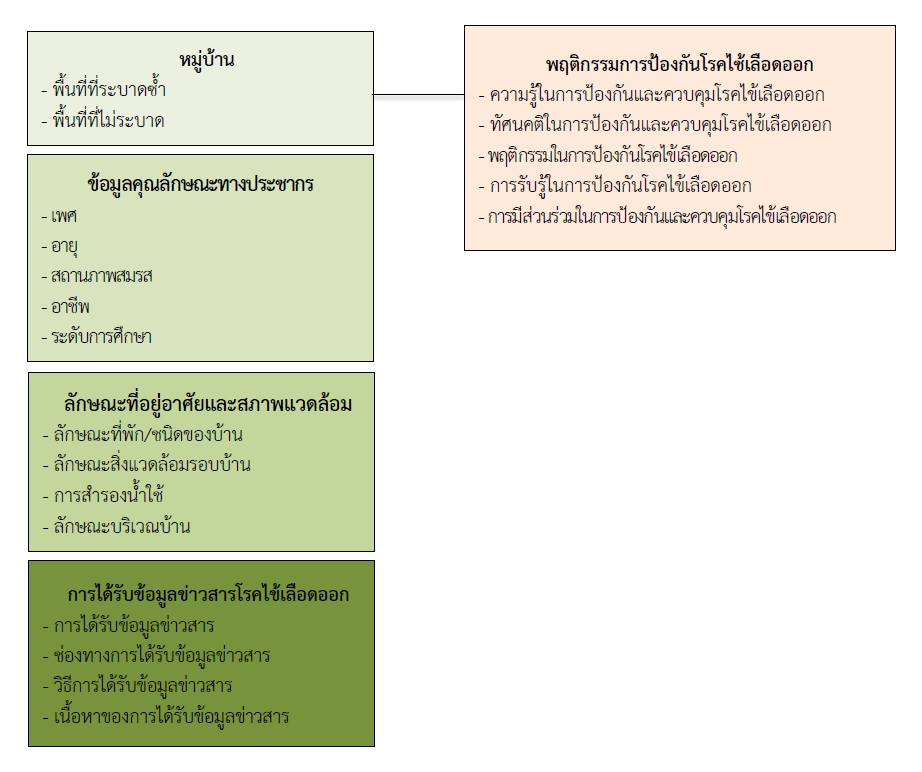
This analytic cross-sectional study aimed to compare the preventing dengue hemorrhagic fever (DHF) between people residing in a repeated outbreak area and a repeated outbreak area of DHF. The repeated outbreak area was purposely selected, while the non-outbreak areas were simple randomly selected, with a 5-year median criteria for morbidity from DHF. In total, 272 samples, aged 20–60 years, were randomly selected from 2 villages (136 samples in each village). All participants were residing in their village for at least one year. The data were gathered between January and March 2020, using a questionnaire validated by three experts with 0.67-1.00 of content validity. The data were analyzed using descriptive statistics and mann whitney u test for comparison of the preventing DHF between people residing in the repeated outbreak area and the non-outbreak area, respectively. Results showed that people residing in repeated outbreak and non-outbreak of DHF had significant differences in attitude (p-value=0.001), behaviors (p-value<0.001), and participation (p-value<0.001) in preventing DHF. However, people had no difference in knowledge (p-value=0.468) and perception (p-value=0.268) in preventing DHF.
This study therefore suggests that public health personnel should organize activities that emphasize community participation in order to raise awareness and attitude, and to prevent DHF. Participation, in particular, should focus on eliminating mosquito larvae breeding sites and in areas where there are repeated outbreaks.
References
Bureau of Epidemiology, Department of Disease Control, Ministry of Public Health. (2019). Summary of the Annual Disease Surveillance Report. Bangkok: Agricultural Cooperative Assembly of Thailand Printing House. (in Thai)
Division of Preventive Medicine. (2005). Handbook of Preventive Medicine. Documentation Teaching Technical Courses. Preventive medicine. Division of Preventive Medicine Naval Medical Department. Bangkok
Green, L. W. & Kreuter, M. W. (2005). Health Program Planning an Educational and Ecological Approach. New York: Quebecor World Fairfield.
Jirawan, W. (2016). Behavior for Dengue Hemorrhagic Fever Control and Prevention of People in the Area with Low and High Epidemics, Amphoe Mueang Trang, Changwat Trang. Master of Public Health. Trang: College of Public Health. (in Thai)
Office of Epidemiology, Department of Disease Control, Ministry of Public Health. (2019). Weekly Outbreak News Summary, 2018 from https://ddc.moph.go.th/disease_detail.php?d=44
Phatmanee, J., Woradet, S. & Chaimay, B. (2020). A Review of the Literature on Differences of Behavioral Factors among People Living in High and Low Endemic Areas of Dengue Fever in Thailand. UBRU Journal of Public Health Research, 9(2), 6-19.
Phichet, S. (2011). Comparison of Knowledge Social Support and Preventive Behavior of Dengue Hemorrhagic Fever among People in Epidemic and Non-Epidemic Villages in Thungbenja Subdistrict Thamai District Chanthaburi Province. Master of Public Health. Chanthaburi: Burapha University. (in Thai)
Piromrat, K. (2015). Prevention and Control Behavior of Dengue Fever of Health Network Partners in Muang District Buriram Province. Research and Development Journal, Buriram Rajabhat University, 10(2), 84-90.
Praphasi, S. (2014). The Comparision of People Behavior and Community Leaders Participation for Dengue Hemorrhagic Fever Prevention and Control between Sub-District which Had High and Low, Incidence Rate, Buayai District, Nakhonratchasima Province. Master of Public Health. Nakhonratchasima Province: Khon Kean Universit.
Ruetai, S. & Niramol, M. (2012). A Comparative Study of Dengue Hemorrhagic Fever Prevention Behavior among the People Living in the Epidemic and Non-epidemic Villages: A Case Study in Phimai District. Nakhon Rachasima Province. Srinakarin Vejsarn, 27(4), 361-365.
Sutipong, N. (2003). Compare Public Perceptions and Participation in Prevention and Control. Dengue Fever Between the Villages, the Incidence of the Disease was Found High and Dengue Fever was Not Observed. Nampad District, Uttaradit Province. Master of Public Health. Uttaradit: Chiang Mai University. (in Thai)
The Bureau of Communicable Diseases is Led by Insects. (2018). Dengue Prognosis. 2018 from https:ttps://ddc.moph.go.th /uploads/files/ e0325809a787bf36b787fe9a56acc691.pdf
World Health Organization. (2012). Handbook for Clinical Management of Dengue. Geneva. Organisation Mondiale De La Sante.
World Health Organization. (2019). Dengue and Severe Dengue. November 10, 2019. Available from: https://www.who.int/news-room/fact-sheets.
Downloads
Published
Issue
Section
License
Copyright (c) 2023 Journal of Nursing and Education

This work is licensed under a Creative Commons Attribution-NonCommercial-NoDerivatives 4.0 International License.



