
The Effects of an Eating Behaviors Development Program on Knowledge, Health Beliefs, Eating Behaviors, and Blood Pressure among People at Risk of Hypertention in Rural Nakhon Si Thammarat Province
Keywords:
Eating Behavior, People at Risk of Hypertension, Health Belief Model [HBM]Abstract
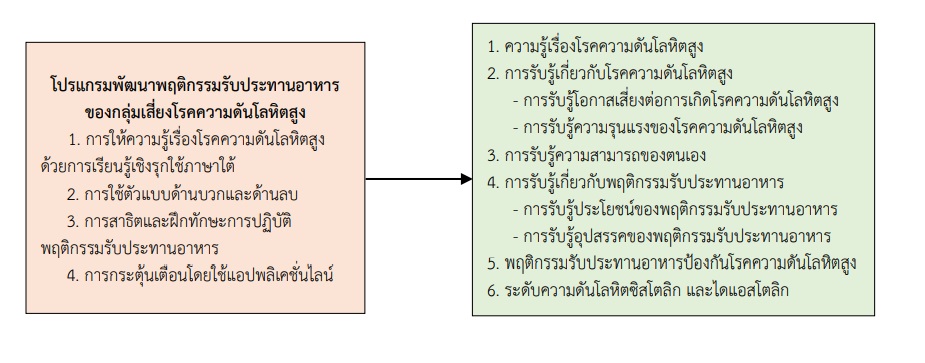
The objectives of this quasi–experimental research were to compare knowledge, perceptions, perceived self-efficacy, perceptions about eating behaviors, eating behaviors to prevent hypertension, and blood pressure levels among hypertension adults at risk in rural Nakhon Si Thammarat Province. The participants were adults (both male and female) aged 35-59 years, who had been hypertensive risk, with blood pressure between 120/80-139/89 mmHg. The experimental group, 30 people from the Banthungkhwai Subdistrict Health Promoting Hospital, was selected by the simple random technique, as well as the comparison group of 30 people from the Banthungsan Subdistrict Health Promoting Hospital. The tools were 1) the Eating Behaviors Development Program for Hypertensive Risk, based on Health beliefs model, 2) a record form, 3) a Line mobile phone application, 4) aquestionnaire, and 5) a sphygmomanometer. The data were analyzed by descriptive statistics, t–test, Wilcoxon Signed Ranks test, and Mann–Whitney U test.
The results showed the following. After the experiment, the knowledge about hypertension in the experimental group was significantly higher than before the experiment, and increased more than the comparison group (p<.05). In the experimental group, both perceptions about hypertension, and perceived benefits of eating behaviors, were significantly higher than before the experiment. They were also higher than among the comparison group (p<.05). In the experimental group, perceived barriers to eating behaviors were significantly lower than before, and lower than in the control group. Perceived self-efficacy of the experimental group was significantly higher than before the experiment, but not different from the control group (p<.05). Eating behaviors to prevent hypertension were significantly higher than before the experiment, and increased more than in the comparison group (p<.05). The systolic blood pressure among participants of the experimental group was significantly lower than before the experiment, and decreased more than among participants in the comparison group. Diastolic blood pressure among the experimental group was significantly lower than before the experiment, and also lower than among people in the comparison group (p<.05).
The developed program should be applied to prevent high incidence of chronic non-communicable diseases. However, a follow-up of groups must be done every first and sixth months, so to pursue sustainability of eating behaviors and to do prospective screening for hypertension.
References
Becker, M. H., Drachman, R. H., & Kirscht, J. P. (1974). A New Approach to Explaining Sick Role Behavior in Low Income Populations. American Journal of Public Health, 64(3), 205–216.
Bloom, B. S., Hastings, T. J., & Madaus, G. F. (1971). Hand Book on Formative and Summative Evaluation of Student Learning. New York: McGraw – Hill Book Company Inc.
Bonwell, C. C., & Eison, J. A. (1991). Acitve Learning: Creating Excitement in the Classroom. Washington, D.C.: The George Washington University.
Chanprasit, C., & Senaratana, W. (2010). Nursing and Health Promotion in Nursing Concept and Process. (13rd ed). Nonthaburi: Sukhothai Thammathirat Open University. (In Thai).
Hosutisima, P. (2018). The Effectiveness of Health Education Program on Hypertension Prevention among High Risk Groups in Jorrakeahin Sub District Khonburi District Nakhonratchasima Province 2560. The Office of Disease Prevention and Control 9th Nakhonratchasima, 25(2), 56-66.
Information and Communication Technology Center, Office of the Permanent Secretary Ministry of Public Health. (2018). Report Group Illness Standards with Important Non-Communicable Disease. Retrieved June 18, 2022 https://hdcservice.moph.go.th/hdc/main/index_pk.php. (in Thai).
Janda, J., Veleminsky, M., Sulakova, T., Prochazka, B., Eliasek, J., & Stransky, P. et al. (2017). Effect of the DASH-Diet and Salt Kardisal on Blood Pressure in Addolescents with Prehypertension. Neuroendocrinology Letters, 38(8), 544-548.
Khumthaweeporn, P., Ronritwiechai, J., Thongcharean, W., & Leehahkun, W. (2015). Phathophysiology in Nursing. Bangkok: T.S.B Product. (in Thai).
Kongvivat, K., Iemsawasdikul, W., & Nuysri, M. (2017). Effects of Preventive Behavior Developing Program for Patients with Cerebrovascular Disease Risk at Kanchanaburi Province. Journal of Nursing and Health Care, 35(3), 129-137. (In Thai).
Lin, P. H., Allen, J. D., Li, Y. J., Yu, M., Lien, L. F., & Svetkey, L. P. (2012). Blood Pressure-Lowering Mechanisms of the DASH Dietary Pattern. Journal of Nutrition and Metabolism. doi.org/10.1155/2012/472396.
Malloy-McFall, J., Barkley, J. E., Gordon, K. L., Burzminski, N., & Glickman, E. L. (2010). Effects of DASH Diet on Pre-and Stage 1 Hypertensive Individuals in a Free-Living Environment. Nutrition and Metabolic Insights, 3, 15-23.
Maneesriwongkul, W., (2016). Behavioral Theory for Community Nurse Practitioner. In Health Policy and Health System, Leadership, Concepts and Theories in Nursing and Community Nurse Practitioner’s Roles. Nonthaburi: Sukhothai Thammathirat Open University. (In Thai).
Non–Communicable Disease Section of Public Health. (2018). World Hypertension League. Retrieved November 22, 2019 http://thaincd.com/document/file/info/non-communicable-disease/. (in Thai)
Nutrition Department of Health, Public Health. (2013). Healthy Alternative Food of Pre Diabetes Mellitus and Pre Hypertension. Samut Sakhon: Born to Be Publishing. (In Thai).
Phetphum, C. (2020). Theory of Planned Behavior. (3nd ed). Phitsanulok: Naresuan University. (in Thai).
Phichayapongsopon, S., & Chulaporn Sota, C. (2018). The Effectiveness of Health Education Program for Health Behavior among Pre-Hypertension, Muang District, Nakornratchasima Province. Thailand Journal of Health Promotion and Environmental Health, 41(1), 57-69. (in Thai).
Phunsuwan, N., Glangkarn, S., & Tewthong, K. (2015). Effectiveness of Change Management Health Beliefs and Health Behaviors Self Risk Essential Hypertension Disease at Kokmamaung Subdistrict, Pakham District, Buriram Province, Thaksin University Journal, 18(2), 70-78.
Sacks, S. M., Svetkev, L. P., Vollmer, W. M., Appel, L. J., Bray, G. A., Harsha, D., et al. (2001). Effects on Blood Pressure of Reduced Dietary Sodium and the Dietary Approaches to Stop Hypertension (DASH) diet. The New England Journal of Medicine, 344(1), 1-10.
Singkharotai, A. (2017). Effect of Health Promotion Program in Groups at High of Blood Pressure by Application of Health Belief Model, Khaopanom Sub-District, Khaopanom District, Krabi Province. Community Health Development Quartery Khon Kaen University, 5(2), 259-279.
Srimorgot, P. (2010). Medical3surgical Nursing: Clinical Management for Positive Outcomes 4th. Bangkok: I Group Press Company Limited. (in Thai).
Thai Health Promotion Foundation. (2019). Food to Reduce High Blood Pressure. Retrieved June 22, 2022 from https://www.thaihealth.or.th/Content/46593. (in Thai)
Thai Hypertension Society. (2015). Thai Hypertension Society: Guidelines in the Treatment of Hypertension. Chiang Mai: Trickthink. (In Thai).
Thunchai, M. (2015). Adult and Hypertension in Elderly Nursing. In Adult and Elderly Nursing. (10nd ed). Nonthaburi: Sukhothai Thammathirat Open Niversity. (in Thai).
Tippawangkosol, P. (Eds.). (2010). Medical-Surgical Nursing Clinical Management for Positive Outcomes 4. Bangkok: I Group Press. (in Thai).
Wichiranon, S., Boonna, P., & Athimuttisan, J. (2012). The Way of Life and Local Food Security in the Southern Part, Journal Science and Technology, 8(1), 94-107.
Downloads
Published
Issue
Section
License
Copyright (c) 2023 Journal of Nursing and Education

This work is licensed under a Creative Commons Attribution-NonCommercial-NoDerivatives 4.0 International License.



