
Chronic Venous Insufficiency (CVI) Disease: Prevalence and Related Factors among Nurses in Chonburi Hospital
Keywords:
Chronic Venous Insufficiency Disease, CVI, Nurse, CEAP ClassificationAbstract
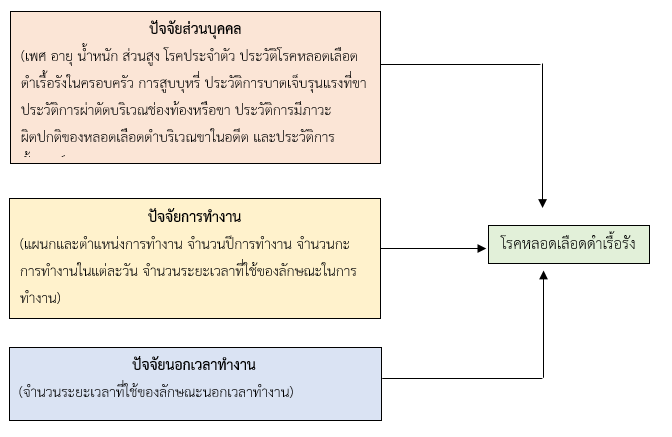
Chronic venous insufficiency (CVI) disease has a high prevalence in many countries, causing high costs of treatment and affecting the quality of life. Being a nurse is one of the occupations at risk of developing CVI disease. At present, there is still limited data on CVI disease among nurses. Therefore, this research aimed to explore the prevalence and analyze the factors influencing CVI disease among nurses. The research tool was a questionnaire and physical examination to look for lower limb abnormalities that are compatible with CVI disease. The diagnosis was based on clinical symptoms and classified with CEAP classification. The data were analyzed with descriptive statistics and inferential statistical logistic regression.
The results showed as follows. Subjects were aged from 22 to 59 years, and the prevalence of chronic venous disease (C0-C6) was at a 66% level. Age and family history of venous disease were the factors influencing CVI disease with statistically significant (P-value < 0.05) in this study. The risk of developing CVI increases by 7% per year, and those with a family history of venous disease are 10 times more likely to develop the CVI disease than those without a family history.
It can be concluded that nurse is one of the occupations with a high prevalence of chronic venous disease. The risk factors for the venous disease include age and people with a family history of venous disease. In those with the above risk factors, they may act to prevent the disease or slow the progression of the disease by avoiding sitting cross-legged for long periods of time, elevating legs above heart level, dorsiflexion of the ankles, applying the stockings, and daily observation of the skin on the legs to reduce the incidence of chronic venous disease in nurses in the future.
References
Anwar Muzaffar, Georgiadis Kyrillos, Shalhoub Joseph, Lim Chung , Gohel Manjit, Davies Alun (2012). A Review of
Familial, Genetic, and Congenital Aspects of Primary Varicose Vein Disease. Circulation: Cardiovascular Genetics,
(4), 460-466.
Bahk Wook, Kim Hyunjoo, Jung Kyunghee, Jung Chul, Lee Inseok. (2012). Relationship Between Prolonged Standing
and Symptoms of Varicose Veins and Nocturnal Leg Cramps among Women and Men. Ergonomics, 55(2), 133-139.
Jennifer Beebe-Dimmer, John Pfeifer, Jennifer Engle, David Schottenfeld. (2005). The Epidemiology of Chronic Venous
Insufficiency and Varicose Veins. Ann Epidemiol, 15(3), 175-184.
Berti-Hearn Linda, Elliott Brenda. (2019). Chronic Venous Insufficiency: A Review for Nurses. Nursing2022, 49(12), 24-
Cires-Drouet Rafael, Fangyang Liu, Rosenberger Sarah, Startzel Matthew, Kidwell Margaret, Yokemick John et al.,
(2020). High Prevalence of Chronic Venous Disease among Health Care Workers in the United States. J Vasc Surg
Venous Lymphat Disord, 8(2), 224-230.
Dindelli Moreno, Parazzini Fabio, Basellini Aldo, Emanuela Rabaiotti, Giuseppe Corsi, Augusto Ferrari. (1993). Risk
Factors for Varicose Disease Before and During Pregnancy. Angiology, 44(5), 361-367.
Eberhardt Robert, Raffetto Joseph (2014). Chronic Venous Insufficiency. Circulation, 130(4), 333-346.
Gloviczki Peter, Comerota Anthony , Dalsing Michael, Eklof Bo, Gillespie David, Gloviczki Monika et al., (2011). The
Care of Patients with Varicose Veins and Associated Chronic Venous Diseases: Clinical Practice Guidelines of the
Society for Vascular Surgery and the American Venous Forum. Journal of Vascular Surgery, 53(5), 2S-48S.
Gourgou Sophie, Dedieu Florence, Sancho-Garnier Helene. (2002). Lower Limb Venous Insufficiency and Tobacco
Smoking: a Case-Control Study. American Journal of Epidemiology, 155(11), 1007-1015.
Hugo Partsch. (2012). "The Natural Progression of Chronic Venous Disorder: An Overview of Available Information
from Longitudinal Studies. In Amanda C. Shepherd, Tristan R. Lane, Alun H. Davies" Phlebolymphology (Vol. 19).
(pp. 138-147). France: Les Laboratoires Servier.
Kontosic Ivica, Vukelic Mihovil, Drescik Ivan, Mesaros-Kanjski Elika, Materljan Eris, Jonjic Anto. (2000). Work
Conditions as Risk Factors for Varicose Veins of the Lower Extremities in Certain Professions of the Working
Population of Rijeka. Acta Medica Okayama, 54(1), 33-38.
Krejcie Robert, Morgan Daryle (1970). Determining Sample Size for Research Activities. Educational and Psychological
Measurement, 30(3), 607-610.
Scott Thayer, LaMorte Wayne, Gorin Daniel, James Menzoian. (1995). Risk factors for Chronic Venous Insufficiency: a
Dual Case-Control Study. Journal of Vascular Surgery, 22(5), 622-628.
Vuylsteke Marc, Colman Roos, Thomis Sarah, Guillaume Genevieve, Quickenborne Damien, Staelens Ivan. (2018). An
Epidemiological Survey of Venous Disease among General Practitioner Attendees in Different Geographical
Regions on the Globe: the Final Results of the Vein Consult Program. Angiology, 69(9), 779-785.
Yun Myeong, Kim Young, Kang Dong, Kim Jong, Ha Won, Jung Kap. et al., (2018). A Study on Prevalence and Risk
Factors for Varicose Veins in Nurses at a University Hospital. Saf Health Work, 9(1), 79-83.
Zolotukhin Igor, Seliverstov Evgeny, Shevtsov Yuri, Avakiants Ilona, Nikishkov Aleksey, Tatarintsev Andrey et al.,
(2017). Prevalence and Risk Factors for Chronic Venous Disease in the General Russian Population. Eur J Vasc
Endovasc Surg, 54(6), 752-758.
Downloads
Published
Issue
Section
License
Copyright (c) 2022 Journal of Nursing and Education

This work is licensed under a Creative Commons Attribution-NonCommercial-NoDerivatives 4.0 International License.



