
The Development of Blended Learning Model in Adult Nursing 1 for Student Nurse
Keywords:
Blended Learning, Adult Nursing, Student NurseAbstract
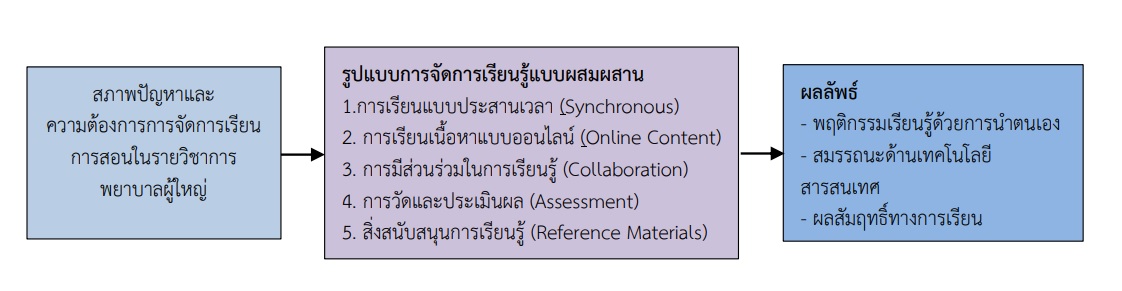
The research and development aims to 1) analyze problem situation and students need 2) develop a blended learning model and 3) effect of a blended learning model in adult nursing 1 subject on self directed behavior, information technology and achievement test for student nurse. The study conducted 3 phase as follow: phase 1 studying situation and need of students, by focus group and content analysis, phase 2 develop model, apply and improve blended learning model by One-to-One Testing with 3 students and small Group Testing with 10 students and phase 3 evaluating blended learning model in adult nursing 1 subject by using quasi experimental study (one group pretest- post test design).The instruments consisted of self directed behavior questionnaire, information technology questionnaire, and achievement test.The reliability of questionnaire are of .86 and .92. The analysis employed frequency percentage of demographic data, mean and standard deviation and pair test of self-directed behavior and information technology.
The result showed that 1. the problem situations and students’ need in the Adult 1 subject, lowest mean score was having fair achievement test, then the teacher support, willingness of searching and assist to find searching method. The student need group activity and various VDO, develop the teaching method through the use of media VDO and mind mapping. 2. The effective blended learning model of adult nursing 1 subject by using carmen concept (2005) consist of 1) 40 % of lectured participation and 60% of learning from VDO by teacher synchronous with student in the same time, online changing opinion 2) Google classroom 3) Case study analyze 4 lesson 4) Quit test, midterm and final test 5) Self study with online data base.3. When comparing self directed behavior, information technology competency, it is found that after study was significantly higher than before study (t=-3.062, p<.01; t=-12.474, p<.001). The achievement test found that 4 phase passing the criteria of 60 percent.
The suggestion, blended learning model by using carmen concept can promote self directed behavior, information technology competency and achievement test. This model can be use for develop nursing subject learning in theoretical section and future study should preparing study with face-to-face learning or online learning.
References
Carman, J. M. (2005). Blended Learning Design: Five Keys Ingredients. (online) Retrieved May 31 , 2021 from http://www.agilantlearning.com/pdf/Blended%20L.pdf.
COMAS-QUINN, A. (2011). Learning to Teach Online or Learning to Become an Online Teacher: an Exploration of Teachers’ Experiences in a Blended Learning Course. European Association for Computer Assisted Language Learning, 23(3), 218–232. .doi.org/10.1017/S0958344011000152
Gouifrane, R., Lajane, H., Belaaouad, S., Benmokhtar, S., Lotfi, S., Dehbi, F., & Radid, M. (2020). Effects of a Blood Transfusion Course Using a Blended Learning Approach on the Acquisition of Clinical Reasoning Skills among Nursing Students in Morocco. International Journal of Emerging Technologies in Learning (iJET), 15(18), 260-269.
Jang, H. J., & Hong, S. Y. (2016). Effect of Blended Learning in Nursing Education. International Journal of Multimedia and Ubiquitous Engineering, 11(5), 297-304.
Jeffrey, L. M., Milne, J., Suddaby. G., & Higgins, A. (2014). Blended Learning: How Teachers Balance the Blend of Online and Classroom Components. Journal of Information Technology Education: Research, 13, 121-140. Retrieved May 31 , 2021 from http://www.jite.org/documents/Vol13/JITEv13ResearchP121-140Jeffrey0460.pdf
Kachapai, M., Onming, R., Pradubwate, & Wongyounoi, S. (2015). The Development of a Blended Instructional Model to Enhancing Knowledge and Competency on Educational Innovation and Information Technology for Bachelor of Education Students of Srinakharinwirot University. Social Science of Research and Academic, 29 (10), 71-86. (in Thai)
Kim, S. D. (2014). Effects of a Blended Learning Program on Ethical Values in Undergraduate Nursing Students. Journal of Korean Academy of Nursing Administration, 20(5), 567-575.
Kotra, P., Phoklin, S., & Krommuang, A. (2017). A Scenario of Educational Management of Undergraduate Nursing Curricula in the Context of ASEAN Community. Journal of Health Science Research, 11(2), 18-27. (in Thai)
Panyoyai, P., & Laser, P. (2020). Effective Instructional Design During the COVID-19 Pandemic: Lesson Learned from Teaching the Gerontological Nursing Practicum in Community. APHEIT Journal of Nursing and Health, 3(3), 1-18. (in Thai)
Poapanoa, S. (2012). The Study of Information Technology and Communication Competencies for Learning of Undergraduate Students in Rajamangala University of Technology Rattanakosin Wangkraikangwon Campus. Veridian E-Journal, Silapakorn University, 5(1), 541-561. (in Thai)
Ponsingchan, S. Course Specification of Adult Nursing 1 Subject. (2020). Boromarajonani College of Nursing, Surin. Praboromrajanok institute. (in Thai)
Pradubtong, O. Course Specification of Adult Nursing 2 Subject. (2020). Boromarajonani College of Nursing, Surin. Praboromrajanok Institute. (in Thai)
Prasert, S. (2011). The Self Directed Learning Questionnaire Cited in Paladkong. (2019). The Development a Learning Model Using Scaffolding Technique to Encourage Self-Directed Learning Among Students in The Distance Education System. A Dissertation Submitted in Partial Fulfillment of Requirements for Doctor of Philosophy (Applied Psychology) Behavioral Science Research Institute, Srinakharinwirot University. (in Thai)
Sankas, S., Woraratpanya, K., & Krootjohn, S. (2013). A Development of Content and Activity Blended Learning Model on Computer Programming. The Journal of Library and Information Science Srinakharinwirot University, 4(2), 80-94. (in Thai)
Sriboonpimsuay, W. (2015). Factors Influencing Self-directed Learning of Nursing Students at Boromarajonani College of Nursing, Udonthani. Journal of Nursing and Education, 7(4), 74-91. (in Thai)
Tantranont, K., Tuanrat, W., & Kaewthummanukul, T. (2018). The Application of a Blended Learning Approach to an Epidemiology Course. Nursing Journal, 45(1), 100-109. (in Thai)
Thungkanai, K. (2021). New Normal Blended Learning in a New Normal. Journal of Educational Studies, 15(1), 29-43. (in Thai)
Xuto, P., Niyomkar, & Yothayai, C. (2014). The Effect of Using Blended Learning to Improve Nursing Students Information Technology Competency as a way to support Training for Fourth Year Nursing Student, Faculty of Nursing, Chiang Mai University. Journal of Nursing and Education, 7(4), 156-167. (in Thai)
Yimyam, S., et al. (2015). Developing on Blended Learning for Developing the 21st Century Learning Skills Nursing journal, 42 (Supplement), 129-140. (in Thai)
Downloads
Published
Issue
Section
License
Copyright (c) 2022 Journal of Nursing and Education

This work is licensed under a Creative Commons Attribution-NonCommercial-NoDerivatives 4.0 International License.



