
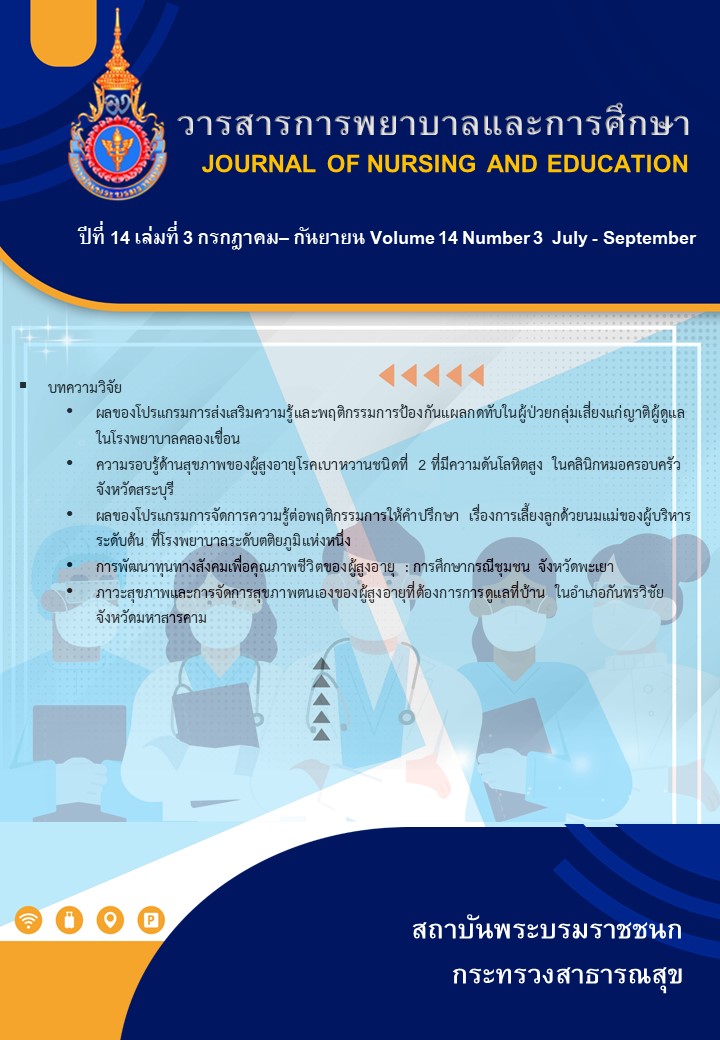
T he Effect of Enhancement Program on Knowledge and the Caring for Pressure Sore Prevention Behavior in Patients at Risk among Caregiver at the In-Patient Department, Klong Khuen Hospital
Keywords:
Caregiver, Pressure Sore Prevention, Patient at RiskAbstract
Pressure sore is a major complication of patients who are unable to care themselves and the patients at risk of pressure sore. It affects on patients and caregivers. This quasi-experimental research (Pretest–Posttest Control Group Design)aimed to examine the effect of enhancement program on knowledge and skills to caring for pressure sore prevention in patients at risk among caregiver at the In-patient Department, Klong Khuen Hospital, Chachoengsao province. The samples were caregiver who care the patients at risk and recruited by simple random sampling. The experimental group (n = 35) received 4 monthly sessions of enhancement program on knowledge and skills to caring for pressure sore prevention in patients at risk among caregiver while in the hospital and discharge to rehabilitate at home between September to December 2020 and the control group (n = 33) was receiving the care according to the nursing guidelines. The research tools consisted of 1) The enhancement program on knowledge and the caring for pressure sore prevention behavior (reliability = .71) 2) The patients assessment form 3) Questionnaire consisted of 3parts: Part 1 General information of patients and the caregiver, Part 2 Knowledge about pressure sore and prevention (reliability = .77) and Part 3 Pressure sore prevention behavior (reliability = .85). Data were collected in the pre-test and post-test and analyzed using frequency, percentage, mean, standard deviation, Paired t-test, and independent t-test.
The results found that after the intervention, the experimental group had mean score of knowledge and preventive of pressure sore and the behavior of preventive of pressure sore in patients at risk significantly higher than that of the pre-test and control group (p < .05). In addition, the number of pressure sore in patients at risk of experimental group was not significantly different from that of the control group (p > .05)
Conclusion, this research strongly support knowledge about pressure sore and prevention and training the caregiver in the caring the patients for preventive of pressure sore while in the hospital and discharge to rehabilitate at home for preventive of pressure sore and promote a quality of life of patients at risk.
References
Chobchuen, R. Nursing care in pressure sore. Srinagarind Med J., 2013; 25 (Supplement): 41 – 46. (in Thai)
Mamom, J. The Nurses Role and Pressure Ulcers: Challenge in prevention and management. Thai Science and Technology Journal, 2012; 5 (Supplement): 478 – 490. (in Thai)
Baumgarten, M., Margolis, D., Berlin, JA., et al. Risk factors for pressure ulcers among elderly hip fracture patients. Wound Repair Regen, 2003; 11: 96–103.
Whitty, JA., Mclmmes, ET., Webster, J., Gillespie, BM., et al. The cost-effectiveness of a patient-centered pressure ulcer prevention care bundle:Findings from the INTACT cluster randomized trial. IJNS, 2017; 75: 35-42.
Suttipong, S. & Sinduh, S. Factors predicting development of pressure ulcer in non-diabetic elderly stroke patients. Journal of Nursing Science, 2011; 29 (Supplement): 113 – 123. (in Thai)
Chawalitsupasearani, P. Comparison of pressure ulcer risk factor and caregivers’ capacity on prevention of pressure ulcer development among hospitalized stroke patients. Thesis for the Degree of Master of Nursing Science (Adult Nursing) Songkla: Prince of Songkla University, 2010. (in Thai)
Thaipradit, S. Impact of a skin humidity control program on skin integrity and pressure ulcers in elderly patients with pressure ulcer risks. Thai Journal of Nursing Council, 2014; 19(1): 43 – 54. (in Thai)
Orem, D. E. Nursing: Concepts and practice. 6thed. St. Louis: MO: Mosby-YearBook, 2001.
Medical Record Department, Klong Khuen Hospital, 2017 – 2019.
Mahoney, FI. & Barthel, DW. Functional evaluation: The Barthel Index. Maryland State Medical Journal, 1965; 14(1): 56 - 61.
Department of Nursing. The Braden Scale for predicting pressure sore risks. Bangkok: Siriraj Hospital, 2013. (in Thai)
National Pressure Ulcer Advisory Panel. National Pressure Ulcer Advisory Panel (NPUAP) announces a change in terminology from pressure ulcer to pressure injury and update the stages of pressure injury. April 13, 2016.
Bloom, BS., Englehart, M., Furst, E., Hill, W., Krathwohl, D. Taxonomy of educational objectives: The classification of educational goals. Handbook I: Cognitive domain. New York: Longmans Green, 1971.
Ingwu, JA., Nwaordu, AH., Opara, H., Israel, OE., Ogbogu, C. Caregivers' knowledge and practice toward pressure ulcer prevention in national orthopedic hospital, Enugu, Nigeria. Niger Journal Clinical Practice, 2019; 22: 1014 - 1021.
Usahapiriyakul, S., Changmai, S., and Leelahakul, V. The effects of caring program on caregiver’s operational capabilities of pressure ulcer prevention in dependent older patients at risk group. The Journal of Faculty of Nursing, Burapha University, 2019; 27(4): 21 – 31. (in Thai)
Downloads
Published
Issue
Section
License

This work is licensed under a Creative Commons Attribution-NonCommercial-NoDerivatives 4.0 International License.



