
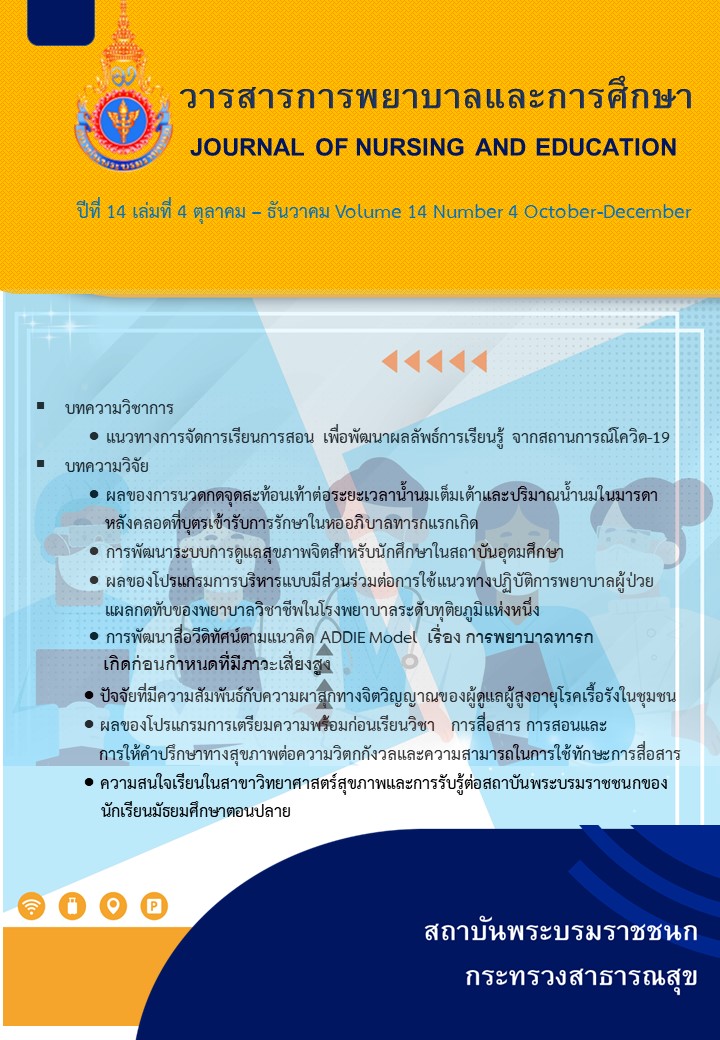
Effects of the Participative Management Program on Clinical Practice Guideline for Pressure Injury among Professional Nurses in a Secondary Level Hospital
Keywords:
The Participative Management, Clinical Practice Guideline, Pressure Injury PatientAbstract
This quasi-experimental research aimed to study the effect of participatory management program on the use of nursing practice guidelines for pressure injury patients among professional nurses between the experimental group and the control group. The sample group includes a professional nurse who works as a ward in a secondary hospital who takes care of adult patients at risk of pressure injury, a total of 70 people were divided into experimental groups and a control group of 35 people each. The research instruments used was a participatory management in nursing supervision program questionnaire on the use of nursing practice guidelines for pressure injury patients of professional nurses. The content validity index was .93 and .88 respectively. Cronbach's alpha coefficient was .92. Data were analyzed using descriptive statistics and inferential statistics, including paired t-test and independent t- test.
The results of the study found that
1) The use of nursing practice guidelines for pressure injury patients of the experimental group and the control group before receiving the participatory management program overall, the level was low (Mean=3.80, S.D.=0.11 and Mean=2.42, S.D.=0.28, respectively).
- The use of nursing practice guidelines for pressure injury patients who received the participatory management program in the experimental group was significantly higher than the control group (p<.05).
- The use of nursing practice guidelines for pressure injury patients in the experimental group After receiving the participatory management program, higher than before receiving the participatory management program statistically significant (p<.05).
In conclusion, the results of the research indicated that the developed participatory nursing supervision program can be used to develop professional nurses to use higher nursing practices in pressure injury patients. Therefore, administrators should use participatory management in continuous nursing supervision.
References
Marquis, B. L. & Huston, C. J. Leadership Roles and Management Functions in Nursing: Theory and Application. 9th ed. Philadelphia: Wolters Kluwer Health/Lippincott Williams & Wilkins, 2017.
Nursing Division, Office of the Permanent Secretary, Ministry of Public Health. Indicators for improving the quality of annual nurse 2020. Bangkok: Tawan Media Press, 2020. (in Thai)
Agency for Health Care Policy and Research: AHCPR Interim manual for clinical practice guideline development [online]. 1991 [cited 18/10/2020]. Available from: @www.ahrq.gov.
Woolf, S.H., Grol, R., Hutchinson, A., Eccles, M., and Grimshaw, J. Potential Benefits, Limitations, and Harms of Clinical Guidelines. British Medical Journal, 1999; 318: 527-530.
The National Pressure Injury Advisory Panel (NPIAP) and the Pan Pacific Pressure Injury Alliance (PPPIA). Clinical Practice Guideline for Prevention and Treatment of Pressure Injuries (CPG), 2019.
Sashkin, M. A manager's guide to participative management. New York: AMA Membership Publication Division, 1982.
Waiyakorn, R., Singchangchai, P., and Putthiangkura, B. The Relationship between participatory management, Job empowerment, and tower effectiveness patients according to perceptions of nursing executives at the first level of private hospitals. NURSING JOURNAL, 2019; 46(2): 142-152. (in Thai)
Muangprasert, S., et al. The Development of Participative Clinical Supervision Model among the Nursing Division in Naradhiwas Rajanagarindra Hospital. Princess of Naradhiwas University Journal, 2018; 10(2): 13-24. (in Thai)
Garcia-Llana, H., Remor, E., del Peso, G., Celadilla, O., & Selgas, R. Motivational
interviewing promotes adherence and improves wellbeing in pre-dialysis
patients with advanced chronic kidney disease. J Clin Psychol Med settings, 2014.
Srisaard, B. Statistical methods for research, Volume 1. Bangkok: Suwiriyasarn, 2013. (in Thai)
Wanichbancha, K. Statistics for Research. 4thed. Bangkok: Thammasarn Co Ltd., 2009. (in Thai)
Benoliel, P. & Somech, A. Who benefits from participative management? Journal of Educational Administration, 2010.
Dongpho, P. The effectiveness of using clinical practice guidelines for the prevention of pressure ulcers. Journal of Thammasat University Hospital, 2019; 19(2): 319- 323. (in Thai)
Downloads
Published
Issue
Section
License

This work is licensed under a Creative Commons Attribution-NonCommercial-NoDerivatives 4.0 International License.



