
The Efficiency of Nursing Instructors Influencing Sustainability of the Nursing Colleges under Praborommarajchanok Institute
Keywords:
Efficiency, Sustainability, Nursing Instructors, Colleges of NursingAbstract
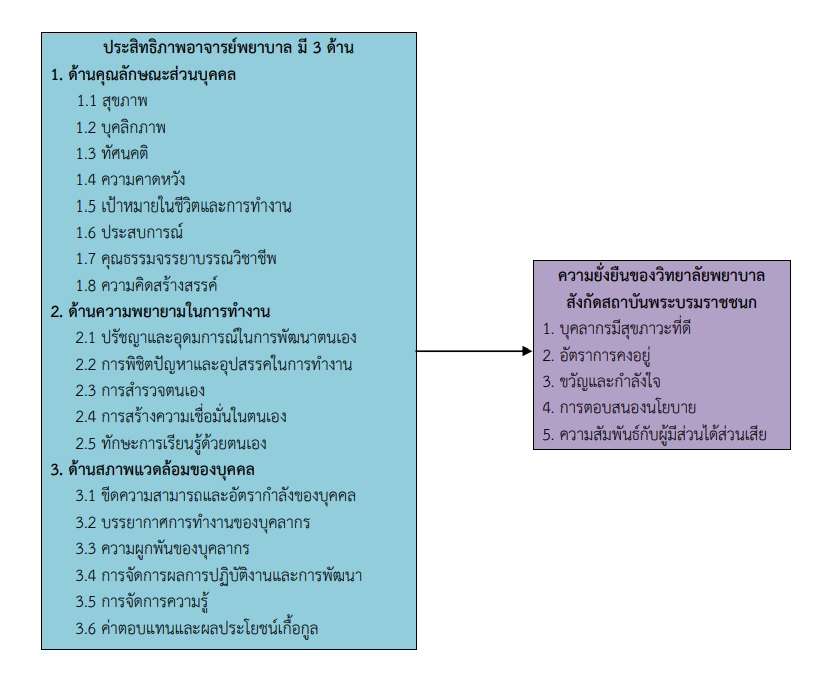
This research on the sustainability of the nursing colleges under Praborommarajchanok Institute aimed: 1) to evaluate the nursing instructors' efficiency, and 2) to determine the influences of the nursing instructors' efficiency on the sustainability of the nursing colleges under Praborommarajchanok Institute. The subjects consisted of 272 nursing instructors. The research tool was a questionnaire comprising 3 sections: 1) personal factors, 2) factors affecting the efficiency of nursing instructors, and 3) factors of sustainability in the study of nursing instructors’ efficiency. Research data were analyzed by frequency, percentage, mean, standard deviation, and stepwise multiple regression analysis.
Study results showed as follows. Nursing instructors' efficiency and the sustainability of the Institute were at a high level. The factors that influenced efficiency were statistically at the .01 level, the following predictors accounting for 69.90%: personal characteristics (such as health and attitude), work effort (self-survey and philosophy and ideology of self-improvement), the environment of a person (knowledge management, capacity, and manpower, compensation, and benefits).
Per findings, those factors should be concerned in order to promote the nursing instructors’ efficiency resulting in the sustainability of the College of Nursing under Praborommarajchanok Institute.
References
Akarathitipong, J. (2013). Human Resorce Development. Pranakhonsiayutthaya: Faculty of Management Science Pranakhonsiayutthaya Rajabhat University, Ayutthay. (in Thai)
Chidthong, P., & Kosito P. (2017). The Role of Teachers in Promoting Learning Skills in the 21st Century for THAI Graduates. Phikanate Journal, 13(1), 1-11. (in Thai)
Choatmanee, S. (2011). Modern KM Application in Business Management. Bangkok: National Productivity Institute. (in Thai)
Hair, F.J., Black, C.W., Babin, J.B, & Anderson, E.R. (2019). Multivariate Data Analysis 7th ed. New Jersey: Pearson Education.
Koompai, S. (2010). Comparison Among Organizational Cultures Affecting Organizational Effectiveness: A Case Study of Thailand’s Public Enterprises. Doctor of Public Administration. Bangkok: National Institute of Development Administration.
Lawrence. (2005). Barriers to Organizational Learning: An Integration of Theory and Research. Academy of Management Review, 30, 180-191.
Lucksana, S. (2009). Efficiency Development. (4th edition.) Bangkok: Faculty of Management Science, Suan Sunundha Rajabhat University. (in Thai)
Office of the Higher Education Commission. (2015). Education; Criteria for Performance Excellence 2015-2018. Bangkok: Amarin Printing and Publishing Company Limited. (in Thai)
Pender, N. J. (1966). Health Promotion in Nursing Practice. (3rd edition.) Norwalk: Connectcut: Appleton & Lange.
Phaopan, D. & Foosiri, P. (2013). A Tudy of Job Description and Attitude that Effect on Employee Engagement for Supporting Staff. Journal of Finance, Investment, Marketing and Business Management, 3(4), 135-147. (in Thai)
Poempon, K. (2009). Developing Work Efficiency. Bangkok: Boonsiri Printing Co., Ltd. (in Thai)
Rungruangkul, P. & Laohakosol, W. (2018). Factors Affecting Sustainable Human Resource Development for Real Estate Companies Listed in the Stock Exchange of Thailand. Journal of Humanities and Social Sciences, 4(1), 29-43. (in Thai)
Satthum, D. (2019). Organizational Climate and Organizational Support Affecting the Performance of Public Health Personnel Under the Primary Care Quality and Outcome Framework at Sub-District Health Promoting Hospital in Chaiyaphum Province. KKU Journal for Public Health Research, 12(1), 41-50. (in Thai)
Sriplung. T. (2013). Future of Human Resources with the Creation of Business Sustainability. Journal of HR Intelligence, 8(1), 68-73. (in Thai)
Thirawanutpong, P. & Bunprom. (2017). Development the Potential of Teacher in Higher Education Institutions. SKRU Academic Journal, 8(1), 33-40. (in Thai)
Turner, K. (2015). Quality of Working Life and Related Factors of Nurse Educators at Central Network 1 Nursing Colleges of Praboromarajchanok Institute. Nursing Journal of the Ministry of Public Health, 25(3), 184-198. (in Thai)
Downloads
Published
Issue
Section
License
Copyright (c) 2022 Journal of Nursing and Education

This work is licensed under a Creative Commons Attribution-NonCommercial-NoDerivatives 4.0 International License.



