
Current Situations, Challenges, and Proposed Policy for Developing toward High-Performance Organization among Colleges of Nursing, Praboromarajchanok Institute
Keywords:
Policy Recommendations, High-Performance Organization, College of Nursing, Thailand 4.0Abstract
This mixed-methods research aimed at studying current conditions, challenges (problems and barriers) in the administration and development of policy proposals for developing colleges of nursing under Praboromarajchanok Institute toward high-performance organizations in compliance with the Thailand 4.0 policy. The sample of the quantitative approach was 295 nursing instructors, and the sample of the qualitative approach was 17 administrators. The research instruments were the “current conditions, challenges in the administration and guide for developing colleges of nursing toward high-performance organizations” questionnaire with a reliability of 0.95, and an in-depth interviews questionnaire. Data were analyzed by using descriptive statistics consisting of frequency distribution, mean, percent, standard deviation, and content analysis.
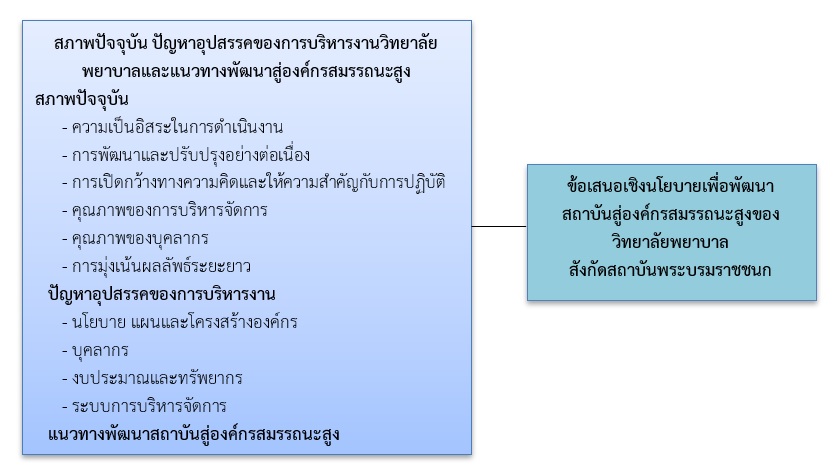
According to the findings, the mean scores for current situations in administrating institutes toward becoming high-performance organizations were at a high level (M = 3.82, SD = .48). The area with the highest mean score was openness to ideas and priority given to practice (M = 3.97, SD = 55). The lowest mean score was in the area of personnel quality (M = 3.60, SD = 60). In the areas of problems and barriers in administrating institutes to become high-performance organizations, the highest mean scores were in the areas of inadequate buildings and facilities (52.88%). The lowest mean score was in the area of unsuitable organization structure (9.15%). The components of high performance among colleges of nursing were visionary leadership, highly capable personnel, productivity, innovation and creativity, competitive capacity, and good management.
The policy recommendations for developing colleges of nursing into high-performance organizations in compliance with the Thailand 4.0 policy are as follows: 1) promoting autonomy in operations, 2) creating exponential growth of quality outcomes, 3) openness and action orientations, 4) improving professional strategic management with innovation and technology, 5) developing high competencies of personnel to increase competitiveness, 6) build cooperation networks with the ASEAN community and the global community, and 7) focusing on quality long-term outcomes and leading to sustainable social development.
Therefore, colleges of nursing should improve and develop a strategic plan by defining a challenging future vision, promote high competencies of personnel at every level, improve the organizational structure appropriately, engaged result-based management and driving mechanisms for operations with innovation and technology, and allocate sufficient budget and resources.
References
Bonsu, S., & Twum-Danso, E. (2018). Leadership Style in the Global Economy: A Focus on Cross-cultural and
Transformational Leadership. Journal of Marketing and Management, 9(2), 37-52.
Brokaw, G. S., & Mullins, J. M. (2006). In Pursuit of Higher Performance-Part I. Public Manager, 35(4), 28.
Brown, S. (2015). Virtual University–Real Challenges: Infrastructure and Faculty Support at De Montfort University.
[Internet]. 2015 [cited 2021 Dec 6]; Available from: https://www.che.de/wpcontent/uploads/upload/
Veranstaltungen/CHE_Vortrag_Brown_PK71.pdf
Certo S. C., & Peter, J. P. (1991). Strategic Management: Concept and Applications. New York: McGraw-Hill.
Chaiprasi S., Kulophas D., & Siribanpitak. P. (2016). Management Strategies for Enhancing High Performance
Organization of Nursing Colleges Under the Ministry of Public Health. Boromarajonani College of Nursing,
Uttaradit Journal, 8(2), 112-130. (in Thai)
De Waal, A. (2012). Characteristics of High Performance Organizations. Journal of Management Research, 4(4), 39-71.
Edwards, S., & Ashida, A. (2021). Higher Education in Japan: Internationalization, the Sustainable Development Goals
and Survivability. International Journal of Comparative Education and Development, 23(2), 104-119.
Epstein, M. J., & Manzoni, J. F. (2004). Performance Measurement and Management Control: Superior Organizational
Performance. Amsterdam: Elsevier.
Krejcie, R. V., & Morgan, D. W. (1970). Determining Sample Size for Research Activities. Educational and Psychological
Measurement.
Krippendorff, K. (2013). Content Analysis: An Introduction to its Methodology. 3rd Edition. LA: SAGE Publication.
Mahat, M., & Goedegebuure, L. (2016). Strategic Positioning in Higher Education: Reshaping Perspectives. In Theory
and Method in Higher Education Research. Emerald Group Publishing Limited, 2, 223-244.
Ministry of Higher Education, Science, Research and Innovation. (2021). Education Criteria for Performance
Excellence, 2020-2023. Bangkok: Ammarin Printing and Publishing. (in Thai)
Nkang, I. E. (2013). Challenges of Globalization and Quality Assurance in Nigerian University Education. International
Education Studies, 6(1), 207-215.
Office of the Higher Education Commission. (2017). 20 Year Long-Term Higher Education Plan 2018-2037. Bangkok:
Phrik-whan Graphic. (in Thai)
Office of the Public Sector Development Commission. (2017). Manual of Assessing Government Agencies according
to the Standards for Improving the Efficiency of Government Agencies in the Fiscal Year 2017. Bangkok: OPDC. (in
Thai)
Polit, D. F., & Beck, C. T. (2017). Nursing Research: Generating and Assessing Evidence for Nursing Practice (10th ed.).
Philadelphia: Wolters Kluwer.
Posthuma, R. A., Campion, M. C., Masimova, M., & Campion, M. A. (2013). A High Performance Work Practices
Taxonomy: Integrating the Literature and Directing Future Research. Journal of management, 39(5), 1184-1220.
Praboromarajchanok Institute for Health Workforce Development. (2018). Praboromarajchanok Institute for Health
Workforce Development Strategic Plan B.E. 2560-2564. Nonthaburi: PBRI. (in Thai)
Research Administration and Educational Quality Assurance Division, Institute for the Promotion of Knowledge
Management for Society. (2016). The Blueprint Thailand 4.0: Model for Driving towards Stability, Prosperity and
Sustainability of Thailand. Retrieved September 19, 2017 from: https://www.nstda.or.th/home/knowledge_post
/blueprint-thailand-4/ (in Thai)
Schejbal, D. (2012). In Search of a New Paradigm for Higher Education. Innovative Higher Education, 37(5), 373-386.
Sukphiphat, S., Suksamran, S., & Chaowalit, S. (2017). Administrating Rangsit University to be High Performance
Organization. Journal of Rangsit Graduate Studies in Business and Social Science, 3(1-2), 126-135. (in Thai)
Wongwiseskul, S. (2011). The Development of High Performance Organization Strategies for Nursing Education
Institutes under The Office of Higher Education Commission Doctoral Dissertation. Bangkok: Chulalongkorn
University. (in Thai)
Downloads
Published
Issue
Section
License
Copyright (c) 2022 Journal of Nursing and Education

This work is licensed under a Creative Commons Attribution-NonCommercial-NoDerivatives 4.0 International License.



