
Family Management in Caring for Older Persons with Dementia
Keywords:
Older Person, Dementia, Symptom Perception, Family Management, Grounded Theory StudyAbstract
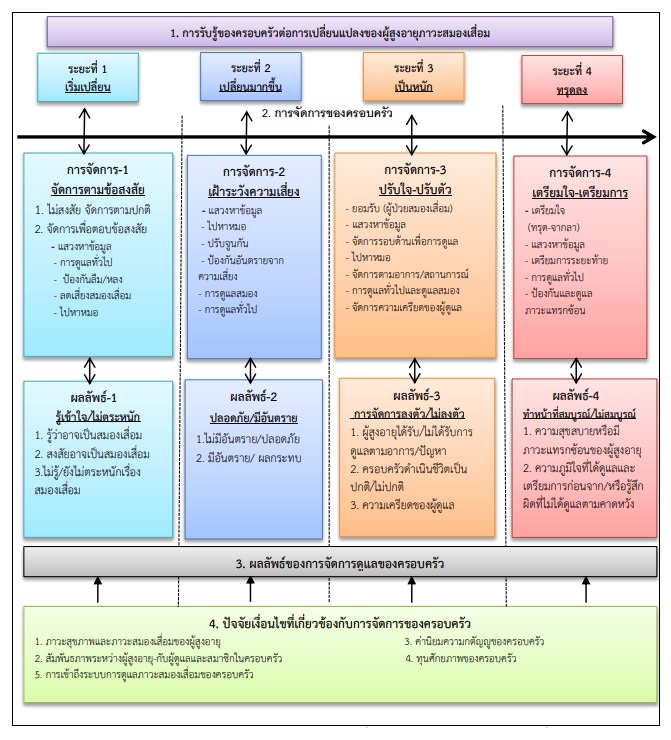
This grounded theory study aimed to explore the phenomenon of family management in caring for older persons with dementia. The informants were 60 family caregivers from 49 families. Data were collected through in-depth interviews and observations. Data were analyzed using the constant comparative analysis method. Family management in caring for older persons with dementia is the process where families manage care based on their perceptions regarding symptom changes of older persons with dementia. Those can be divided into 4 phases. Phase 1 is the early stage of changes where management is based on suspicion. Phase 2 is the progressive stage where changes are monitored accordingly to the risks. Phase 3 starts when coping with both mind and body challenges becomes a serious issue. And phase 4 is the downing stage when caregivers must prepare minds and families to face the loss.
Findings suggested that the family management process in caring for older persons with dementia varies based on symptom changes and family management within each phase. Factors related to management in each phase play important roles resulting in positive and/or negative outcomes of each phase throughout the process.
References
Beeber, A. S. & Zimmerman, S. (2012). Adapting the FMSF for Families Caring for Older Adults with Dementia. Journal of Family Nursing, 18(1), 1-17. Retrieved February 4, 2015, from https://www.ncbi.nlm.nih.gov/pmc/articles/PMC3872061
Cohen, L. W., Zimmerman, S., Reed, D., Sloane, P. D., Beeber, A. S., Washington, T et al. (2014). Dementia in Relation to Family Caregiver Involvement and Burden in Long-Term Care. Journal of Applied Gerontology, 33(5), 522–540. Retrieved December 10, 2015, from https://www.ncbi.nlm.nih.gov/pmc/articles/PMC3989456/
Foundation of Thai Gerontology Research and Development Institute, & Institute for Population and Social Research, Mahidol University. (2020). Situation of the Thai elderly 2019. Nakhon Pathom: Printery. (in Thai)
Jang, H. Y., & Yi, M. (2013). Effects of Burden and Family Resilience on the Family Adaptation of Family Caregivers of Elderly with Dementia. Korean J Adult Nurs, 25(6), 725-735. Retrieved December 20, 2015 from https://synapse.koreamed.org/articles/1076234
Knaft, K., Deatrick, J., & Havill, N. (2012). Continued Development of the Family Management Style Framework. Journal of Family Nursing, 18(1), 11-34.
Muangpaisan, W. (2013). Burden of Dementia. In Muangpaisan W. (Ed.), Dementia: Prevention, Assessment and Care. (p. 9-15). Bangkok: Parbpim. (in Thai)
Office of the National Economic and Social Development Council. (2019). Report of the Population Projections for Thailand 2010-2040 (revision). Bangkok: Amarin. (in Thai)
Saowaphan, J., & Lertrat, P. (2016). Caregiving Experience of Caregivers of Older Persons with Dementia. Journal of Nursing and Health Care, 34(3), 110-116. (in Thai)
Sasat, S., Choowattanapakorn, T., Pukdeeprom, T., Lertrat, P., & Aroonsang, P. (2013). Long-Term Care Institutions in Thailand. Journal of Health Research, 27(6), 413-418. Retrieved July 27, 2015, from https://he01.tci-thaijo.org/index.php/jhealthres/article/view/88736
Sihapark, S., Chuengsatiansup, K., & Tengrang, K. (2014). The Experience of Burden and Impact Involving in Long-Term Care for the Elderly in Thailand (Research Report). Nonthaburi: Health Systems Research Institute. (in Thai)
Sikolia, D., Biros, D., Mason, M., & Weiser, M. (2013). Trustworthiness of Grounded Theory Methodology Research in Information System. MWAIS 2013 Proceedings. 16. Retrieved November 20, 2015 from: http://aisel.aisnet.org/mwais2013/16.
Sritanyarat, W., Aroonsang, P., Leethongin, M., Piyawattanapong, S., & Panpanich, L. (2015). Lesson Learned and Synthesis Continuous Elderly Care Services System: Stroke and Dementia. Khon Kaen: Klungnanavittaya. (in Thai)
Strauss, A., & Corbin, J. (1998). Basics of Qualitative Research: Techniques and Procedures for Developing Grounded Theory (2 nd.). California: Sage.
Watthanachai, P. & Tirapaiwong, Y. (2019). Family Management: Concept and Implementation Guidelines to Help Families of Children with Chronic Illness. Nursing Journal of the Ministry of Public Health, 29(2), 12-23. (in Thai)
Zhang, H., Xiong, R. H., Hujiken, S., Hujiken, S., Zhang, J. J., & Zhang XQ. (2013). Psychological Distress, Family Functioning, and Social Support in Family Caregivers for Patients with Dementia in the Mainland of China. Chinese Medical Journal, 126(18), 3417-21. Retrieved May 12, 2015, from https://medcentral.net/doi/pdf/10.3760/cma.j.issn. 0366-6999.20131254
Downloads
Published
Issue
Section
License
Copyright (c) 2022 Journal of Nursing and Education

This work is licensed under a Creative Commons Attribution-NonCommercial-NoDerivatives 4.0 International License.



