The Enhancement of Happiness in Studying of the Nursing Students Using an Appreciative Inquiry Process
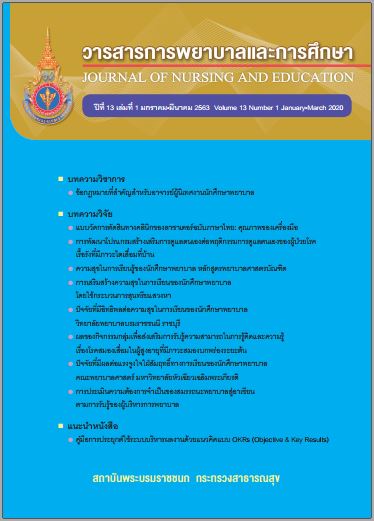
การเสริมสร้างความสุขในการเรียนของนักศึกษาพยาบาล โดยใช้กระบวนการสุนทรียแสวงหา
Keywords:
Happiness, Appreciative Inquiry Process, Nursing StudentsAbstract
ABSTRACT
This study aimed to investigate effects of the enhancement of happiness in studying of nursing students using an appreciative inquiry process. A participatory action research was performed. A purposive sampling technique was used to select the study participants: 12 sophomore nursing students registered for the academic year 2018, Suratthani Rajabhat university with low level of happiness in studying measured by the Happiness in Studying Scale were selected. An instrument used was a guideline for group discussions built on an appreciative inquiry framework which consisted of four stages: 1) discovering the experience, 2) weaving the dream image, 3) designing the action plan, and 4), executing the action to achieve the dream. Data triangulation was performed to test the validity. Participatory observation, focus group, and after action review (AAR) were used to collect data; content analysis was used for qualitative data analysis.
Results showed that 1) Three themes of happiness in studying were found: had high academic performance, had ability to care for others and families, and obtained social acceptance. 2) The dream image that foster happiness in studying was to have positive relationship with others and be able to graduate on time. 3) There were four types of the activities fostering happiness in studying: formed a group for experience sharing, prepared for studying in both theory and practicum, practiced self-exploration to make an improvement, and asked for suggestions from trustworthy people. 4) Three themes of the outcomes of the actions were found: understood a lesson better, obtained better results and passed the criteria of achievement tests, and had less anxiety. These results can be implemented in the management of learning activities to foster happiness and successful learning for nursing students.
References
1. Sinsawad P, Pittard B. Factors Related to Quality of Life of Nursing Ntudent at Boromarajonani College of Nursing, Ratchaburi. Kuakarun Journal of Nursing, 2016; 23 (1): 8-20. (in Thai)
2. Doyle K, Sainsbury K, Cleary S, Parkinson L, Vindigni D, McGrath I, et al. Happy to Help/Happy to be Here: Identifying Components of Successful Clinical Placements for Undergraduate Nursing Students. Nurse Education Today, 2017; 49: 27-32.
3. Mahakittikun K, Suwanchinda P, Chanchong W. Adolescent students’ happiness. Songklanagarind Journal of Nursing, 2016; 36 (1): 87-98. (in Thai)
4. Sricamsuk SA, Voraharn W, Senarak W. Happiness of Undergraduate Nursing Students,
Faculty of Nursing, Khon Kaen University. Journal of Nursing Science & Health, 2011;
34 (2): 70-79. (in Thai)
5. Bundasak T, Chaowiang K, Jangasem N. Happily Learning Among Nursing Students. Journal of MCU Peace Studies, 2017; 5 (1): 357-369. (in Thai)
6. Sharif F, Masoumi S. A Qualitative Study of Nursing Student Experiences of Clinical Practice. BMC Nursing, 2005; 4 (6): 1-7.
7. Kawsaard N, Arpanantikul M, Putwatan P. Selected Variables Related to Nursing Students’ Happiness. Thai Journal of Nursing Council, 2013; 28 (1): 19-33. (in Thai)
8. Mark C, Heather Carter-Templeton, Rita H, Talicia T, Mark P. Attrition of Medical Students and Nursing Students with Anxiety and Depression: A Systematic Review. Annuals of Behavioral Science and Medical Education, 2015; 21 (1): 30–37.
9. Papastavrou E., Maria D, Haritini T, Christos A. Nursing Students’ Satisfaction of the Clinical Learning Environment: a Research Study. BMC Nursing, 2016: 1-10.
10. Thongsom P. The Development of Indicators of Happiness in Learning of Student in Nursing Science Undergraduate Programs under the Ministry of Public Health. Journal of Nursing and Education, 2011; 4 (1): 88-96. (in Thai)
11. Chimanlal HP. A Comparative Study of Happiness Index’ in Medical and Paramedical students. Happiness Index’ in Medical and Paramedical Students, 2015; 2 (6): 91-97.
12. Rattanapun P. What is Appreciative Inquiry? and who do you use? 2011. [cited 2016 April 14]. Available from: https://www.gotoknow.org/posts/314324. (in Thai)
13. Ridley-Duff JR, Duncan G. What is Critical Appreciation? Insights from Studying the Critical Turn in an Appreciative Inquiry. Human Relations, 2015; 68 (10): 1579–1599.
14. Trajkovski S, Schmied V, Vickers M, Jackson D. Using Appreciative Inquiry to Transform Health Care. Contemporary Nurse, 2013; 45 (1): 95–100.
15. Watkins S, Dewar B, Kennedy C. Appreciative Inquiry as an Intervention to Change Nursing Practice in-Patient Settings: An Integrative Review. International Journal of Nursing Studies, 2016; 60: 179–190.
16. Tosati S, Lawthong N, Suwanmonkha S. Development of an Appreciative Inquiry and Assessment Processes for Students’ Self-Knowing and Self-Development. Procedia - Social and Behavioral Sciences, 2015; 191: 753–758.
17. Photisita C. Qualitative Research. Bangkok: Amarin Printing and Publishing Company Limited, 2013. (in Thai)