
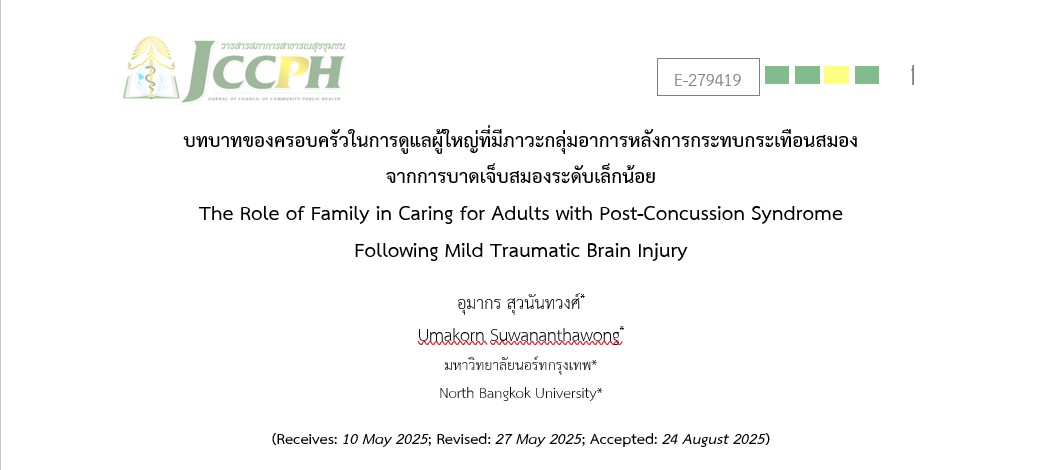
The Role of Family in Caring for Patients with Mild Traumatic Brain Injury and Post-Concussion Syndrome
Keywords:
Mild traumatic brain injury, Post-concussion syndrome, Family role, Caregiver, RehabilitationAbstract
This article aims to evaluate thoroughly the existing academic literature regarding the role of familial structures in the caregiving of individuals suffering from mild traumatic brain injury (mTBI) who subsequently develop post-concussion syndrome (PCS), emphasizing research from the last ten years. The results underscore the pivotal functions that family caregivers fulfill in the domains of symptom surveillance, fostering a conducive environment, facilitating treatment and rehabilitation, as well as offering psychological and social support. Nonetheless, the caregiving of mTBI patients exhibiting prolonged symptoms is fraught with difficulties, encompassing a deficit in accessible medical information, inadequate coordination within the healthcare system, caregiver fatigue and stress, as well as prevailing knowledge deficits within Thai society. This review encapsulates various support strategies, including the provision of accurate information, the establishment of follow-up mechanisms post-hospital discharge, the delivery of psychosocial support, and the creation of culturally sensitive manuals or specialized programs, aimed at enhancing the efficacy of caregiving and mitigating the long-term repercussions on patients.
References
Brain Injury Association of America. (2011). BIAA Adopts New TBI Definition [Online]. Retrieved from https://www.biausa.org/ (cited in Siripituphum et al., 2020).
Gamgee, J., Runacres, J., Norman, A., & Pradhan, P. (2023). The Secondary Impact of Mild Traumatic Brain Injury: An Interpretative Phenomenological Analysis of the Experiences of Family Members. The Family Journal. 31(4), 433–442. https://doi.org/10.1177/10664807231164421
He, J., Chen, Z., Zhang, J., & Liu, X. (2024). Knowledge and attitudes toward mild traumatic brain injury among patients and family members. Frontiers in Public Health, 12, 1349169. https://doi.org/10.3389/fpubh.2024.1349169
Kratz, A. L., Sander, A. M., Brickell, T. A., Lange, R. T., & Carlozzi, N. E. (2017). Traumatic brain injury caregivers: A qualitative analysis of spouse and parent perspectives on quality of life. Neuropsychological Rehabilitation, 27(1), 16–37. https://doi.org/10.1080/09602011.2015.1051056
Ontario Neurotrauma Foundation. (2018). Guideline for Concussion/Mild Traumatic Brain Injury & Persistent Symptoms (for Adults). Toronto: Ontario Neurotrauma Foundation. (Available from https://braininjuryguidelines.org)
Royal College of Neurological Surgeons of Thailand (ราชวิทยาลัยประสาทศัลยแพทย์แห่งประเทศไทย). (2019). แนวทางเวชปฏิบัติกรณีสมองบาดเจ็บ พ.ศ.2562 [Clinical Practice Guidelines for Traumatic Brain Injury 2019, in Thai]. กรุงเทพฯ: สถาบันประสาทวิทยา กรมการแพทย์, กระทรวงสาธารณสุข. (Retrieved from RCNST website: https://www.rcnst.or.th/)
Siripituphum, D., Songwathana, P., Khupantavee, N., & Williams, I. (2020). Caring for Thai traumatic brain injury survivors in a transitional period: What are the barriers? Journal of Health Science and Medical Research, 38(1), 43–52. https://doi.org/10.31584/jhsmr.202076
Yaowarat Emeot. (2020). การฟื้นฟูกลุ่มอาการภายหลังสมองกระทบกระเทือนในผู้ป่วยสมองบาดเจ็บระดับเล็กน้อย: บทบาทพยาบาล [Rehabilitation of post-concussion syndrome in mild TBI patients: Nurse’s role]. วารสารกองการพยาบาล, 47(1), 1–10. (ภาษาไทย)
สมพร อินทะกนก. (2548). การพัฒนากิจกรรมการเรียนการสอนทักษะการเขียนภาษาอังกฤษของนักเรียนชั้นประถมศึกษาปีที่ 6 ด้วยกระบวนการสอนของเฮวินส์. [วิทยานิพนธ์ปริญญาครุศาสตรมหาบัณฑิต สาขาวิชาหลักสูตรและการสอน มหาวิทยาลัยราชภัฏอุดรธานี]. มหาวิทยาลัยราชภัฏอุดรธานี
Downloads
Published
Issue
Section
License
Copyright (c) 2025 Journal of Council of Community Public Health

This work is licensed under a Creative Commons Attribution-NonCommercial-NoDerivatives 4.0 International License.
- บทความหรือข้อคิดเห็นใด ๆ ที่ปรากฏในวารสารสภาการสาธารณสุขชุมชน ที่เป็นวรรณกรรมของผู้เขียน บรรณาธิการ ไม่จำเป็นต้องเห็นด้วย
- บทความที่ได้รับการตีพิมพ์ถือเป็นลิขสิทธิ์ของ วารสารสภาการสาธารณสุขชุมชน


