
The effect of Powerful Tools for Caregivers Program on Caregiving Burden of Persons with Schizophrenia in Community
Keywords:
The powerful tools for caregivers program, Caregiving burden, Persons with schizophrenia in communityAbstract
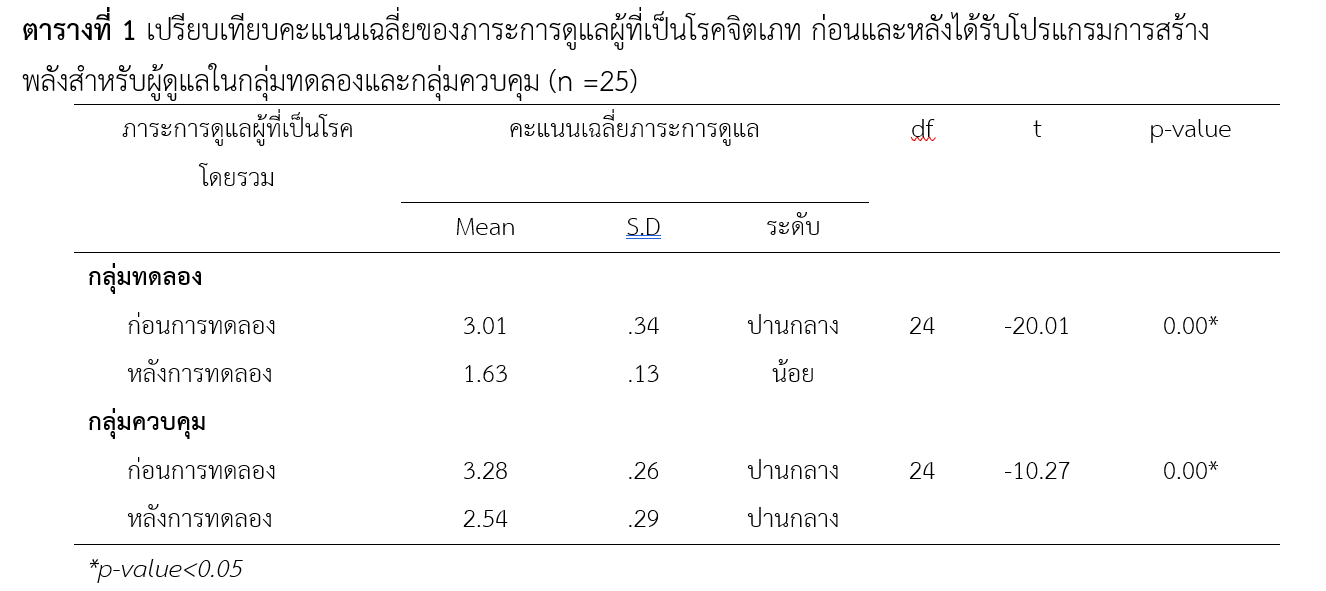
This study is quasi-experimental research with two groups pretest-posttest design. This research purposed to compare: 1) Caregivers burden of persons with schizophrenia in community before and after received the powerful tools for caregiver program, and 2) Caregivers burden of persons with schizophrenia in community who received the powerful tools for caregiver program and those who received regular nursing care. The samples consisted of 50 caregivers of persons with schizophrenia in community according to inclusion criteria. The caregivers were matched pair by patient care’s period and then randomly assigned into experimental group and control group, 25 subjects in each group. The research instruments consisted of the powerful tools for caregiver program, and the caregiver burden scale. All the research instruments were tested by 5 professional experts. The Cronbach’s alpha coefficient reliability was .88, data were analyzed using mean, standard deviation, and t-test statistics. The results and conclusion revealed the following: 1) Caregivers burden of persons with schizophrenia in community after received the program was significantly lower than that before (p<0.05). 2) Caregivers burden of persons with schizophrenia in community who received the program were significantly lower than those who received regular nursing care (p<0.05).
References
กรมสุขภาพจิต. (2559). แผนยุทธศาสตร์กรมสุขภาพจิตในช่วงแผนพัฒนาเศรษฐกิจและสังคมแห่งชาติ ฉบับที่ 12 (พ.ศ.2560-2564) และนโยบายกรมสุขภาพจิต ประจำปี 2560–2561. นนทบุรี: กองแผนยุทธศาสตร์ กรมสุขภาพจิต
ขนิษฐา สุขทอง. (2555). ผลของสุขภาพจิตศึกษาครอบครัวแบบกลุ่มต่อภาระและการแสดงออกทางอารมณ์สูงของผู้ดูแลผู้ป่วยจิตเภทในชุมชน.วิทยานิพนธ์ปริญญามหาบัณฑิต สาขาวิชาการพยาบาลสุขภาพจิตและ จิตเวช, คณะพยาบาลศาสตร์, จุฬาลงกรณ์มหาวิทยาลัย.
จุฬาลักษณ์ นิลอาธิ และเนาวรัตน์ สิงห์สนั่น. (2564) บทบาทของพยาบาลจิตเวชชุมชนเพื่อเสริมสร้างพลังสุขภาพจิตในผู้ดูแลผู้ป่วยจิตเภทที่ได้รับการวินิจฉัยครั้งแรก.วารสารพยาบาลศาสตร์ มหาวิทยาลัยสยาม, 22 (43), 103–113
จรัสพร หอมจันทร์ดี และเพ็ญนภา แดงด้อมยุทธ์. (2562). โปรแกรมการสนับสนุนทางสังคมที่เน้นการมีส่วนร่วมของชุมชนต่อภาระการดูแลของผู้ดูแลผู้ป่วยจิตเภทชุมชน. วารสารพยาบาลตำรวจ, 11(2), 433-443.
ไชยุตม์ ไชยศิวามงคล. (2565). ปัจจัยที่สัมพันธ์กับความรู้สึกเป็นภาระของผู้ดูแลผู้ป่วยจิตเภท อำเภอยางตลาด จังหวัดกาฬสินธุ์. วารสารสุขภาพและสิ่งแวดล้อมศึกษา, 7(4), 102–113.
ดลฤดี ทับทิม. (2552). การศึกษาการใช้โปรแกรมสุขภาพจิตศึกษาครอบครัวต่อภาระการดูแลของผู้ดูแลผู้ป่วย จิตเภทในชุมชน อำเภอไทรน้อย จังหวัดนนทบุรี. วิทยานิพนธ์ปริญญามหาบัณฑิต สาขาการพยาบาลจิตเวชและสุขภาพจิต คณะพยาบาลศาสตร์ จุฬาลงกรณ์มหาวิทยาลัย.
นพรัตน์ ไชยชำนิ. (2544). ผลของการใช้โปรแกรมการดูแลผู้ดูแลแบบองค์รวมต่อภาระและความสามารถในการดูแลผู้ป่วยจิตเภท.วิทยานิพนธ์ปริญญามหาบัณฑิต สาขาวิชาการพยาบาลสุขภาพจิตและจิตเวช, คณะพยาบาลศาสตร์, จุฬาลงกรณ์มหาวิทยาลัย.
ประเทือง ละออสุวรรณ และนภา จิรัฐจินตนา. (2561). ผลของการใช้โปรแกรมสุขภาพจิตศึกษาครอบครัวต่อภาระของผู้ดูแลผู้ป่วยจิตเภทที่ได้รับการเยี่ยมบ้านเขตกรุงเทพมหานคร. วารสารสถาบันจิตเวชศาสตร์สมเด็จเจ้าพระยา, 12(2), 37–47.
โรงพยาบาลนภาลัย. (2567). รายงานประจำปี โรงพยาบาลนภาลัย. สมุทรสงคราม.
วันทนีย์ ล้ำเลิศ และเพ็ญนภา แดงด้อมยุทธ์. (2561). ผลของโปรแกรมการส่งเสริมความสามารถของผู้ดูแลต่อภาระการดูแลผู้ป่วยจิตเภทในชุมชน. วารสารการพยาบาลจิตเวชและสุขภาพจิต, 32(3), 104–117.
สรินดา น้อยสุข และพิมพ์พิมล เรืองฤทธิ์ (2564). ผลของโปรแกรมการเสริมสร้างพลังอำนาจต่อภาระการดูแลของผู้ดูแล ผู้ป่วยจิตเภท.วารสารกองการพยาบาล, 48(2), 30–41.
เสาวนีย์ คงนิรันดร, ดวงใจ วัฒนสินธุ์ และชนัดดา แนบเกษร. (2561). ปัจจัยที่มีอิทธิพลต่อภาระการดูแลของผู้ดูแลผู้ป่วยจิตเภท. วารสารการพยาบาลจิตเวชและสุขภาพจิต, 32(3), 118–132.
อัครวัฒน์ เพียวพงภควัต. (2561). ปัจจัยที่มีผลต่อภาระการดูแลของผู้ดูแลผู้ป่วยจิตเภทที่มารับบริการ โรงพยาบาลหนองกี่ จังหวัดบุรีรัมย์. วารสารส่งเสริมสุขภาพและอนามัยสิ่งแวดล้อม, 12(28), 072–084.
Aly Hamed, S., Ahmed Mohamed Ismail, M., Abd Elaziem Mohamed, A., & Mohammed Mahmoud Abu Salem, E. (2023). Effect of Educational Supportive Program on Knowledge, Emotional Empathy, and Burden of Schizophrenic Patients' Caregivers. Egyptian Journal of Health Care, 14(4), 135–150.
Bandura, A. W., Sebastian. (1997). Self-efficacy. Cambridge University Press Cambridge.
Bademli, K., Lök, N., & Lök, S. (2023). The Effect of a Physical Activity Intervention on Burden and Depressive Symptoms in Depressed Family Caregivers of Patients with Schizophrenia: A Randomized Controlled Trial. Journal of Physical Activity and Health, 20(12), 1109–1115.
Chan, S. W., Yip, B., Tso, S., Cheng, B. S., & Tam, W. (2009). Evaluation of a psychoeducation program for Chinese clients with schizophrenia and their family caregivers. Patient Education and Counseling, 75(1), 67-76. DOI: 10.1016/j.pec.2008.08.028
Goonathilake, P., Ediriweera, D., Ruban, R., & Isuru, A. (2022). Prevalence and correlates of cognitive impairment in schizophrenia: a cross-sectional study from a teaching hospital southern Sri Lanka. BMC Psychiatry, 22(1), 716.
Health Data Center: HDC. (2567). ร้อยละของผู้ป่วยโรคจิตเภท.https://hdc.moph.go.th/udn/public/standard-report-detail/7b13c6fcfb0be636fc5cce071e49a71a.
Koujalgi, S. R., & Nayak, R. B. (2016). Factors associated with family burden in schizophrenia. Indian Journal of Health Sciences and Biomedical Research kleu, 9(3), 273-278.
Lefley, H. P. (1987). Aging parents as caregivers of mentally ill adult children: An emerging social problem. Psychiatric Services, 38(10), 1063-1070.
Montgomery, R. J., Gonyea, J. G., & Hooyman, N. R. (1985). Caregiving and the experience of subjective and objective burden. Family Relations: An Interdisciplinary Journal of Applied Family Studies, 34(1), 19–26. https://doi.org/10.2307/583753
Provencher, H. L. (1996). Objective burdenamong primary caregiver of persons withchronic schizophrenia. Psychiatric and Mental Health Nursing, 3(3), 181–187 DOI: 10.1111/j.1365-2850.1996.tb00085.x
Schmall, V. L, Clcland, M., & Sturdevant, M. (2000). The caregiver help book (use in the powerful tools for carc giving). Oregon,Oregon Gcrontological Association:Legacy Health System.
Savundranayagam, M. Y., Montgomcry, R. J., Kosloski, K., & Little T. D. (2011). Impact of a psychocducational program on three types of carcgiver burden among spouscs. International Journal of Geriatric Psychiatry, 26(4), 388–396. doi: 10.1002/gps.2538.
Thimmajja, S. G., & Rathinasamy, E. V. L. (2019). Effectiveness of psycho-education on knowledge regarding schizophrenia and caregivers’ burden among caregivers
of patients with schizophrenia–a randomized controlled trial. Family Medicine & Primary Care Review 21(2), 104–111. DOI:10.5114/fmpcr.2019.84552
Wold Health Organization. (2022). Schizophrenia. https://www.who.int/news-room/fact-sheets/detail/schizophrenia
Yazici, E., Karabulut, Ü., Yildiz, M., Tekeş, S. B., Eda, İ., Çakir, U., Boşgelmez, Ş., & Turgut, C. (2016). Burden on caregivers of patients with schizophrenia and related factors. Nöro Psikiyatri Arşivi, 53(2), 96–101. doi: 10.5152/npa.2015.9963.
Downloads
Published
How to Cite
Issue
Section
License
Copyright (c) 2025 Journal of Nursing, Siam University

This work is licensed under a Creative Commons Attribution-NonCommercial-NoDerivatives 4.0 International License.
Content and information published in the Journal of Nursing, Siam University is the comment and responsibility of the authors.
Articles, information, images, etc. published in the Journal of Nursing. Siam University is the copyright of the Journal of Nursing, Siam University. If any person or entity wants to take all or part of it for publication for any purposes, please reference the Journal of Nursing, Siam University.

