
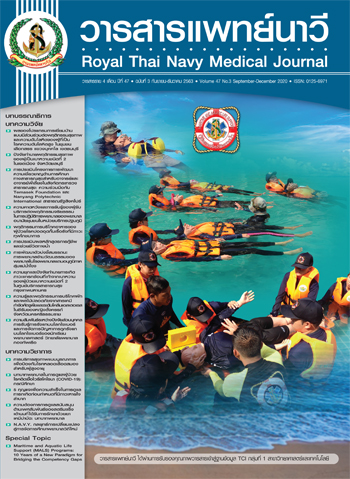
การประเมินผลหลักสูตรการกู้ชีพและช่วยชีวิตทางน้ำ
Article Sidebar
Main Article Content
บทคัดย่อ
การวิจัยนี้มีวัตถุประสงค์เพื่อประเมินผลหลักสูตรการกู้ชีพและช่วยชีวิตทางน้ำ กลุ่มตัวอย่าง คือ ผู้เรียน จำนวน 328 คน ผู้สอน จำนวน 10 คน และผู้บังคับบัญชาจำนวน 15 คน คัดเลือกกลุ่มตัวอย่างจากหน่วยงานที่มีผู้ผ่านการเรียนหลักสูตรการกู้ชีพและช่วยชีวิตทางน้ำในปี พ.ศ. 2560 และ 2561 จำนวน 15 หน่วยงาน โดยใช้การสุ่มอย่างง่ายตามสัดส่วนประชากรในแต่ละหน่วยงาน เครื่องมือที่ใช้ในการเก็บรวบรวมข้อมูล ได้แก่ แบบสอบถามสำหรับผู้เรียน ได้ค่าดัชนีความสอดคล้องระหว่างข้อคำถามและวัตถุประสงค์ 0.70 - 1 และแบบสัมภาษณ์เชิงลึกสำหรับผู้สอนและผู้บังคับบัญชาของผู้เรียน ได้ค่าดัชนีความสอดคล้องระหว่างข้อคำถามและวัตถุประสงค์ 0.80-1 วิเคราะห์ข้อมูลโดยใช้สถิติเชิงพรรณนา
ผลการวิจัย พบว่า หลังการอบรมเกินครึ่งหนึ่งของผู้เรียนไม่มีโอกาสนำไปปฏิบัติจริงในที่ทำงานเพราะยังเป็นนักเรียนนักศึกษาอยู่ โดยเป็นกลุ่มการกู้ชีพและช่วยชีวิตทางน้ำขั้นพื้นฐาน ร้อยละ 51.4 และกลุ่มการกู้ชีพและช่วยชีวิตทางน้ำสำหรับบุคลากรทางการแพทย์ ร้อยละ 62.5 ความรู้และการนำไปปฏิบัติเมื่อเทียบก่อนเข้ารับการอบรมและหลังการอบรมหลักสูตรการกู้ชีพและช่วยชีวิตทางน้ำ มีความรู้เพิ่มขึ้นร้อยละ 89.9 ในกลุ่มการกู้ชีพและช่วยชีวิตทางน้ำขั้นพื้นฐาน และร้อยละ 94.2 ในกลุ่มการกู้ชีพและช่วยชีวิตทางน้ำสำหรับบุคลากรทางการแพทย์ ความมั่นใจในการปฏิบัติงานหลังจบหลักสูตรในทั้งสองกลุ่มอยู่ที่ร้อยละ 50
กลุ่มตัวอย่างให้ข้อมูล ดังนี้ ทุกหัวข้อของหลักสูตร 1. การป้องกัน 2. การช่วยชีวิตทางน้ำ 3. การดูแลผู้ป่วยเจ็บหลังขึ้นจากน้ำ และ 4. การลำเลียงและการส่งต่อผู้ป่วย มีความสำคัญเท่าๆ กันเพราะต้องมีความรู้ที่สัมพันธ์และต่อเนื่องทุกห่วงโซ่ จึงจะสามารถช่วยชีวิตได้อย่างปลอดภัยและมีประสิทธิภาพสูงสุด แต่ความสำคัญการให้น้ำหนักของเนื้อหาที่เรียนควรคำนึงถึงการนำไปใช้ของผู้เรียน ทั้งอาชีพและหน่วยงาน
ข้อเสนอแนะจากการวิจัย ได้แก่ ควรกำหนดคุณสมบัติผู้เข้ารับการอบรมหลักสูตรการกู้ชีพและช่วยชีวิตทางน้ำขั้นพื้นฐานและการกู้ชีพและช่วยชีวิตทางน้ำสำหรับบุคลากรทางการแพทย์ให้ชัดเจน หลักสูตรการอบรมควรยึดผู้เรียนเป็นศูนย์กลาง การจัดการเรียนการสอนต้องสอดคล้องกับการนำไปปฏิบัติจริง เพิ่มศักยภาพครูผู้สอนและพัฒนาหลักสูตรการอบรมอย่างต่อเนื่อง
Article Details

อนุญาตภายใต้เงื่อนไข Creative Commons Attribution-NonCommercial-NoDerivatives 4.0 International License.
เอกสารอ้างอิง
World Heanth Organization. Preventing drowning: an implementation guide. Geneva: WHO; 2017.
Petrass LA, Blitvich JD, Finch CF. Lack of caregiver supervision: a contributing factor in Australian unintentional child drowning deaths, 2000-2009. Med J Aust. 2011;194(5):228-31.
Petrass LA, Blitvich JD. Preventing adolescent drowning: understanding water safety knowledge, attitudes and swimming ability. The effect of a short water safety intervention. Accid Anal Prev. 2014;70:188-94.
Weiss J, American Academy of Pediatrics Committee on Injury V, Poison P. Prevention of drowning. Pediatrics. 2010;126(1):e253-62.
Division of Non Communicable Diseases, Department of Disease Control, Ministry of Public Health. Situation of drowning children 2017: preventive measures. Nonthaburi: Ministry of Public Health; 2018. (in Thai).
Division of Non Communicable Diseases, Department of Disease Control, Ministry of Public Health. Situation of drowning children 2018. Nonthaburi: Ministry of Public Health; 2019. (in Thai).
Chaiyakul T, editor. Maritime and aquatic life support guidelines manual. Bangkok: Ultimate Printing; 2014. (in Thai).
Daniel WW. Biostatistics: a foundations for analysis in the health sciences. 6th ed. New York: John Wiley & Sons; 1995.
Passmore JW, Smith JO, Clapperton A. True burden of drowning: compiling data to meet the new definition. Int J Inj Contr Saf Promot 2007;14(1):1-3.
van Beeck EF, Branche CM, Szpilman D, Modell JH, Bierens JJ. A new definition of drowning: towards documentation and prevention of a global public health problem. Bull World Health Organ 2005;83(11):853-6.
Parenteau M, Stockinger Z, Hughes S, Hickey B, Mucciarone J, Manganello C, et al. Drowning Management. Mil Med. 2018;183(suppl 2):172-9.
Barcala-Furelos R, Abelairas-Gomez C, Romo-Perez V, Palacios-Aguilar J. Effect of physical fatigue on the quality CPR: a water rescue study of lifeguards: physical fatigue and quality CPR in a water rescue. Am J Emerg Med 2013;31(3):473-7.
Barcala-Furelos R, Szpilman D, Palacios-Aguilar J, Costas-Veiga J, Abelairas-Gomez C, Bores-Cerezal A, et al. Assessing the efficacy of rescue equipment in lifeguard resuscitation efforts for drowning. Am J Emerg Med 2016;34(3):480-5.
Abelairas-Gomez C, Barcala-Furelos R, Mecias-Calvo M, Rey-Eiras E, Lopez-Garcia S, Costas-Veiga J, et al. Prehospital emergency medicine at the beach: What is the effect of fins and rescue tubes in lifesaving and cardiopulmonary resuscitation after rescue? Wilderness Environ Med 2017;28(3):176-84.
Tabaczek-Bejster I, Kiszka J, Ozga D. Is the water rescue service in poland heading in the right direction? Preparing lifeguards to the standards of first aid in Europe. Wilderness Environ Med 2018;29(2):279-81.
Kiszka J, Tabaczek-Bejster I, Walicka-Cuprys K. Preparation of lifeguards to Basic Life Support in the drowning. Am J Emerg Med 2018;36(12):2335.
Koon W, Rowhani-Rahbar A, Quan L. The ocean lifeguard drowning prevention paradigm: how and where do lifeguards intervene in the drowning process? Inj Prev 2018;24(4):296-9.
Attard A, Brander RW, Shaw WS. Rescues conducted by surfers on Australian beaches. Accid Anal Prev 2015;82:70-8.
Wallis BA, Watt K, Franklin RC, Taylor M, Nixon JW, Kimble RM. Interventions associated with drowning prevention in children and adolescents: systematic literature review. Inj Prev 2015;21(3):195-204.
McCool J, Moran K, Ameratunga S, Robinson E. New Zealand Beachgoers’ swimming behaviors, swimming abilities, and perception of drowning risk. International Journal of Aquatic Research and Education 2008;1(1):7-15.
McCool J, Ameratunga S, Moran K, Robinson E. Taking a risk perception approach to improving beach swimming safety. Int J Behav Med 2009;16(4):360-6.
Truhlar A, Deakin CD, Soar J, Khalifa GE, Alfonzo A, Bierens JJ, et al. European Resuscitation Council Guidelines for resuscitation 2015: Section 4. Cardiac arrest in special circumstances. Resuscitation 2015;95:148-201.
Adelborg K, Dalgas C, Grove EL, Jorgensen C, Al-Mashhadi RH, Lofgren B. Mouth-to-mouth ventilation is superior to mouth-to-pocket mask and bag-valve-mask ventilation during lifeguard CPR: a randomized study. Resuscitation 2011;82(5):618-22.
Szpilman D, Webber J, Quan L, Bierens J, Morizot-Leite L, Langendorfer SJ, et al. Creating a drowning chain of survival. Resuscitation 2014;85(9):1149-52.
Moran K, Webber J. Leisure-related injuries at the beach: an analysis of lifeguard incident report forms in New Zealand, 2007-12. Int J Inj Contr Saf Promot 2014;21(1):68-74.
Moran K, Webber J, Stanley T. The 4Rs of Aquatic rescue: educating the public about safety and risks of bystander rescue. Int J Inj Contr Saf Promot 2017;24(3):396-405.
Carvalho DP, Azevedo IC, Cruz GK, Mafra GA, Rego AL, Vitor AF, et al. Strategies used for the promotion of critical thinking in nursing undergraduate education: a systematic review. Nurse Educ Today 2017;57:103-7.
Ramos WD, Greenshields JT, Knee EN, Kreitl BK, Espirito KJ. Drowning prevention: assessment of a classroom-based water safety education program in Vietnam. Asia Pac J Public Health 2018;30(5):470-8.
