
A Study of the Use of Smart Adult E-Learning for Nursing in the Adult and Geriatric Nursing II Course at the Royal Thai Navy College of Nursing
Article Sidebar
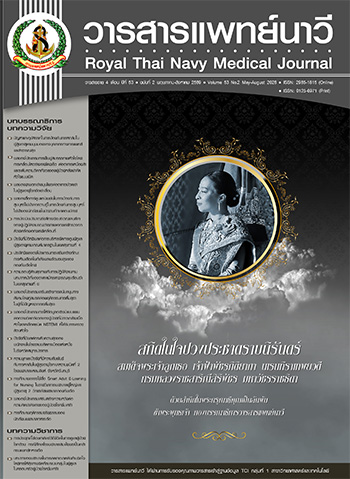
Main Article Content
Abstract
This descriptive research aimed to: (1) examine the academic achievement of second-year naval nursing students after using the Smart Adult E-Learning for Nursing media in the Adult and Geriatric Nursing II course; (2) examine the relationship between the duration of Smart Adult E-Learning for Nursing usage and learning achievement; and (3) investigate the satisfaction of second-year naval nursing students regarding the use of the Smart Adult E-Learning for Nursing media. The sample consisted of 59 second-year naval nursing students from the Royal Thai Navy College of Nursing who were enrolled in the Adult and Geriatric Nursing II course during the 2025 academic year. The research instruments included: (1) the Smart Adult E-Learning for Nursing media; (2) a user manual for Smart Adult E-Learning for Nursing; (3) a demographic questionnaire; (4) media access logs; and (5) a satisfaction questionnaire. Instruments 1 - 4 had an Item-Objective Congruence (IOC) index of 1.00; and instrument 5 had an IOC index ranging from 0.67 - 1 with a Cronbach's alpha coefficient of 0.89. Data were analyzed using descriptive statistics and Spearman's rank correlation coefficient.
The results revealed that: (1) the learning achievement of second-year nursing students after using Smart Adult E-Learning for Nursing as a supplementary learning tool in the Adult and Geriatric Nursing II course was at a good level (Mean = 3.31, SD = 0.32); (2) time spent using the media showed no statistically significant relationship with academic achievement (rs = -.02, p = .88); and (3) overall student satisfaction with Smart Adult E-Learning for Nursing was at a very high level (Mean = 4.57, SD = 0.41). In conclusion, the "Smart Adult E-Learning for Nursing" media is a learning tool accepted by learners and can be used as supplementary self-directed learning resource outside classroom hours in the Adult and Geriatric Nursing II course to promote achievement of educational outcomes in future academic years.
Article Details

This work is licensed under a Creative Commons Attribution-NonCommercial-NoDerivatives 4.0 International License.
References
Royal Thai Navy College of Nursing. Bachelor of nursing science program (Revised Curriculum 2023). Bangkok: Royal Thai Navy College of Nursing; 2023. (in Thai).
Wadyim N, Wangchom S, Mano A. Teaching and learning management in nursing using electronic learning. JBCN, Bangkok 2017;33(3):146-57. (in Thai).
Bunmachu D, Klungchunan T, Kaewlee P. Effects of e-learning on learning achievements of nursing student in child and adolescent nursing I, Faculty of Nursing, Ubon Ratchathani University. Regional Health Promotion Center 9 Journal 2021;15(37):352-64. (in Thai).
Marawa'a A. E-Learning experiences among nursing students: A scoping review. Advances in medical education and practice 2024;15:369-79.
Laorungruang J. The internet using behavior and learning achievement a case study: Rajamangala University of Technology Phra Nakhon students. [Master’s Thesis, Faculty of Science Information Technology Policy and Management]. College of Innovation Thammasat University; 2018. (in Thai).
Shafiq D, Marjani M, Habeeb R, Asirvatham D. Digital footprints of academic success: An empirical analysis of Moodle logs and traditional factors for student performance. Educ Sci 2025;15(304):1-23.
Kühbeck F, Berberat PO, Engelhardt S, Sarikas A. Correlation of online assessment parameters with summative exam performance in undergraduate medical education of pharmacology: a prospective cohort study. BMC Med Educ 2019;19(1):412.
Janson MP, Janke S. The influence of e-learning on exam performance and the role of achievement goals in shaping learning patterns. Int J Educ Technol High Educ 2024;21(1):1-22.
Thammetar T. E -learning: from theory to practice. Bangkok: Thailand Cyber University Project, Office of the Higher Education Commission; 2014. (in Thai).
Chang WC, Siew WF, Yee BL. Mediating effect of e-learning quality on learning outcomes through student satisfaction in nursing education. Frontiers of Nursing 2023;10(3):261-71.
Mayer RE. Multimedia learning. New York: Cambridge University Press; 2001.
Mayer RE, Moreno R. Nine ways to reduce cognitive load in multimedia learning. Educational Psychologist 2003;38(1):43-52.
Ananpatiwet S, Tubtimtong W, Cinmuk U. The development of video media based on ADDIE model on nursing care for high-risk preterm infants. Journal of Nursing and Education 2021;14(4):64-77. (in Thai).
Zimmerman BJ. Becoming a self-regulated learner: an overview. Theory into Practice 2002;41(2):64-70.
Pearl J. Causality: Models, Reasoning, and Inference. 2nd ed. New York: Cambridge University Press; 2009.
Spady WG. Outcome-based education: critical issues and answers. Alexandria: AASA; 1994.
Duangmanee A. Learning management strategies to develop nursing students’ research competencies. RTN Med J 2022;49(1):223-44. (in Thai).
Kim S, Jeong SH, Kim HS, Jeong YJ. Academic success of online learning in undergraduate nursing education programs in the COVID-19 pandemic era. J Prof Nurs 2022;38:6-16.
Nadoon W, Padta U. The development of e-learning for knowledge and skill primary medical care in the 4th year nursing students. J Health Sci BCNSP 2022;6(2):16-29. (in Thai).
Kumar A, Kalal N, Rana N, Vyas H, Choudhary V, Rani R. Online learning in nursing students: Satisfaction and barriers. J Educ Health Promot 2021;10:411.
