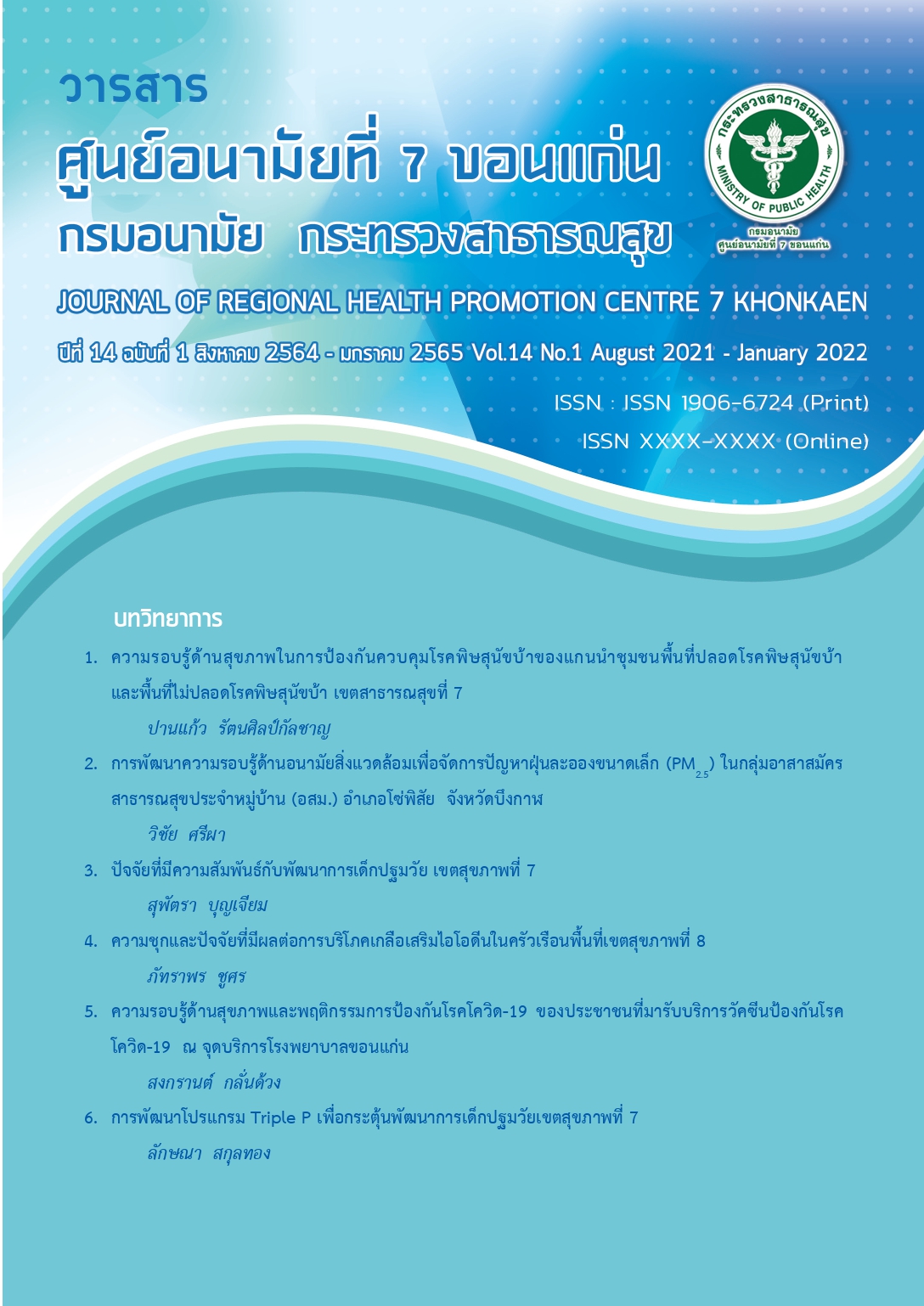
The Development of Triple-P, a DSPM-base Preschool Parenting Program for Enhancing Early Childhood Development in Area 7
Keywords:
การสร้างวินัยเชิงบวกด้วยโปรแกรมTriple-P, positive discipline, Triple-P ProgramAbstract
Positive discipline can positively create a bond between caregivers and children which is vital to the physical and mental development of children. It has been found that the level of intellectual abilities and abilities to live in society is associated with a stable emotional bond between a mother and a child. This quasi-experimental research aimed to study the effects of the Triple-P Program on an early childhood development program, focusing on the emotional bond between children and primary caregivers. The current study was carried out in Wapi Pathum District, Maha Sarakham Province. The sample group consisted of parents of early childhood children who voluntarily participated in the research activity. The participants were twenty pairs of a child and a caregiver. Ten pairs were put in an experimental group of ten pairs while another ten pairs were in a control group. The experimental group participated in the Triple-P activity four times for sixty minutes each time. Each time was one week apart with a total of four activities. The control group, on the other hand, had to follow the traditional model. The assessment was repeated at the end of the program within two weeks. Data were analyzed using frequency, percentage, mean, standard deviation, and independent t-test statistics.
The results showed the experimental group had a significantly higher level of frequency of positive discipline than those of the control group (p< .05). The results of this study suggest that stakeholders should implement Triple-P activities to enhance and build knowledge and skills for parents of children who are in early childhood. The results can be further extended to serve as a guideline for those involved in raising children in Area 7 in the future.
Downloads
Published
How to Cite
Issue
Section
License
This article was published in the Journal of regional healh promotion centre 7 khonkaen. It is considered an academic work or research. The results of the analysis and recommendations are subjective opinions. It is not the opinion of the Journal of regional healh promotion centre 7 khonkaen or the editorial office in any way. Authors are responsible for their own articles.